
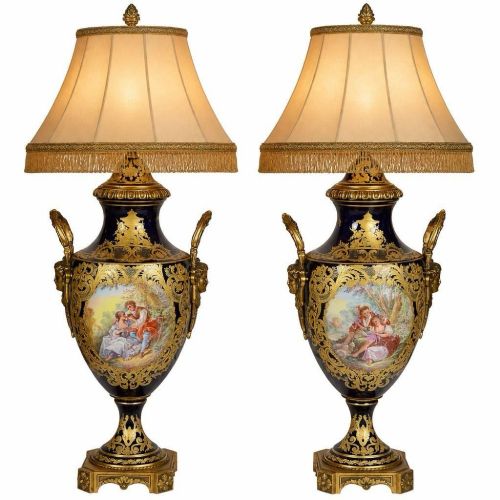
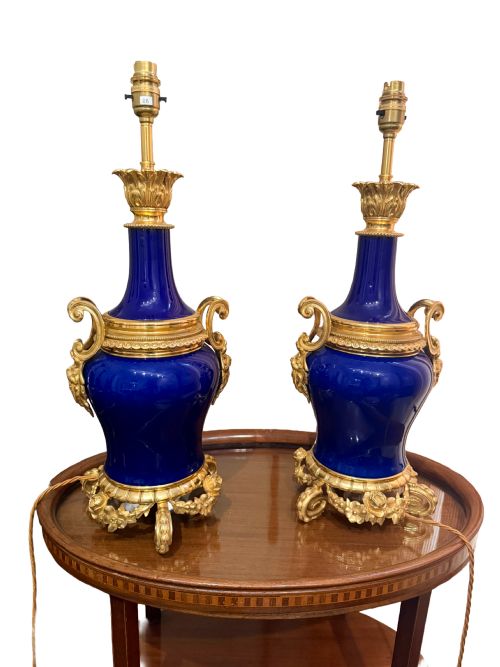


French Sevres Style Lamps
These French sevres style lamps bring nineteenth-century porcelain and ormolu mounts into domestic interiors as striking table and oil lamps.
French Sevres Style Lamps
When you search for french sevres style lamps, you encounter nineteenth-century lighting fixtures that adapt decorative porcelain vessels into table and oil lamps. The examples appearing here span periods from the 1870s to 1900, reflecting nineteenth-century French aesthetic preferences.
Most pieces combine painted porcelain bodies with ormolu, brass, or gilt metal mounts. Forms frequently originate from nineteenth-century French Chateau, Napoleon III, and Louis XVI styles, incorporating classic vessel shapes transformed for illumination.
Buyers regularly find pairs of table lamps alongside individual vases converted into lamps. The visual character relies on rich glaze colours such as cobalt blue, bleu celeste, and bleu royale, often paired with hand-painted details and gilt bronze fittings.
How they were made
The makers of these lamps combined fired porcelain bodies with cast ormolu, brass, and gilt bronze mounts. Artisans applied hand-painted decoration directly onto the porcelain surface, sometimes utilising pate sur pate techniques to build up delicate relief designs against coloured grounds.
Metalworkers cast and chased the ormolu and gilt metal mounts to frame the porcelain necks, bases, and handles. These metal fittings were then secured around the ceramic bodies to provide structural support for the lamp fittings and bases.
Current listings feature porcelain, ormolu, brass, glass, and silk across periods spanning 1870 to 1900.
What varies in quality
Quality in these lamps rests primarily on the crispness of the ormolu chasing and the finesse of the hand-painted porcelain. Finer examples display deeply detailed metal mounts and carefully articulated brushwork on the ceramic bodies.
The choice of porcelain ground colour and the integration of specialised techniques like pate sur pate also distinguish finer pieces. Superior specimens maintain harmonious proportions between the ceramic vessel and the surrounding metalwork.
The French Sevres Style Lamps Glossary
- Ormolu
- Gilded bronze mounts applied to furniture, porcelain, and lighting. This technique involved coating cast bronze with a mercury and gold amalgam before heating.
- Pate sur pate
- A ceramic decorating method where successive layers of liquid clay slip are applied to a body before firing, creating a cameo-like relief.
- Bleu celeste
- A bright sky blue glaze colour popular on eighteenth-century porcelain and revived during the nineteenth century. It provides a vivid backdrop for gilt accents.
- Napoleon III style
- A nineteenth-century eclectic French design movement drawing heavily on historical royal aesthetics. It combined various revival elements into opulent decorative objects.
French Sevres Style Lamps: Frequently Asked Questions
How do I light these lamps safely?
Most of these nineteenth-century pieces have been converted to electricity for modern domestic use. You should have the wiring inspected by a qualified professional before plugging them in.
Ensure the bulb wattage matches the capacity of the vintage fittings to protect the delicate porcelain and metal components.
Are these lamps sold as pairs?
Many listings feature matched pairs of table lamps, though single vase-converted lamps also appear. Pairs typically originate from large nineteenth-century salon settings.
Matching pairs share identical porcelain bodies, colourways, and ormolu mount configurations.
What porcelain colours are common?
Cobalt blue, bleu celeste, and bleu royale dominate the colour palette of these nineteenth-century pieces. These rich blue grounds frequently highlight hand-painted scenes and gilded details.
Alternative white and pale porcelain bodies also appear beneath elaborate ormolu mounts.
How do I clean the ormolu?
Dust the metal mounts gently with a soft, dry brush to prevent dirt accumulation in the chased details. Avoid harsh chemical polishes that can strip the original gilding from the bronze.
Keep the porcelain surfaces wiped with a soft, lint-free cloth.