



Coastal Cliff Landscape Art
Coastal cliff landscape art captures dramatic shores and sea views, offering a timeless window into maritime history and topography.
Coastal Cliff Landscape Art
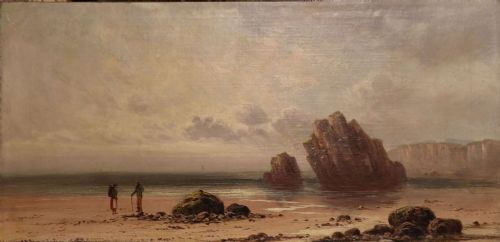
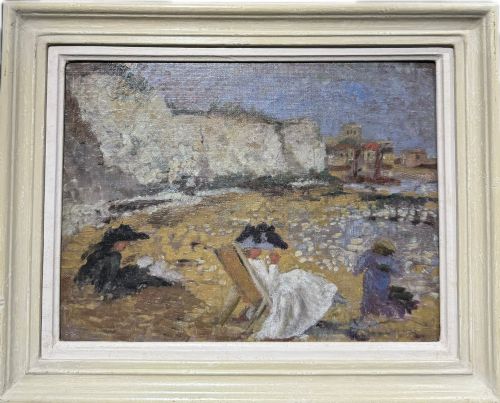
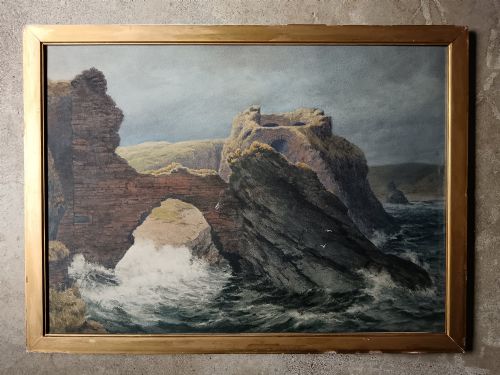
When you search for coastal cliff landscape art, you encounter a focused selection of paintings depicting beaches, headlands, and coastal architecture from various eras. These works range from large Victorian oil paintings to intimate watercolours created across the nineteenth and twentieth centuries.
The pieces on this page heavily feature British and French locations, including Cornish coves, Yorkshire piers, and the Alabaster Coast. Viewers frequently find depictions of figures on rocky beaches, sea stacks, and historic castles perched above the tide.
Represented movements span Victorian realism, British impressionism, and post-impressionism, illustrating how artists across different decades interpreted the shifting light and rugged geography of the shore.
Methods and Materials
Artists utilised oil paint on canvas or board and watercolour pigment on paper to capture the luminescence of sea and sky. Oil paintings provide thick texture and deep pigment, while watercolours rely on delicate washes to render atmospheric coastal mist.
Supports range from traditional stretched canvas and wooden panels to heavy watercolour paper, often framed to protect the delicate medium from moisture and handling over the decades.
Coastal Cliff Landscape Art Retail Price Guide 2026
Typical asking prices for coastal cliff landscape art among the pieces listed under this phrase on Sellingantiques today, from the lower quarter to the upper quarter. They describe what is for sale here now, not the wider market.
Materials in coastal cliff landscape art span oil paint, canvas, watercolour pigment, paper, and wood.
Judging Quality
Quality rests upon the artist's command of light, shadow, and spatial depth in capturing the sheer drop of a cliff or the movement of waves. Superior works demonstrate confident brushwork and precise atmospheric perspective rather than flat, formulaic application of colour.
The distinction between standard topographical records and exceptional fine art lies in the handling of natural elements, where master painters convey the palpable weight of chalk cliffs and the luminosity of open water.
John Moxon·Sir Thomas Newenham Dean·Stephen John Batchelder·Thomas Rose Miles·Joseph Newington Carter·Herbert James·William Savage Cooper·James Watson·William Edward Webb·Rowland Henry Hill·Edward T Jones·Fred Stead·Charles Jones·Joseph William Carey·George Marks·Alfred Egerton Cooper·Henry Valter
The Coastal Cliff Landscape Art Glossary
- Oil on Canvas
- A painting execution where oil-based pigments are applied to a woven fabric surface stretched across a wooden frame. This method permits rich colour blending and textured impasto work.
- Watercolour
- A painting method where water-soluble pigments are suspended in a water-based solution on paper. It yields transparent washes that create luminous effects.
- Post-Impressionism
- An art movement extending roughly from the late nineteenth century that rejected naturalistic depiction in favour of expressive use of form and colour. Artists emphasised symbolic content and distinct brushstrokes.
- Sea Stack
- A geological landform consisting of a steep and often vertical column or columns of rock in the sea. They are formed by wave erosion over long periods.
Coastal Cliff Landscape Art: Frequently Asked Questions
What periods do these paintings date from?
The works span the nineteenth and twentieth centuries, encompassing Victorian academic painting alongside early twentieth-century impressionism and post-impressionism.
Dates range from the 1870s through to the 1950s, reflecting changing artistic approaches to maritime subjects over several decades.
How were coastal landscapes framed originally?
Many pieces retain period wooden frames that complement the painting style, offering structural support and aesthetic enclosure.
Original framing often includes gilt moulding or simple wood surrounds typical of the era in which the artwork was produced.
Where do the depicted locations come from?
The scenes record specific coastal areas across Britain and France, including Cornwall, Yorkshire, the Isle of Man, Normandy, and the Riviera.
Artists frequently painted en plein air, documenting recognisable local landmarks such as piers, castles, and chalk cliffs.
How do oil and watercolour works differ?
Oil paintings utilise heavy pigments on canvas or board, creating a textured surface that captures light and deep colour.
Watercolours employ pigment washes on paper, producing lighter, translucent effects that emphasise atmospheric conditions.