
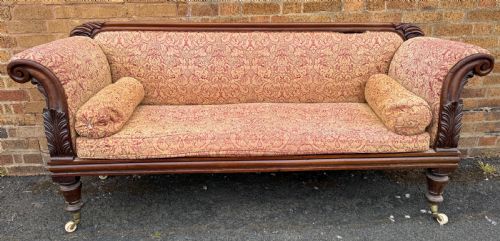


Classical Scroll Sofa
A classical scroll sofa brings architectural dignity and sweeping lines to a room, offering deep, curved seating rooted in the Regency and Victorian eras.
Classical Scroll Sofa
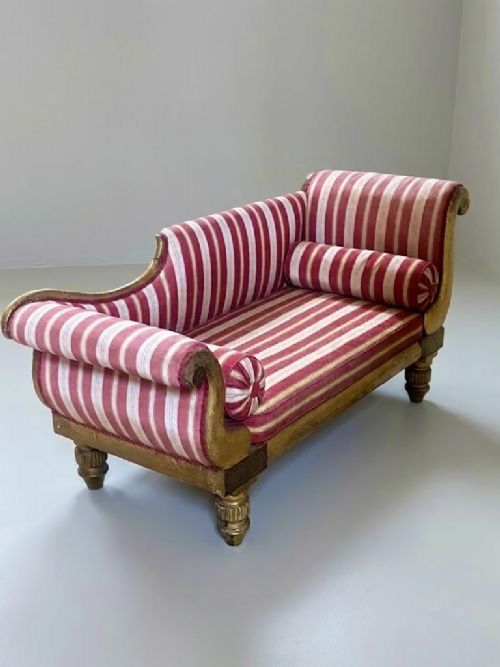
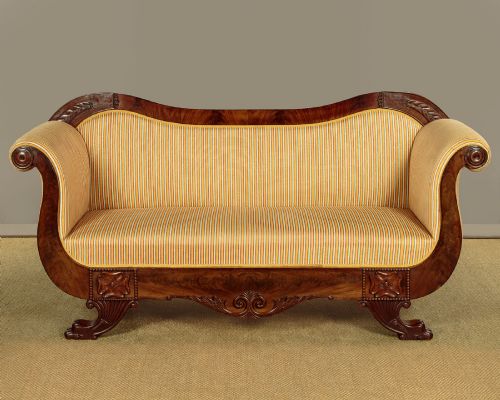
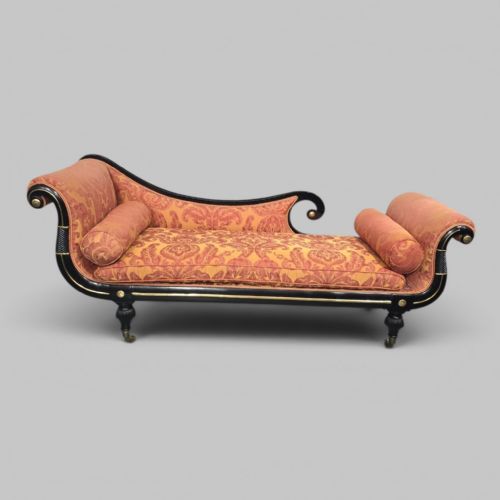
A classical scroll sofa embodies the architectural ambition of the early nineteenth century, drawing heavily on antique forms with its sweeping, scrolled arms and generous proportions. These pieces range from grand double scroll-ended settees designed for formal reception rooms to more intimate chaise longues built for resting.
The versions most frequently met on this page belong to the Regency, William IV, and Victorian periods, often presenting substantial timber frames alongside lower profiles. They function as both central decorative anchors and deeply functional seating, bridging neoclassical severity with domestic comfort.
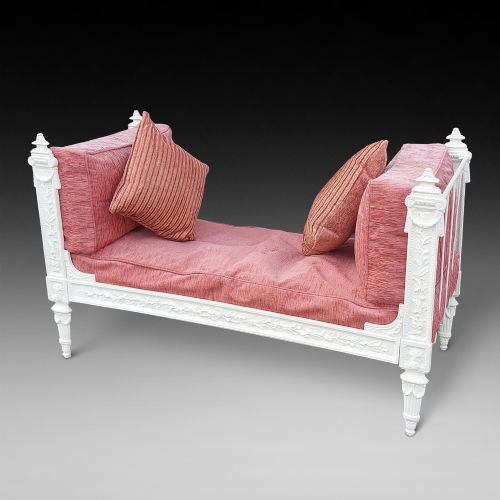
Makers and workshops of the period adapted these scrolling silhouettes across various seating forms, including daybeds and settees, while maintaining a consistent emphasis on the horizontal sweep. The form relies entirely on the balance between the outward roll of the ends and the tautness of the upholstered body.
How they were made
Frames rely primarily on solid mahogany, simulated rosewood, and ebonised wood, often augmented by cast iron in later Victorian daybeds. Skilled cabinetmakers shaped the timber to form the characteristic continuous curve of the scroll ends, frequently employing carved details along the wooden show frames.
Traditional upholstery techniques underpin the structure, utilising hessian and various fabrics over internal stuffing to achieve the required tension and contour. Brass accents, including castors and decorative mounts, frequently finish the feet and terminals of the higher-quality frames.
Early nineteenth-century daybeds occasionally doubled as temporary sleeping quarters for overburdened politicians debating late into the night.
What varies in quality
Quality reveals itself in the architectural confidence of the timber frame and the precision of the carved details rather than superficial decoration alone. Superior examples display seamless transitions from the back rail into the scrolling arms, maintaining structural integrity without heavy reinforcement.
The choice of primary timber and secondary framing woods dictates the longevity and weight of the piece, with dense mahogany and expertly executed simulated rosewood standing at the upper end. Furthermore, the fluidity of the scroll work itself separates standard production from exceptional cabinet work.
The Classical Scroll Sofa Glossary
- Regency
- A stylistic period spanning the late eighteenth and early nineteenth centuries, characterised by a revival of Greco-Roman architectural motifs. This era forms the backbone of the classical scroll sofa tradition.
- Simulated rosewood
- A painted or stained wood finish designed to imitate the rich grain and deep colour of genuine rosewood. Craftsmen utilised this technique on native timbers to achieve exotic visual depth at a lower material cost.
- Scroll end
- A sweeping, outward-curved terminal on a sofa or settee that mimics classical scrollwork. It provides both a visual anchor and a natural armrest.
- Chaise longue
- An elongated upholstered seat designed for reclining, combining the functions of a chair and a daybed. These pieces frequently share the double scroll architecture of larger settees.
- Ebonised wood
- Timber treated with a chemical stain or black finish to imitate ebony. This treatment was particularly favoured for formal, neoclassical seating elements.
Classical Scroll Sofa: Frequently Asked Questions
Where should I place a classical scroll sofa?
These pieces demand space to let their sweeping silhouettes breathe, making them ideal as centrepieces in large living rooms or libraries. Their finished backs and sculptural ends also allow them to sit effectively away from walls.
Position them where the side profiles remain visible, as the architecture of the scroll arms defines the character of the design.
How do I identify a Regency period piece?
Look for dense mahogany or simulated rosewood frames, classical carved motifs such as reeding or anthemion, and graceful, low-slung proportions. The joinery and timber weight generally point to early nineteenth-century manufacturing methods.
Double scroll-ended designs with balanced, symmetrical framing provide the clearest indication of the Regency aesthetic.
Are these sofas comfortable for daily use?
While originally designed for formal lounging and upright entertaining, their deep seats offer substantial physical comfort. Modern users often find them well-suited for reading or resting.
The firmness depends on the traditional internal upholstery structure, which typically utilises sprung or webbed support.
How do I care for the wooden frame?
Maintain the polished mahogany or ebonised surfaces by dusting with a soft cloth and applying appropriate wax sparingly. Avoid placing the furniture in direct sunlight or near heat sources to prevent timber splitting.
Protect brass castors and mounts from excessive moisture during routine cleaning to preserve their original finish.