



Classical Painted Credenza
A classical painted credenza brings refined symmetry and delicate brushwork to a room, offering both display space and concealed storage.
Classical Painted Credenza
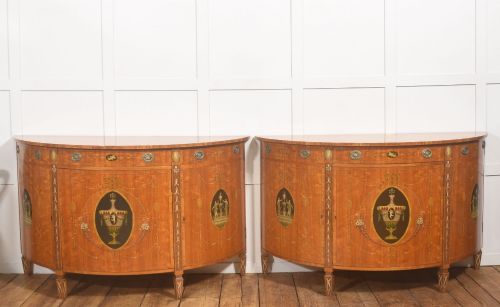
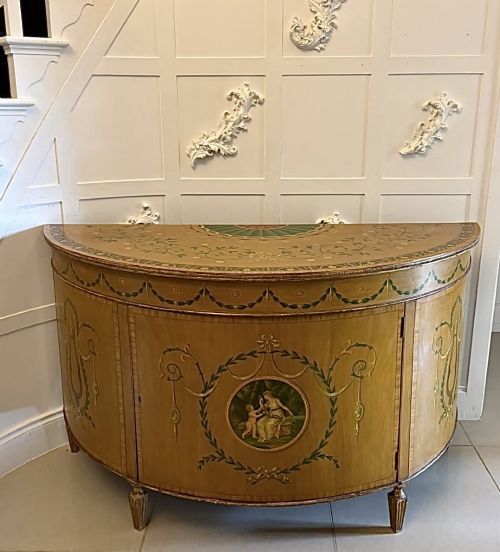
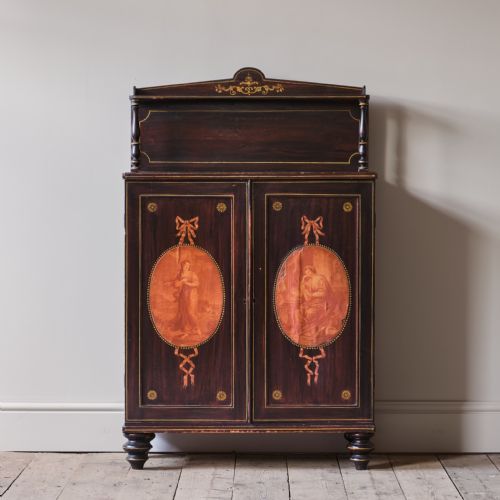
When you search for a classical painted credenza, you are looking at sophisticated timber furniture decorated with oil paint, featuring classical panels, floral motifs, and structured forms. These pieces bridge architectural formality and decorative grace, serving as substantial storage units for the dining room or drawing room.
The versions most frequently met on this page date from the nineteenth century into the early twentieth century, spanning Victorian, Regency, and revival movements. They arrive in formats such as demi-lune side cabinets, serpentine fronted sideboards, and chiffoniers.
Makers of these items drew heavily on Sheraton and Neoclassical vocabularies, employing satinwood, walnut, and pine as foundations for elaborate painted surfaces. Their structural variety ranges from curved front commodes to cabinets raised on stands.
How they were made
Construction relies upon solid timbers such as pine and walnut, frequently faced with fine satinwood veneers to provide a smooth ground for decoration. Cabinetmakers shaped these woods into curved bow fronts, serpentine edges, and demi-lune profiles that demanded precise joinery.
Surface decoration relies upon oil paint applied directly to the wood or veneer, often complemented by gilt highlights and inlaid details. Specialised artists executed classical panels and floral compositions by hand, sealing the finished artwork to protect the delicate pigments.
Classical Painted Credenza Retail Price Guide 2026
Typical asking prices for classical painted credenza among the pieces listed under this phrase on Sellingantiques today, from the lower quarter to the upper quarter. They describe what is for sale here now, not the wider market.
A French cabinet signed by Kaufman brings a touch of continental painterly flair straight to the British drawing room.
What varies in quality
Quality rests significantly upon the finesse and execution of the painted panels, where the skill of the artist dictates the depth and expression of the classical figures or floral garlands. Finer examples display meticulous brushwork and balanced composition that elevate the piece beyond standard production.
The choice of primary timber and veneer also defines the grade of the piece, with carefully selected satinwood grain providing a richer foundation than simpler painted pine. Additionally, the crispness of the cabinet's architectural lines and the integration of brass mounts reveal the standard of the workshop.
Kaufman
The Classical Painted Credenza Glossary
- Demi-lune
- A half-moon shape used for the plan of cabinets and commodes designed to sit flush against a wall. This profile became particularly popular during the Sheraton Revival.
- Satinwood
- A durable tropical hardwood with a characteristic golden-yellow sheen that takes paint and polish exceptionally well. It forms the primary visible surface for many fine nineteenth-century cabinets.
- Chiffonier
- A compact sideboard or cabinet featuring shelves or enclosed storage below a flat top. They evolved during the Regency and Victorian periods for domestic utility.
- Serpentine front
- A furniture front characterised by a central convex curve flanked by two concave curves. This contour requires advanced carpentry to execute smoothly.
- Neoclassical Revival
- A nineteenth-century artistic movement drawing inspiration from classical Greek and Roman art. It emphasises symmetry, urns, swags, and classical painted panels.
Classical Painted Credenza: Frequently Asked Questions
What is a classical painted credenza?
A classical painted credenza is a decorative cabinet featuring oil-painted panels, classical motifs, and fine timber construction. These pieces date predominantly from the nineteenth and early twentieth centuries.
They serve as both storage furniture and decorative focal points, utilising forms like bow fronts, demi-lune shapes, and serpentine credenzas.
Where were these cabinets placed?
Historically, these cabinets stood in principal rooms such as drawing rooms, dining rooms, and parlours. Their flat tops held ornaments, lamps, or serving dishes.
Interior spaces benefited from their reflective satinwood surfaces and symmetrical painted panels, which added light and formality to the room.
How do I care for painted satinwood?
Protect painted satinwood surfaces by keeping them away from direct sunlight, which can fade oil paint and dry out the timber. Maintain a stable indoor environment.
Dust gently with a dry, soft cloth and avoid modern chemical polishes that might damage the historic painted finish.
How do I identify a revival period piece?
Revival pieces combine eighteenth-century classical motifs, such as those popularised by Sheraton, with nineteenth-century manufacturing techniques. Look at the timber preparation and paint composition.
Nineteenth-century makers frequently utilised satinwood veneer over pine bases, applying Neoclassical revival designs that mirror earlier Georgian aesthetics with distinct Victorian execution.