

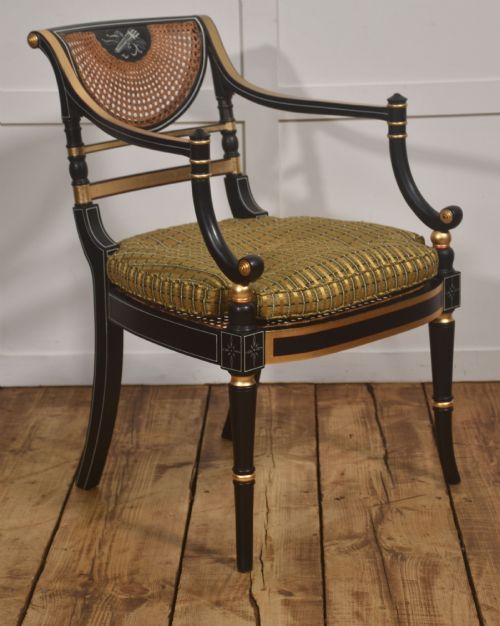
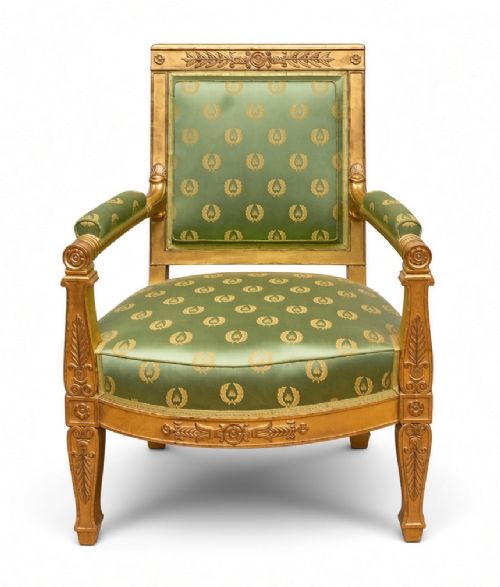

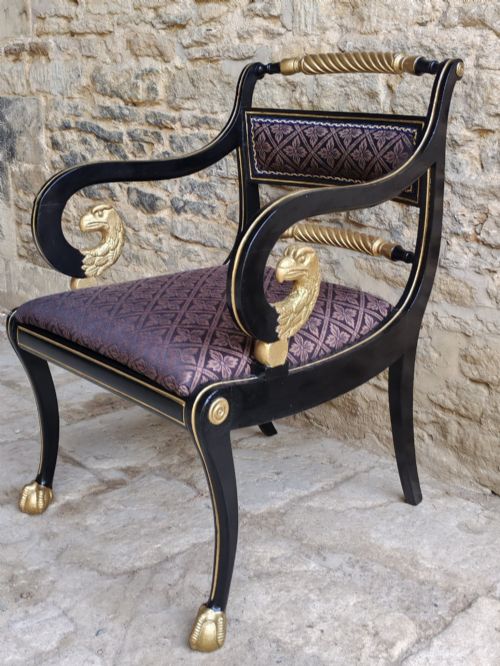
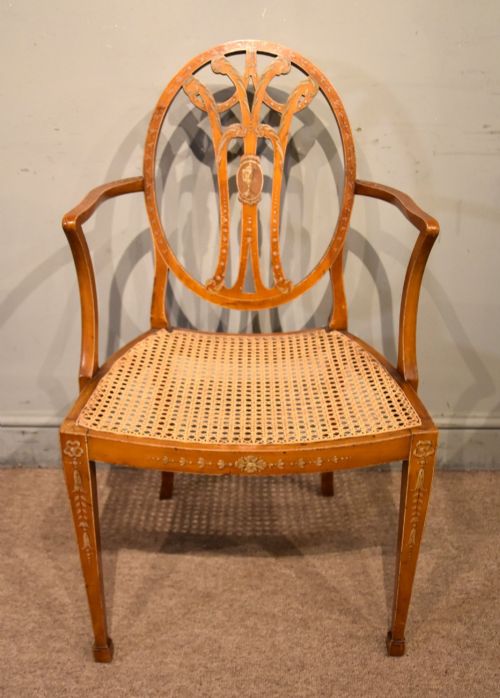
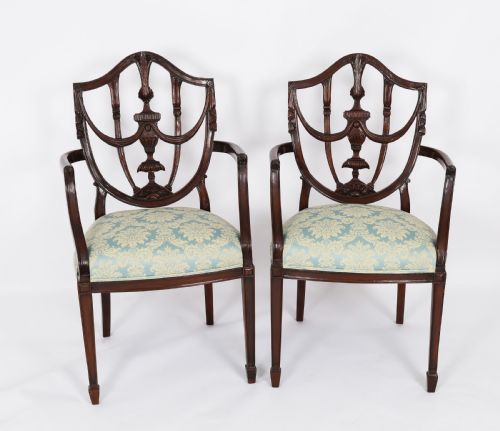
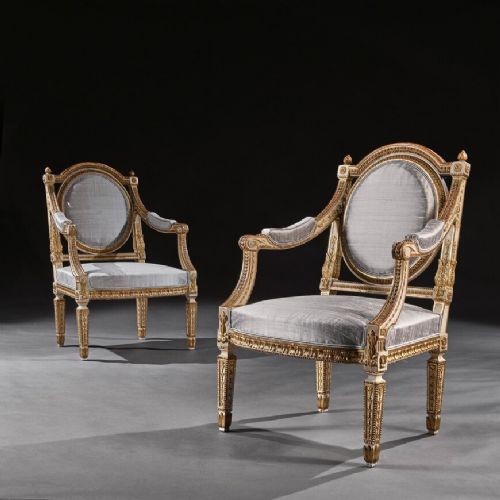
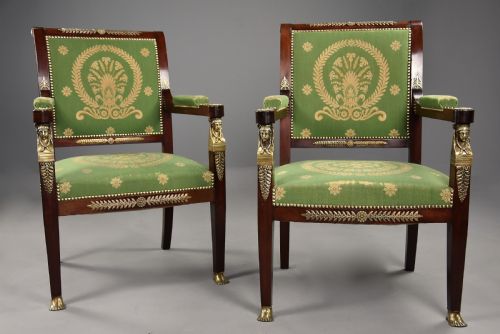


Classical Open Armchairs
Classical open armchairs bring formal restraint and architectural proportion to a room, offering upright seating framed in carved wood and exposed joinery.
Classical Open Armchairs
Classical open armchairs combine the structured lines of ancient architectural design with the comfort of upholstered seating, featuring exposed arms that define their profile. These chairs span periods from the nineteenth century through the early twentieth century, drawing heavily on Regency, Neoclassical, and French Empire aesthetics.
The versions most commonly met on this page range from Regency originals to later revival pieces created in the Edwardian era and the early twentieth century. Makers worked within established historical idioms, producing items that utilise mahogany, giltwood, beech, and ebonised wood alongside silk and damask fabrics.
Pieces frequently display specific regional traits, such as Italian giltwood armchairs of Neoclassical design or French fauteuils executed in mahogany and parcel gilt. The forms vary from library chairs and elbow chairs to grand sets intended for formal salons.
Materials and construction
Carpenters shaped these frames from dense hardwoods including mahogany, beech, oak, and birch, often finishing the surfaces with ebonisation, gilding, or painted decoration. Giltwood and parcel gilt finishes required meticulous application of gold leaf over prepared grounds, while mahogany and satinwood relied on polished natural grain and inlay.
Upholstery techniques matched the formal character of the frames, employing traditional stuffing and horsehair secured beneath silk, damask, or modern fabric coverings. Carved details such as shield backs, classical motifs, and reeded legs were executed by hand before final assembly.
Classical Open Armchairs Retail Price Guide 2026
Typical asking prices for classical open armchairs among the pieces listed under this phrase on Sellingantiques today, from the lower quarter to the upper quarter. They describe what is for sale here now, not the wider market.
Some nineteenth-century makers concealed their workshop signatures inside the seat rails, leaving secret monograms for future restorers to discover.
Judging the execution
Quality in these armchairs rests upon the crispness of the carving and the integrity of the underlying wooden frame. Finer examples display deeply defined acanthus leaves, fluted columns, and balanced proportions that reflect rigorous adherence to classical proportions rather than hurried production.
The treatment of surface finishes also separates standard pieces from exceptional ones, particularly in the depth of the gilding, the smoothness of ebonised surfaces, and the precision of inlaid satinwood. Original upholstery systems and sturdy joinery indicate superior workshop standards at the time of manufacture.
Jacob Desmalter
The Classical Open Armchairs Glossary
- Fauteuil
- An open-armed upholstered armchair with exposed wooden sides originating in France. These chairs typically feature carved frames and padded armrests.
- Bergère
- An enclosed upholstered armchair with closed sides padded with upholstery. They often include a loose cushion and a substantial curved back.
- Giltwood
- Timber coated with gold leaf or gold paint applied over a prepared base layer. It creates a brilliant reflective surface common on high-status neoclassical seating.
- Ebonised
- Wood treated with a dark stain or chemical process to imitate ebony. This finish gained popularity in classical revival pieces for its stark contrast against gilded details.
- Parcel Gilt
- A decorative treatment where only specific carved elements of a wooden piece receive gilding while the remaining surface shows painted or natural wood.
- Neoclassical
- A style spanning the eighteenth and nineteenth centuries inspired by the art and architecture of classical antiquity. It prioritises symmetry, straight lines, and classical motifs.
Classical Open Armchairs: Frequently Asked Questions
What defines a classical open armchair?
These armchairs are characterised by exposed wooden arms, upright structural lines, and decorative vocabulary drawn from Greek, Roman, or French imperial design. They use materials like mahogany, giltwood, and painted beech to create formal seating.
Unlike fully upholstered armchairs, the wooden frame remains visible and forms an integral part of the aesthetic, often featuring carved motifs, fluted legs, or gilt highlights.
How do I identify a Regency period chair?
Regency chairs, dating from the early nineteenth century, generally exhibit restrained classical lines, sabre legs, and dark woods such as mahogany or ebonised finishes. They frequently incorporate brass inlay or parcel gilt details.
Revival pieces made a century later often imitate these exact proportions, making it necessary to inspect the wood ageing, construction pegs, and wear patterns to determine the true age.
Where should I place these chairs at home?
Classical open armchairs work well as accent pieces in drawing rooms, studies, or libraries where their architectural framing can be appreciated from all angles. Their upright posture suits conversation areas rather than lounging.
Pairing a set around a central table or placing a single armchair beside a fireplace highlights their formal proportions and historical design roots.
Are painted and giltwood chairs fragile?
While historic giltwood and painted surfaces require gentle handling to prevent chipping, the underlying hardwood frames are structurally robust. Care involves avoiding direct sunlight and moisture to protect the delicate gold leaf and painted layers.
Regular dusting with a soft, dry cloth preserves the finish without wearing down the delicate edges of the carved decorations.