
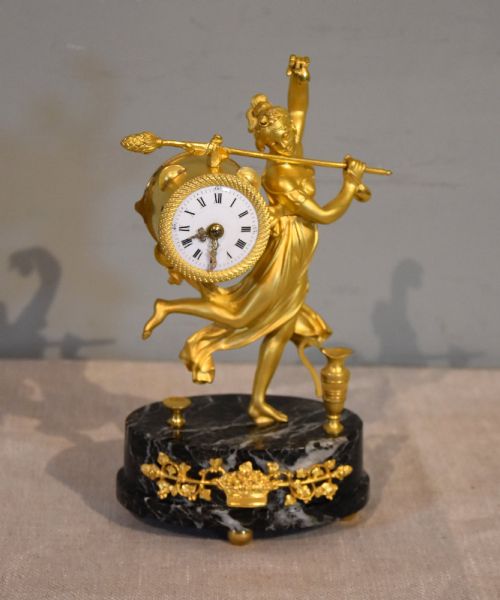


Classical Marble Timepiece
A classical marble timepiece brings architectural proportion and heavy stone presence to a mantelpiece, offering both reliable movement and stately period decoration.
Classical Marble Timepiece
A classical marble timepiece combines heavy stone bodies with decorative metal mounts to form traditional mantel clocks and garniture sets. These objects originate largely from Victorian workshops and French ateliers, spanning the nineteenth century from the eighteen hundreds through to nineteen hundred.
The most common formats found here are substantial mantel clocks alongside matching clock garnitures. They utilise dense stones such as sienna marble, green marble, white marble, and slate, paired with metallic highlights in brass, bronze, and ormolu.
How they were made
Masonry techniques shaped solid blocks of marble and slate into architectural cases, housing mechanical movements driven by springs and pendulums. Enamel dials were fitted behind protective glass doors, often featuring detailed Roman or Arabic numerals.
Metal components were cast in brass, bronze, or ormolu to provide decorative mounts, bezels, and figural toppieces. These metallic elements were then gilded or patinated to contrast against the polished surface of the stone.
Stallions and globes occasionally share top billing with the clock face, proving that Victorian horses and geography kept strict time.
What varies in quality
The standard of execution in the stone cutting and the sharpness of the bronze or ormolu casting define the grade of the piece. Superior examples display precise joinery in the marble and finely chased metal ornamentation rather than mass-produced mounts.
The complexity of the internal movement also sets examples apart, ranging from standard timepieces to eight-day striking mechanisms produced by known makers such as Philippes Paris or James Ritchie and Son.
Philippes Paris·James Ritchie and Son
The Classical Marble Timepiece Glossary
- Ormolu
- Gilded bronze produced by applying a mixture of gold and mercury to a bronze base, creating a bright golden finish. This technique was widely utilised on French classical clocks during the eighteenth and nineteenth centuries.
- Garniture
- A decorative set consisting of a central clock flanked by matching side ornaments such as urns or vases. These matched suites were designed to sit symmetrically on a mantelpiece.
- Sienna marble
- A rich yellowish-brown ornamental limestone quarried in Italy, featuring dark veining. It was frequently chosen for high-status nineteenth-century clock cases.
- Fusee
- A conical pulley used in clock movements to maintain an even pull on the gear train as the mainspring unwinds. This mechanism improves the timekeeping accuracy of the clock.
Classical Marble Timepiece: Frequently Asked Questions
How do I wind a classical marble timepiece?
Most of these mechanical clocks use a key inserted into winding holes on the enamel dial to tension the internal springs. Care must be taken not to over-wind the movement.
Ensuring the clock sits level on the mantelpiece will keep the pendulum beating evenly and maintain correct timekeeping.
What is a clock garniture?
A clock garniture is a matched set comprising a central timepiece accompanied by two matching side pieces, such as decorative urns. These sets were designed to create a balanced display across a fireplace.
They share the same materials, such as marble combined with bronze or ormolu mounts.
How do I distinguish French and Victorian styles?
French classical models often lean towards Louis XVI or Empire aesthetics, featuring refined ormolu mounts and figural toppieces. Victorian English examples tend toward heavier architectural slate and marble forms.
Signatures on the dial or movement often confirm the workshop of origin.
Where should I place a marble clock?
Due to the substantial weight of stone cases, these clocks require a sturdy surface capable of supporting heavy loads. A firm mantelpiece or sideboard is ideal.
Keep them away from direct sunlight and damp environments to protect the polished stone and delicate metal gilding.