


Classical Mahogany Settee
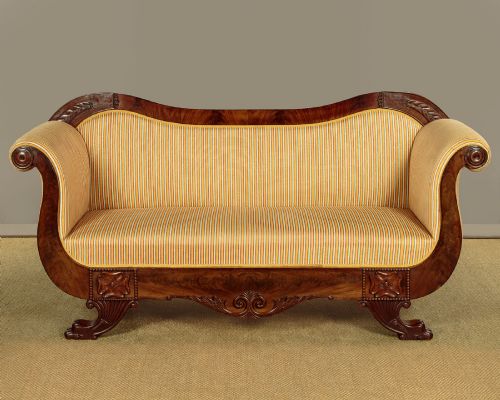
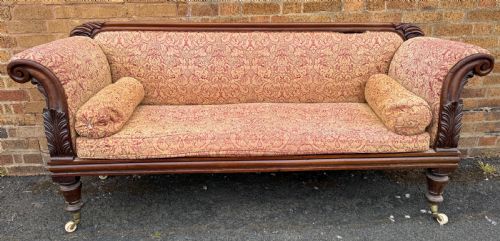
A classical mahogany settee brings substantial nineteenth-century presence to a room, offering deep seating framed in rich timber.
Classical Mahogany Settee
A classical mahogany settee is a seating piece defined by nineteenth-century forms, timber frames and period upholstery.
Most examples found in this category belong to the Regency and William IV periods, characterised by scroll ends and carved wooden frames.
Buyers encounter variations ranging from grand double scroll-ended sofas to Biedermeier three-seater designs and Edwardian inlaid settees.
How they were made
Craftsmen shaped solid mahogany to form the structural frames, often incorporating ebonised wood details and contrasting inlay.
Internal construction relied on traditional upholstery methods supported by Hessian fabric and finished with various textile coverings.
Listings feature pieces spanning the 19th Century, Regency, William IV, Biedermeier and Edwardian styles.
What varies in quality
The degree of carved detail on the mahogany frame separates standard production from finer cabinet work.
Proportion and symmetry in the scroll arms and overall silhouette dictate the visual impact of each piece.
The Classical Mahogany Settee Glossary
- Mahogany
- A dense tropical hardwood prized for its deep reddish-brown colour and durability in furniture construction. It takes a high polish and holds carved details sharply.
- Scroll end
- A design feature where the arms of the sofa curve outward in a tight spiral reminiscent of classical architecture. This form defines many nineteenth-century seating pieces.
- Biedermeier
- A Central European style from the nineteenth century focusing on clean lines and domestic comfort rather than heavy ornamentation. It utilises native timbers alongside mahogany.
- Hessian
- A coarse woven fabric traditionally used beneath outer upholstery as a foundation material. It provides structural support for the internal stuffing.
Classical Mahogany Settee: Frequently Asked Questions
How do I date a mahogany settee?
Dating relies on stylistic markers such as scroll ends, carved wooden frames and inlay techniques. Periods represented range from the early nineteenth-century Regency era to Edwardian times.
Examining the secondary woods and internal upholstery materials also helps determine the age of the piece.
Where does Biedermeier furniture fit?
Biedermeier settees originate from Central Europe during the nineteenth century. They emphasise functional elegance and domestic warmth over ostentatious display.
These pieces often showcase the natural grain of the timber with minimal carved decoration.
How should I care for mahogany?
Keep mahogany furniture away from direct sunlight and heat sources to prevent the wood from drying out. Regular dusting with a soft, dry cloth maintains the finish.
Avoid using silicone-based polishes that can build up on the historic timber surface over time.