
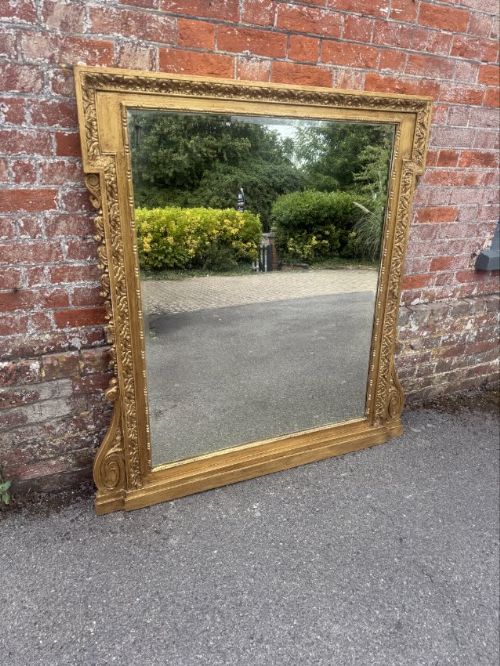
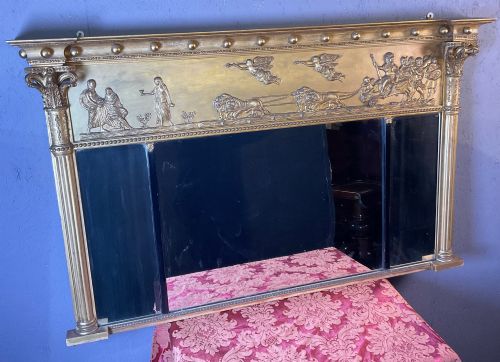


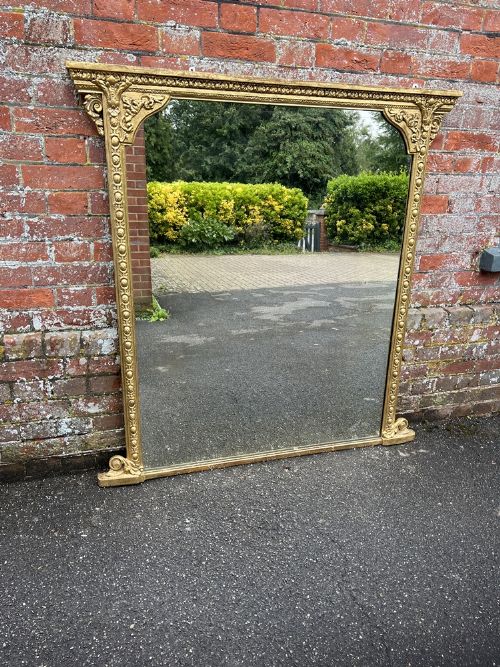


Classical Gesso Mantel Mirror
A classical gesso mantel mirror commands the chimney breast with architectural presence, reflecting light and space through layered nineteenth-century craftsmanship.
Classical Gesso Mantel Mirror
A classical gesso mantel mirror serves as a grand focal point above a fireplace, taking the form of large overmantel mirrors or oval wall mirrors. These pieces are defined by the search phrase classical gesso mantel mirror and anchor nineteenth-century domestic interiors with substantial scale.
The examples seen here originate primarily from the Victorian era, spanning the 1850s through to around 1910. Makers from this period drew upon Neoclassical, Grand Regency, and French Rococo Revival idioms to shape their wooden frames.
Most items encountered on this page are substantial English overmantel mirrors featuring ornate carved wood structures. Alongside these, continental pieces from French and Italian workshops occasionally appear, bringing alternative regional interpretations of classical design.
Construction and Materials
The physical structure relies on a foundation of carved wood, which provides the necessary rigidity for large overmantel dimensions. Over this timber base, artisans applied layers of gesso - a mixture of plaster of Paris or chalk and glue - to build up intricate relief details and mouldings.
Gilded finishes were achieved by laying gold leaf or silver leaf over the prepared gesso surface, creating the luminous metallic sheen characteristic of giltwood and gilt gesso pieces. Some variations employ plain painted gesso rather than metal leaf, offering a softer visual texture.
The listings span from the 1850s to 1910, showing materials like carved wood, gesso, gold leaf, and silver leaf across English, French, and Italian origins.
Judging Quality and Execution
The distinction between ordinary and superior pieces lies in the crispness of the carved wood and the depth of the gesso relief. Finer mirrors exhibit sharp, well-defined enrichment along ribbed columns and borders, whereas lesser examples show softened or blurred ornamentation.
The quality of the gilding further separates the range, with hand-applied gold leaf ageing into a warm, complex patina. The original glass plates also contribute, where genuine antique silvering displays subtle foxing and depth absent in modern replacements.
The Classical Gesso Mantel Mirror Glossary
- Gesso
- A traditional plaster-based mixture applied to wooden frames to create a smooth surface for gilding or painting. It is built up in thin layers and carved or moulded before the finishing leaf is applied.
- Overmantel Mirror
- A large mirror specifically designed to be hung or placed on the mantelpiece above a fireplace. These pieces are proportioned to match the width of the fireplace surround.
- Giltwood
- Timber that has been coated with gold leaf or gold paint. True antique giltwood uses beaten gold leaf applied over a fine gesso and bole foundation.
- Neoclassical
- A style originating from the revival of classical Greek and Roman art and architecture. It emphasises symmetry, straight lines, and classical architectural motifs.
Classical Gesso Mantel Mirror: Frequently Asked Questions
How do I hang a heavy overmantel mirror?
These large frames require secure fixing directly into masonry walls using heavy-duty brackets suited to the weight of carved wood and glass. Professional installation is strongly advised to distribute the load safely above a fireplace.
Because the mirrors often rest partly on the mantel shelf itself, wall fixings primarily act to prevent the frame from tipping forward rather than taking the entire weight.
What is the difference between giltwood and gilt gesso?
Giltwood strictly refers to carved timber covered in gold leaf, whereas gilt gesso highlights the thick plaster layer beneath the leaf that carries the moulded decoration. In practice, nineteenth-century mirrors combine both, using carved wood for the main frame and gesso for the ornamental details.
Examining the edges of the decoration usually reveals the distinct white gesso layer beneath the shimmering gold or silver leaf surface.
Are these mirrors original to the Victorian period?
The listings on this page date predominantly from the mid-nineteenth century through to the early twentieth century, encompassing Victorian and Edwardian production. Stylistic clues such as construction methods, wood types, and the composition of the gesso help establish this timeline.
Original glass plates with minor oxidation and backboards secured with period fixings further confirm the age of these classical overmantels.