

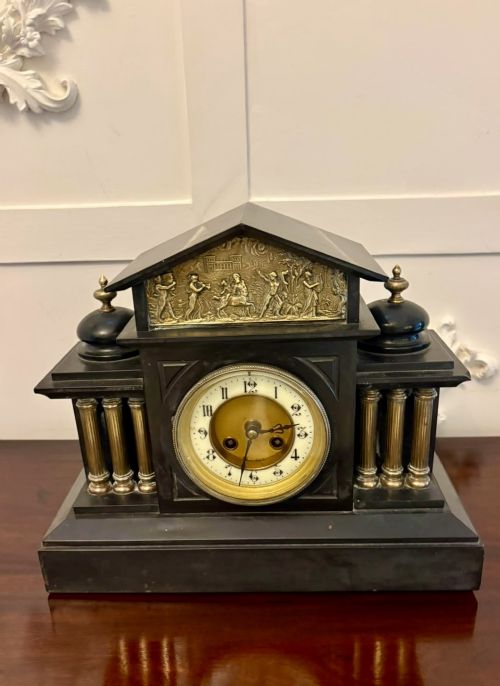
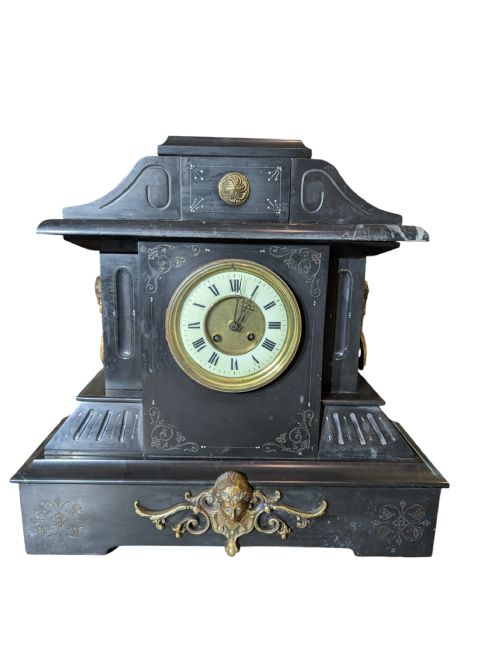


Classical Architectural Table Clock
These classical architectural table clock pieces bring substantial nineteenth-century presence to a room, drawing on neoclassical design and heavy stone forms.
Classical Architectural Table Clock
A classical architectural table clock takes the shape of a miniature building, columned portico or temple facade, built to sit solidly on a mantelpiece or sideboard.
Most examples found here date from the nineteenth century, spanning the Victorian era, French Second Empire, and Napoleon III periods, alongside Charles X and Viennese Historicism.
The primary forms include heavy marble and slate mantel clocks, ornate portico clocks with visible pendulums, and occasional table cabinets.
Materials and construction
Cases combine heavy structural materials like black slate, rouge marble, alabaster and mahogany with reflective highlights of gilt brass, ormolu, and gilt bronze.
Dials frequently feature glass bezels, enamel chapters, and silvered metal, housing mechanical movements that include eight-day and fusee configurations.
Listings feature nineteenth-century materials including black slate, alabaster, Cuban mahogany, and gilt bronze across Victorian and French Second Empire styles.
Judging quality
Quality rests on the architectural precision of the stone cutting, the weight and crispness of the bronze or gilt mounts, and the integration of the movement.
Superior examples display balanced proportions, finely cast dial surrounds, and named maker signatures on the dial or movement plates.
Philippes Paris·Baby and Jannings·Fatton Eleve De Breguet London·Benson 67 Ludgate Hill
The Classical Architectural Table Clock Glossary
- Portico clock
- A clock design featuring supporting columns, typically framing a suspended pendulum that swings between them. This style draws directly on classical temple architecture.
- Fusee
- A conical pulley connected to the mainspring by a chain or cord, designed to equalise the driving force as the spring unwinds. This mechanism improves timekeeping consistency.
- Ormolu
- Finely ground high-carat gold applied to a bronze base using a mercury amalgamation technique. The finish yields a rich, warm metallic lustre.
- Enamel
- Fused glass powder fired onto a metal dial face to create a smooth, durable surface. Roman or Arabic numerals are typically painted onto this white ground.
Classical Architectural Table Clock: Frequently Asked Questions
How do I wind a fusee movement?
Insert the key into the dial winding square and turn it gently in the direction specified by the mechanism until resistance is felt. Care must be taken not to overwind.
Fusee clocks generally require attention once a week, depending on the specific train length of the movement.
Where should I place a heavy marble clock?
Select a sturdy, level surface such as a deep mantelpiece or a heavy sideboard capable of supporting substantial stone weight. Stability prevents vibrations that can disrupt the pendulum beat.
Keep the clock away from direct sunlight and damp walls to protect the marble surface and internal metalwork.
How do I start a portico clock pendulum?
Open the glass bezel or rear access door and gently guide the pendulum a short distance to one side before releasing it evenly. Listen for a steady, even tick.
If the beat sounds uneven, adjust the small regulation nut on the pendulum rod until the rhythm balances.
What is the difference between slate and marble cases?
Slate cases offer a uniform, dense black or dark grey finish that was often polished to a high sheen during the Victorian period. They provide a severe, architectural appearance.
Marble cases display natural veining and varied colouration, such as rouge or faux marble finishes, offering a more decorative and varied visual texture.