

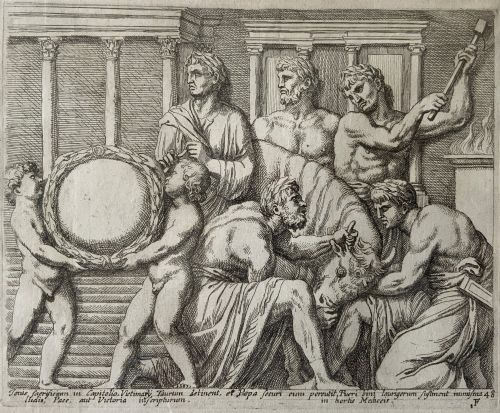


Classical Antiquity Art
Classical antiquity art brings the architectural remnants and mythic figures of Greece and Rome directly into domestic spaces through prints and watercolours.
Classical Antiquity Art
Classical antiquity art encompasses works capturing ancient ruins, statues, and mythological scenes, largely through eighteenth-century engravings and nineteenth-century watercolours.
Buyers encounter architectural engravings depicting Athenian antiquities alongside Grand Tour watercolours of Pompeii and Rome, reflecting centuries of engagement with classical heritage.
The selection ranges from large architectural copperplate engravings to detailed landscape paintings featuring classical ruins and figures.
Materials and Techniques
Makers utilised paper, ink, and copper plates to produce detailed engravings that recorded ancient architecture and sculpture with precision.
Watercolour and oil on canvas were applied to capture the warm light and atmospheric ruins encountered by travellers on the Grand Tour.
Many works incorporate gilded wood frames and gold leaf to complement the neoclassical and baroque aesthetic of the period.
Classical Antiquity Art Retail Price Guide 2026
Typical asking prices for classical antiquity art among the pieces listed under this phrase on Sellingantiques today, from the lower quarter to the upper quarter. They describe what is for sale here now, not the wider market.
The listings span from the seventeenth century through the nineteenth century, featuring paper, copperplate ink, and oil on canvas.
Distinctions in Quality
Quality rests upon the crispness of the ink impression on paper and the depth of detail achieved by the engraver or painter.
The competence of the hand in rendering architectural perspective and the historical fidelity of the ruins distinguish superior examples.
Preservation of the original paper sheet, together with the quality of contemporary framing materials such as gilded wood, shapes the overall standing of a piece.
François Perrier·Giovanni Paolo Panini·Alessandro Mocchetti·James Basire·Edward Rooker
The Classical Antiquity Art Glossary
- Engraving
- A printmaking technique where an artist cuts lines into a copper plate to hold ink. This method allows for exceptional precision in architectural prints.
- Grand Tour
- A traditional trip of Europe undertaken by upper-class European young men of means. Travellers often acquired watercolours and paintings as souvenirs.
- Neoclassical
- A Western cultural movement inspired by the art and culture of classical antiquity. It prioritises grandeur, symmetry, and classical motifs.
- Etching
- A process where acid is used to cut into the unprotected parts of a metal surface to create a design in intaglio. It produces flowing, painterly lines compared to engraving.
- Antiquities
- The ancient civilisations of the Mediterranean region, particularly those of Greece and Rome. The term also denotes the surviving physical artefacts and depictions of them.
Classical Antiquity Art: Frequently Asked Questions
What is classical antiquity art?
Classical antiquity art comprises prints, paintings, and watercolours that record the architecture, statues, and mythological figures of ancient Greece and Rome.
These works include eighteenth-century architectural engravings and nineteenth-century Grand Tour watercolours created by artists documenting classical sites.
How were these prints used?
Engravings and watercolours were framed and displayed on walls to demonstrate the owner's classical learning and refined taste.
They also served as permanent records for travellers returning from Italy and Greece with views of ancient ruins.
How do I date an engraving?
Dating relies on the paper substrate, printing techniques, and stylistic markers recorded in the plate or accompanying documentation.
Seventeenth- and eighteenth-century impressions often bear distinct plate marks, watermarks, and typography characteristic of their period of production.
What is a Grand Tour watercolour?
A Grand Tour watercolour is a painted view of ancient monuments created as a memento for travellers visiting sites like Pompeii and Rome.
These watercolours capture the atmospheric appearance of classical ruins during the nineteenth century.