





Church Altar Candlestick Lamps
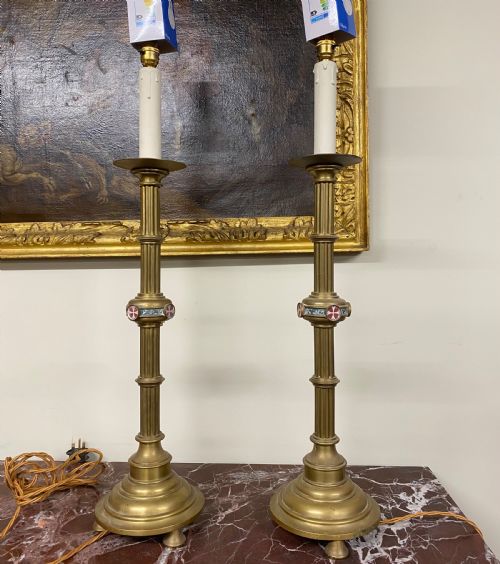
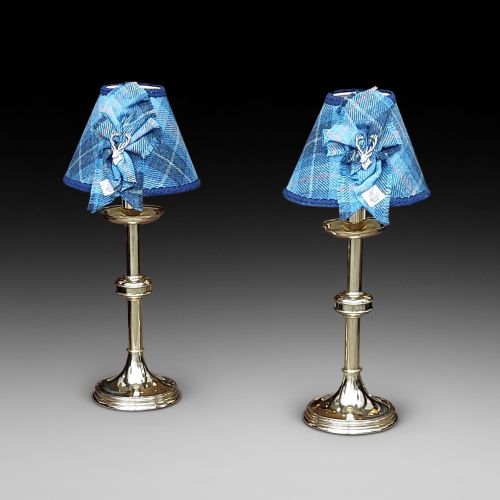
Church altar candlestick lamps are substantial converted liturgical pieces that bring striking vertical form and antique metalwork into a room.
Church Altar Candlestick Lamps
Church altar candlestick lamps adapt historic ecclesiastical lighting for domestic interiors, transforming pricket sticks and tall altar candlesticks into functional table lamps. When you search for church altar candlestick lamps, you encounter commanding pieces designed originally for sacred spaces rather than domestic rooms.
The selections here date primarily from the nineteenth century alongside eighteenth-century examples, incorporating both single pieces and matched pairs. Forms span standard table lamps, converted candlesticks, and larger candelabras.
French ecclesiastical and Gothic Revival designs dominate the selection, often rendered in heavy brass, silver plate, or giltwood. These pieces reflect the solemn aesthetics of nineteenth-century church interiors adapted for modern living.
How they were made
Makers utilised cast and turned brass, gilded bronze, and carved giltwood to construct the foundational shafts of these tall ecclesiastical fixtures. Metal components frequently received heavy silver plating or gilding to enhance their visual weight in dimly lit sanctuaries.
Church Altar Candlestick Lamps Retail Price Guide 2026
Typical asking prices for church altar candlestick lamps among the pieces listed under this phrase on Sellingantiques today, from the lower quarter to the upper quarter. They describe what is for sale here now, not the wider market.
Every single pricket stick started life holding a candle that smelled faintly of incense and holy smoke.
What varies in quality
Quality rests in the crispness of the original casting or carving along the shaft and the integrity of the base. Finer examples retain their original gilding or heavy silver plating in robust condition without excessive wear.
Proportion and weight dictate the desirability of the piece, with heavier cast brass and substantial giltwood specimens offering superior stability as table lamps. The subtlety of Gothic Revival detailing or Spanish Baroque ornamentation further separates standard pieces from exceptional ones.
The Church Altar Candlestick Lamps Glossary
- Pricket stick
- A candlestick featuring an upward-facing metal spike designed to secure a large wax candle rather than a socket. This form requires specific adaptation when converted into an electric lamp base.
- Giltwood
- Timber coated with a thin layer of gold leaf over a prepared gesso ground. It provides a rich reflective surface on eighteenth-century Spanish altar pieces.
- Gothic Revival
- An architectural and decorative style that revives medieval Gothic forms. It manifests here in pointed arches, quatrefoils, and heavy ecclesiastical proportions.
- Ecclesiastical
- Pertaining to the Christian church or its clergy. Pieces described thus were originally fabricated for use within a place of worship.
Church Altar Candlestick Lamps: Frequently Asked Questions
How are these lamps wired safely?
Conversion typically involves running a discreet flex through the existing central channel of the candlestick without altering the historic metalwork.
Professional rewiring ensures the tall, heavy structure remains stable and complies with modern electrical standards.
Where do these altar lamps work best?
Their height and vertical emphasis suit console tables, sideboards, or large mantlepieces where they create a strong focal point.
They pair well with neutral interiors that allow the antique brass and gilt surfaces to stand out.
How do I identify Gothic Revival pieces?
Look for architectural motifs drawn from medieval churches, such as trefoils, heavy knops, and triangular bases.
Nineteenth-century makers frequently employed these symbols to evoke a sense of ancient solemnity.
Are pairs common for altar lamps?
Symmetrical pairs frequently appear because church altars required balanced lighting flanking the tabernacle or crucifix.
Matched pairs are particularly sought after for placement on either side of a large sideboard.