


Christofle Champagne Bucket
A christofle champagne bucket brings French silver plate and distinct period styling to the table, offering practical cooling alongside historic design.
Christofle Champagne Bucket
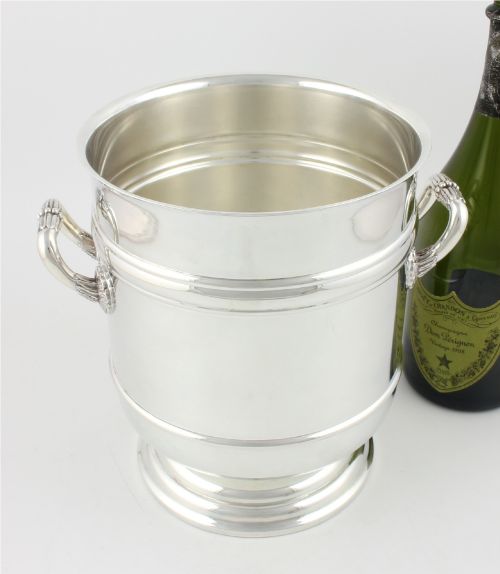
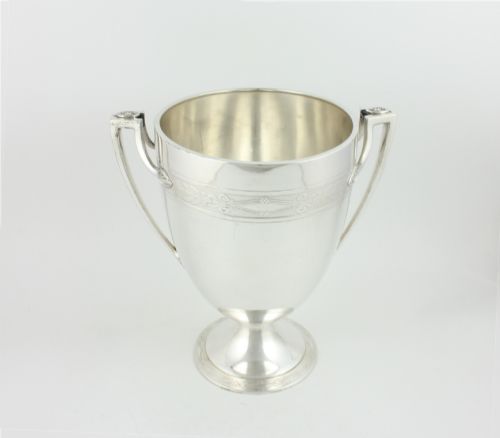
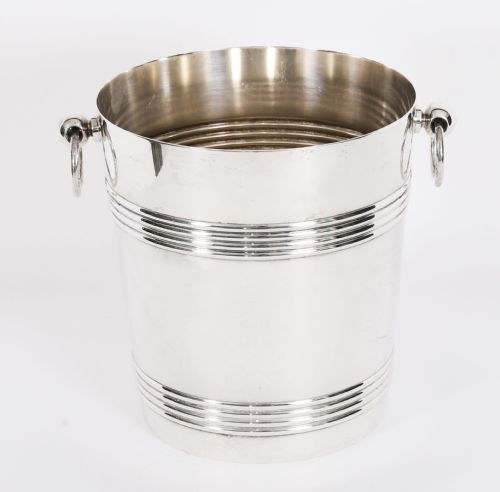
A christofle champagne bucket serves as a practical vessel for chilling wine and champagne, taking the form of deep cylindrical coolers, ice buckets and trophy-style vessels. These pieces emerge from periods spanning the Belle Epoque, Art Deco and Mid-Century Modern eras.
The selection ranges from early twentieth-century pieces bearing French Empire influences to geometric Art Deco designs and later modernist creations. Buyers encounter these items as standalone wine coolers or paired with matching drip plates and ring handles.
Originating from French workshops and Paris studios, these barware items reflect the shifting aesthetic preferences of the twentieth century while maintaining a consistent function for table service.
Distinctions in Execution
Quality rests upon the weight of the metal, the balance of the vessel, and the crispness of applied ornament such as cast handles or structured fluting. Stronger examples display thick silver plate that endures decades of polishing without revealing the base metal underneath.
Attribution to known designers and specific lines elevates a piece, as does the presence of intact matching elements like drip plates. The precision of the silhouette, particularly in geometric Art Deco and modernist profiles, separates standard production items from distinguished studio commissions.
Christofle Champagne Bucket Retail Price Guide 2026
Typical asking prices for christofle champagne bucket among the pieces listed under this phrase on Sellingantiques today, from the lower quarter to the upper quarter. They describe what is for sale here now, not the wider market.
The documented object forms comprise wine coolers, ice buckets, barware and integrated drip plates.
Luc Lanel·Lino Sabatinni
The Christofle Champagne Bucket Glossary
- Silver Plate
- A layer of silver bonded to a base metal core. This technique allows vessels to display the appearance and lustre of solid silver at a different weight.
- Gallia
- A metal alloy and specialised collection line produced by the maker. Items marked with this name often showcase distinct twentieth-century design collaborations.
- Art Deco
- A design style characterised by streamlined geometric forms, symmetry and stylized motifs. This aesthetic heavily influences the profile of many twentieth-century wine coolers.
- Belle Epoque
- A period of optimistic design spanning the turn of the twentieth century. Pieces from this era often incorporate ornate classical details such as trophy handles.
- Mid-Century Modern
- A design movement spanning the middle decades of the twentieth century. Objects from this time favour clean lines and minimalist functionalism.
Christofle Champagne Bucket: Frequently Asked Questions
What periods do these buckets represent?
The pieces span several decades of twentieth-century design, starting around nineteen hundred through the Art Deco periods of the nineteen thirties and nineteen forties, extending into modernist designs of the nineteen sixties.
Design characteristics shift across these eras, moving from ornate turn-of-the-century trophy shapes to geometric styling and later streamlined minimalism.
How were these coolers used originally?
These vessels held ice and water to chill wine and champagne bottles during dining and social gatherings in French homes and establishments.
Drip plates often accompanied the buckets to catch condensation and protect table linens from moisture during service.
What materials make up these pieces?
The primary material is silver plate over a metal or base metal foundation, providing a reflective metallic surface suitable for formal table settings.
Selected examples incorporate auxiliary components made from materials like bakelite for insulation or grip.
How do I identify different design styles?
Belle Epoque pieces often feature classical motifs like ram's heads and trophy handles, whereas Art Deco models lean towards stepped geometry and linear fluting.
Mid-century items present smooth, unadorned surfaces that focus purely on silhouette and metal finish.