

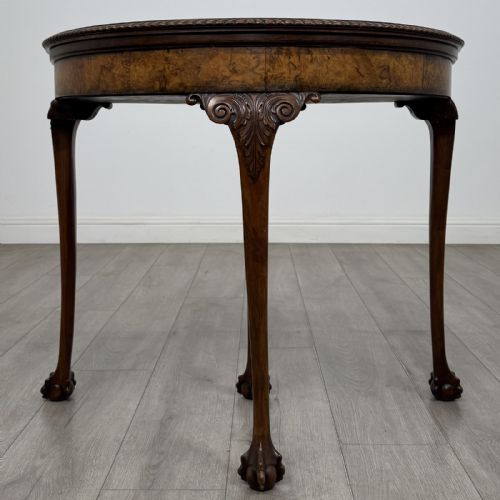
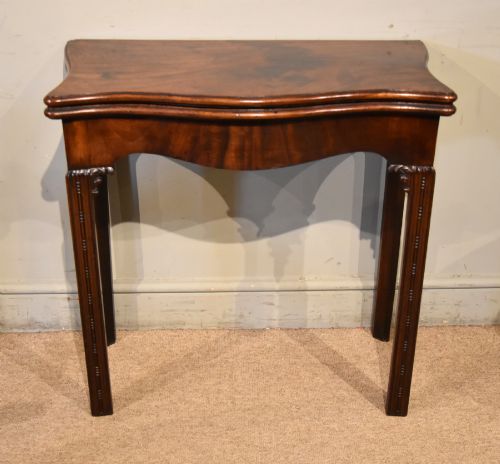
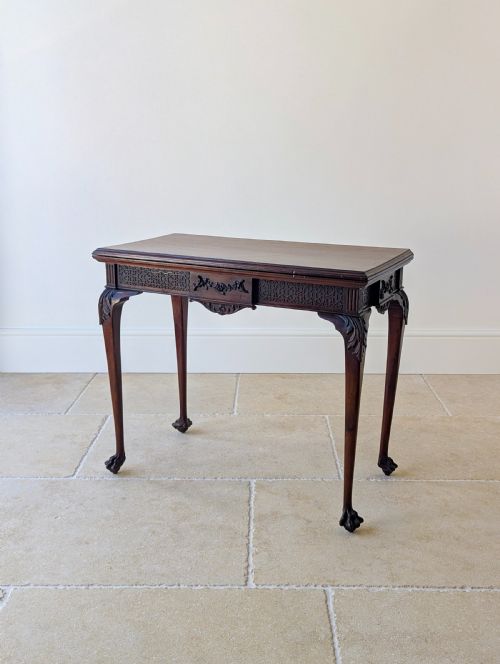


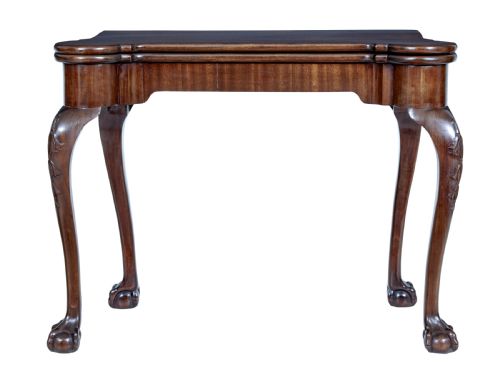


Chippendale Style Games Table
These chippendale style games table pieces combine English cabinet-making tradition with practical surface space, offering sturdy mahogany folding forms for period interiors.
Chippendale Style Games Table
A chippendale style games table provides a folding or opening top designed for card playing, tea, and social gatherings in period rooms. These pieces appear across several eras, ranging from eighteenth-century examples to later Edwardian and Victorian revivals.
The form typically relies on mahogany or walnut construction, featuring fold-over leaves that reveal playing surfaces lined with baize. Card tables, occasional tables, and folding corner variations represent the most common configurations found in these listings.
Buyers encounter eighteenth-century origins alongside later Chippendale Revival interpretations dating from the nineteenth and early twentieth centuries. Each period brings distinct interpretations of the carved woodwork and folding mechanisms established in earlier decades.
Materials and construction
Makers utilised solid mahogany and walnut timbers, often selecting burr walnut veneers for decorative surfaces on later nineteenth and twentieth-century examples. Timber selection dictated the structural stability required for heavy fold-over tops and hinged leaves.
Brass fittings and hinges support the folding mechanisms, while baize provides the traditional green playing surface inset within the wooden frame. Carved details define the legs and edges, linking the physical construction directly to Georgian and revival design canons.
Chippendale Style Games Table Retail Price Guide 2026
Typical asking prices for chippendale style games table among the pieces listed under this phrase on Sellingantiques today, from the lower quarter to the upper quarter. They describe what is for sale here now, not the wider market.
Listings feature mahogany and walnut timbers alongside brass and baize materials across multiple centuries.
Judging quality and execution
The caliber of a chippendale style games table rests upon the crispness of the carved woodwork and the tightness of the joinery in the folding leaves. Superior examples maintain smooth operation in their hinges and leaves without sagging or misalignment when open.
Timber selection and grain matching separate standard production from finer cabinet work, particularly in revival pieces where burr walnut or figured mahogany veneers play a central visual role.
Edwards & Roberts
The Chippendale Style Games Table Glossary
- Fold-over
- A table top design featuring a hinged flap that doubles the surface area when opened for games or tea. This configuration defines the primary function of most card tables.
- Baize
- A woven woolen material used to line the playing surfaces of card tables. It provides a soft, durable texture suited for card playing.
- Serpentine
- A gently undulating curved shape seen on the edges or fronts of table tops and frames. This contour adds visual movement to the mahogany structure.
- Revival
- A later stylistic movement reproducing historical designs from earlier centuries. Chippendale Revival pieces date primarily to the nineteenth and twentieth centuries.
Chippendale Style Games Table: Frequently Asked Questions
What is a chippendale style games table used for?
These tables served primarily for card games, social gatherings, and occasional tea service in domestic parlours and drawing rooms.
The hinged top opens to reveal a felt or baize playing surface, allowing the furniture to transform from a compact side table into a functional gaming area.
How do I spot a Chippendale Revival table?
Revival pieces date mostly from the nineteenth and twentieth centuries, often showing cleaner internal construction methods alongside period-correct mahogany carving.
Examining the secondary woods, hinge types, and wear patterns helps distinguish an original eighteenth-century piece from a later revival version.
Are all these tables made of mahogany?
Mahogany and walnut form the primary timber choices across the listings, with solid and veneered applications appearing frequently.
Some examples incorporate brass hardware and wool baize linings to complete the folding card table construction.
How do fold-over games tables work?
The top surface is split with a hinge, allowing the upper leaf to swing open and rest upon a pivoting leg or concertina frame.
This mechanism provides structural support for the extended wooden leaves while keeping the table compact when closed.