
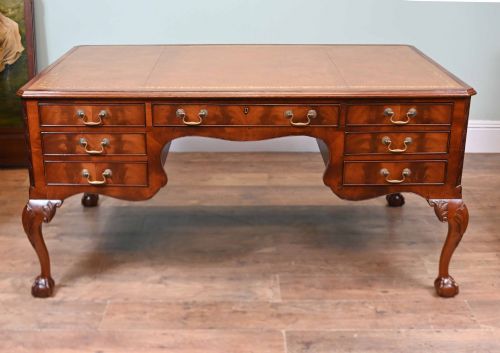
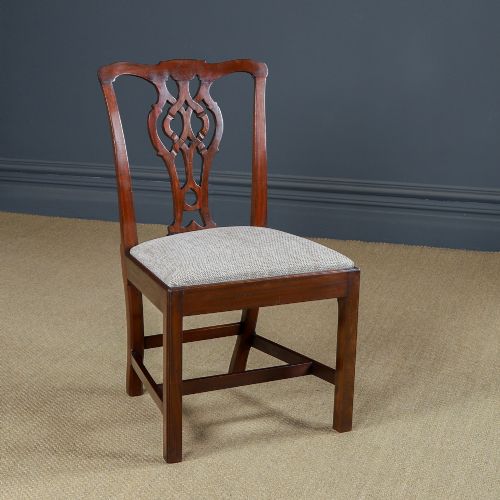


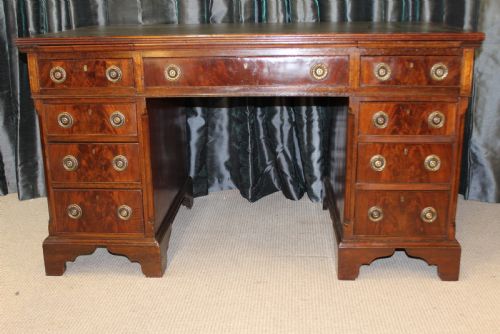


Chippendale Office Furniture
Chippendale office furniture brings substance and enduring craftsmanship into a workspace through substantial timber and considered proportions.
Chippendale Office Furniture
When buyers search for chippendale office furniture, they seek substantial mahogany desks and robust chairs designed for serious study or administrative work. The offerings on this page range from authentic Georgian period examples to later revivals from the nineteenth and early twentieth centuries.
The primary forms encountered here are pedestal desks, kneehole desks, partners desks, library desks, and sturdy single chairs intended for desk use. These pieces bridge formal decorative arts and functional utility, reflecting the design vocabulary associated with Thomas Chippendale's pattern books.
Originating predominantly from English workshops, these items span the eighteenth, nineteenth, and early twentieth centuries. Buyers will encounter both original period survivals and later interpretations executed in the revival taste.
Materials and construction
Cabinetmakers relied heavily upon solid and veneered mahogany, chosen for its rich grain, stability, and capacity for carved detail. Secondary timbers such as oak frequently appear in drawer linings and internal framing.
Working surfaces are regularly inset with tooled leather or fabric panels, while drawer pulls, handles, and key escutcheons are cast from brass. Joinery methods prioritise mechanical strength, employing dovetail construction for drawers and mortise and tenon joints for structural frames.
Listings for chippendale office furniture feature periods spanning the eighteenth, nineteenth, and early twentieth centuries, predominantly constructed from mahogany.
Assessing quality and execution
Superior examples distinguish themselves through the crispness of carved ornamentation, such as acanthus foliage or gadrooning, and the thoughtful selection of timber figure. The integration of secondary woods and the precision of drawer dovetailing reveal the competence of the original maker.
Proportion and structural integrity separate fine library and partners desks from standard utilitarian counterparts. Pieces that retain their original brass hardware, stable leather writing surfaces, and uniform timber patination command greater regard.
The Chippendale Office Furniture Glossary
- Pedestal desk
- A freestanding desk comprising two distinct pedestals of drawers supporting a top surface. This form provides ample storage and a finished back for placement in the centre of a room.
- Kneehole desk
- A compact desk featuring a central recessed space for the legs, flanked by banks of smaller drawers. These were widely used in domestic studies during the eighteenth century.
- Partnership
- The arrangement where two individuals share a desk surface. In antique furniture, it denotes a twin-sided desk configuration.
- Patina
- The surface sheen and softening of colour developed by wood over decades of handling and exposure to light. It is a key indicator of age and authenticity.
Chippendale Office Furniture: Frequently Asked Questions
What defines a partners desk?
A partners desk is built to be used from both sides simultaneously, featuring drawers and cabinets facing in opposite directions.
Such pieces were traditionally used by business associates, bankers, or spouses who required equal workspace within a shared study or library.
How do I identify a revival piece?
Revival pieces are generally dated to the nineteenth or early twentieth centuries, imitating the earlier Georgian aesthetic.
Clues lie in standardised machine-cut dovetails, modern secondary timbers, and surface finishes that differ from eighteenth-century patina.
Are these desks suitable for daily use?
These pieces were constructed for demanding administrative tasks and remain exceptionally sturdy for modern office environments.
Care should be taken to protect leather writing surfaces and maintain consistent room humidity to preserve the solid mahogany structure.
What is a kneehole desk?
A kneehole desk is a smaller pedestal form with a recessed central opening underneath the writing surface.
It offers a neat footprint while retaining adequate drawer storage for writing implements and correspondence.