


Chippendale Ladder Back Chairs
Chippendale ladder back chairs are robust seating forms that bring architectural silhouette and rich timber depth to a dining room.
Chippendale Ladder Back Chairs
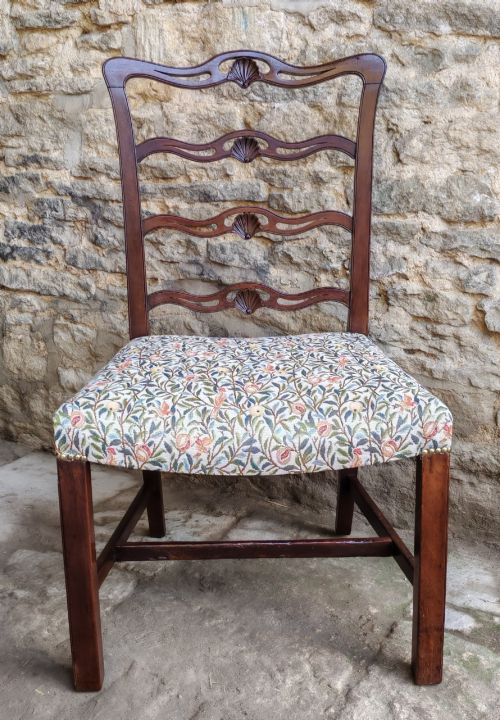
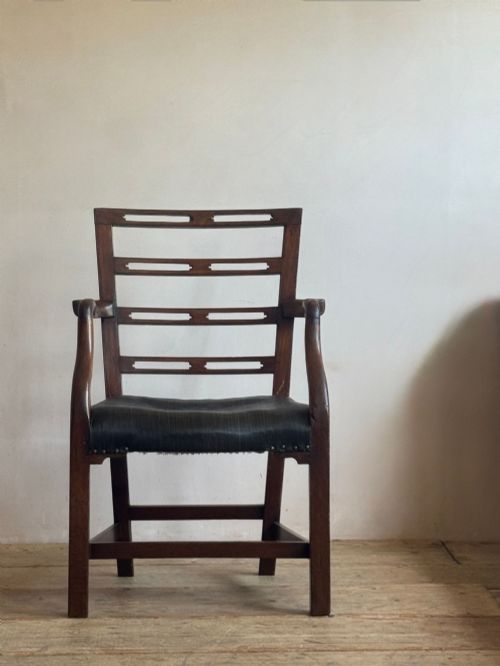
When you search for Chippendale ladder back chairs, you are looking at substantial timber seating featuring horizontal pierced slats across the backrest. The pieces appearing here span from the eighteenth century through nineteenth-century revivals and into twentieth-century interpretations. Single dining chairs and carver armchairs dominate the selection, alongside rarer desk chairs and settees.
The eighteenth-century examples display the crisp carving of the Georgian period, whilst later Victorian revival pieces replicate these proportions in solid mahogany. Sets of six, eight, or twelve dining chairs sit alongside pairs of armchairs, offering options for both large dining tables and individual accent seating.
Materials and construction
Mahogany serves as the primary timber across the listings, chosen for its structural strength and dense grain that permitted delicate piercing of the ladder slats. Joinery relies on traditional mortise and tenon construction to withstand the daily stresses placed upon dining and desk chairs.
Upholstered drop-in seats and fixed pads utilise materials such as leather, fabric, velvet, and tapestry. Brass studwork occasionally secures the edges of these upholstered pads, adding metallic detail to the timber framework.
Carver armchairs provided the master of the house with sufficient elbow room to carve the roast without knocking his neighbour.
Distinguishing quality
Quality rests upon the crispness of the timber carving along the ladder rails and the depth of the mahogany grain. Early eighteenth-century pieces demonstrate hand-carved pierced slats with subtle profiling, whereas revival pieces from the nineteenth century vary according to the fidelity of their cabinetwork.
Original sets maintain uniform timber patination and matching proportions across every chair, distinguishing them from assembled groups. The structural integrity of the arm supports and leg stretchers separates everyday utility pieces from finer examples.
The Chippendale Ladder Back Chairs Glossary
- Ladder-back
- A chair back featuring a series of horizontal cross-rails resembling the rungs of a ladder. These rails are frequently pierced, carved, or shaped along their upper edges.
- Carver
- An armchair designed to match a set of single dining chairs, typically placed at the head of a dining table. They possess supportive arms integrated into the chair frame.
- Chippendale Revival
- A nineteenth or twentieth-century reproduction style inspired by the designs of Thomas Chippendale. These pieces imitate eighteenth-century Georgian proportions and carving motifs.
- Drop-in seat
- A removable upholstered seat frame that rests within a rebate in the chair rails. It lifts out easily for reupholstery or maintenance.
- Stretcher
- A horizontal timber brace connecting the legs of a chair to provide structural stability. Eighteenth-century and revival forms utilise these rails to reinforce the underframe.
Chippendale Ladder Back Chairs: Frequently Asked Questions
How do I spot an eighteenth-century chair?
Examine the timber patination, hand-cut joinery marks beneath the seat frame, and the subtle wear patterns accumulated over generations of use.
Eighteenth-century examples display an oil or wax finish that highlights the dense grain of the mahogany, alongside subtle irregularities in the hand-carved slats.
Are ladder back chairs comfortable for dining?
The curved horizontal slats of these chairs are designed to fit the curve of the sitter's spine, providing lumbar support during long meals.
Upholstered drop-in seats covered in leather, fabric, or tapestry offer a cushioned platform that enhances daily usability.
What is the difference between revival and original pieces?
Original pieces date from the Georgian period and carry the distinct tool marks of eighteenth-century cabinetmakers.
Revival pieces, produced during the nineteenth and twentieth centuries, replicate these classic forms using contemporary nineteenth or twentieth-century woodworking techniques.
How should I care for mahogany frames?
Maintain the timber by applying natural beeswax periodically and keeping the chairs away from direct heat sources and strong sunlight.
Avoid liquid polishes containing silicone, which can penetrate open grain and dull the traditional wax finish over time.