
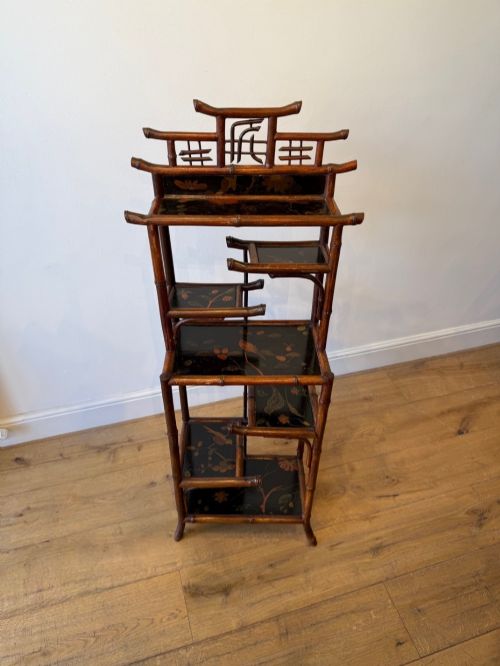


Chinoiserie Bamboo Stand
A chinoiserie bamboo stand brings painted oriental scenes and natural cane framework together, offering both practical surface space and distinct decorative character.
Chinoiserie Bamboo Stand
A chinoiserie bamboo stand combines oriental decorative motifs with natural cane or turned frames, appearing across forms such as tray tables, occasional tables, side tables, display shelves, floor lamps, umbrella stands, magazine racks, and hall stands. These pieces emerge predominantly in nineteenth-century and Victorian contexts, alongside Regency and twentieth-century examples up to the nineteen-thirties.
Buyers most frequently encounter tray tables, side tables, and display shelves on this page, often featuring painted lacquer panels or papier-mâché trays set upon bamboo or faux bamboo supports. The aesthetic movement and Victorian chinoiserie styles heavily influence these configurations, merging British craftsmanship with Chinese decorative inspiration.
Functional pieces like magazine racks, hall stands, and umbrella stands also feature within the selection, applying similar bamboo construction and lacquered decoration to everyday hallway and parlour storage. Such items reflect a sustained nineteenth-century fascination with imported oriental design adapted for domestic English interiors.
Materials and construction
Construction relies upon natural bamboo, hardwood, and papier-mâché, paired with applied lacquer and gold leaf to create decorated surfaces. Makers form structural frames from sturdy cane or ebonised wood shaped to imitate bamboo, supporting painted panels and trays.
Finishes involve detailed hand painting with gold leaf and coloured pigments depicting traditional Chinese scenes upon dark lacquered backgrounds. Glass elements also appear in specific forms like table tops and mirror inserts, completing the decorative assembly.
Several stands feature tiger bamboo, bringing wild jungle patterns straight into polite Victorian parlours.
Distinctions in quality
Quality rests upon the crispness of the hand-painted decoration and the integrity of the lacquer or papier-mâché panels. Superior pieces display intricate detail and rich gold leaf application that remains stable across the surface.
Structural stability in the bamboo or hardwood frame dictates overall durability, distinguishing finely joined examples from simpler utilitarian items. The execution of faux bamboo turning on wooden frames also indicates the maker's level of skill.
The Chinoiserie Bamboo Stand Glossary
- Chinoiserie
- European artistic style reflecting Chinese decorative motifs and landscape scenes. It appears frequently on lacquer panels and papier-mâché trays.
- Papier-mâché
- Composite material made from paper pulp or layers of paper bound with glue, pressed and dried into rigid forms. It provides a smooth base for painted trays and table tops.
- Lacquer
- Protective and decorative resin finish applied in multiple layers and polished to a hard sheen. This technique originates in East Asia and defines many table surfaces and panels.
- Aesthetic Movement
- Nineteenth-century artistic current emphasising visual beauty over narrative content. It promoted Asian art influences within British interior decoration.
- Torchere
- Tall decorative stand designed to support a lamp or candle. Regency examples often incorporate carved wood and lacquered finishes.
Chinoiserie Bamboo Stand: Frequently Asked Questions
What is a chinoiserie bamboo stand?
A chinoiserie bamboo stand is a piece of furniture that uses natural or faux bamboo framing combined with hand-painted oriental lacquer work or papier-mâché surfaces. These items range from small occasional tables and tray stands to larger hall stands and display shelves.
Originating largely in the nineteenth century and the Victorian era, they reflect the period's taste for imported Eastern aesthetics adapted for British homes. They serve both decorative and practical functions in living spaces.
How do I use one in a modern room?
These stands function well as bedside tables, plant pedestals, or small drinks surfaces in a sitting room where floor space is limited. Tray tables and side tables offer movable utility while adding visual texture through their bamboo frames.
Display shelves and magazine racks provide vertical storage and showcase space for books or small objects. Their distinctive appearance allows them to act as focal points within neutral interiors.
Are papier-mâché trays removable?
Many papier-mâché trays rest loosely upon folding or fixed bamboo stands rather than being permanently attached. This design allowed the original owners to use the tray independently for serving drinks.
When positioning the stand, check whether the tray lifts clear of the support frame to ensure safe handling. Securing the tray is unnecessary for normal display purposes.
How do I tell Victorian pieces from Regency ones?
Regency pieces often utilise painted wood shaped as faux bamboo alongside classical proportioning and Brighton Pavilion style influences. Victorian examples frequently employ natural bamboo, ebonised finishes, and heavy aesthetic movement decoration.
Examining the lacquer work, hardware, and underlying materials helps clarify the period of production. Cabinetry techniques also evolve between the early nineteenth century and the later Victorian decades.