
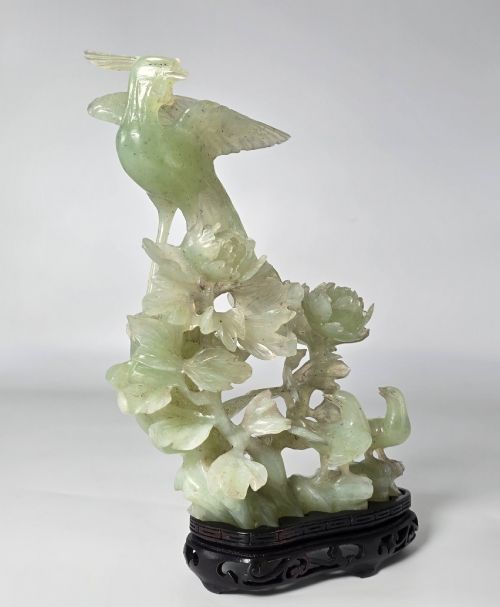


Chinese Soapstone Ornament
These Chinese soapstone ornament examples bring carved natural mineral into a room, offering tactile animal and figure studies from past centuries.
Chinese Soapstone Ornament
When you search for a Chinese soapstone ornament, you encounter hand-carved sculptural works ranging from desk seals to figural groups depicting animals, scholars, and deities. The pieces available on this page span the nineteenth century through the early twentieth century, encompassing Qing Dynasty and Republic Period Chinese styles.
You are most likely to meet sculptures of mythological creatures like Foo Dogs and Shi Shi, alongside naturalistic groups of birds, monkeys, and domestic animals set within carved landscapes. Many sit upon fitted hardwood bases that complement the organic contours of the stone.
The forms vary from utilitarian desk accessories and seals to purely decorative sculptures intended for scholar's tables and display cabinets. Each object reflects traditional Chinese decorative arts subjects executed in soft, workable mineral.
How they were made
Carvers utilised the natural variegation of steatite, Shoushan stone, and related mineral blocks to accentuate the subjects, working the soft stone with hand tools to define feathers, fur, and facial expressions. The material's inherent opacity and soft lustre allowed artisans to achieve deep relief carving without fracturing the medium.
Many figural groups and desk seals incorporate separate hardwood elements, joining carved stone bodies to wooden stands or bases through precise fitting. The surface finish relies on smoothing and polishing rather than applied glazes, preserving the tactile warmth of the natural stone.
What varies in quality
The distinction between ordinary and exceptional work lies in the ambition of the carving and the exploitation of the stone's natural colour variations. Superior pieces display crisp undercutting, expressive anatomical detail in figures and animals, and a harmonious integration of the stone's native hues into the final composition.
Scale and complexity also define the upper tier, where large figural groups or substantial desk seals demonstrate sustained patience from the carver. The presence of matching pairs and well-fitted original hardwood bases further elevates the standing of an individual piece.
The Chinese Soapstone Ornament Glossary
- Steatite
- A metamorphic rock composed largely of talc, commonly known as soapstone. Its softness makes it an ideal medium for intricate carving.
- Shoushan Stone
- A traditional Chinese soapstone originating from the mountains of Fujian province. It is prized for its wide palette of natural colours and smooth texture.
- Shi Shi
- A traditional guardian lion or Foo Dog represented in Chinese art. These mythical beasts often appear in pairs guarding entrances or supporting seals.
- Desk Seal
- A carved stamp used for personal signatures or calligraphy marks. Chinese examples frequently feature elaborate figural tops.
- Qing Dynasty
- The final imperial dynasty of China, spanning from sixteen forty-four to nineteen twelve. Pieces from this era often show traditional decorative motifs.
Chinese Soapstone Ornament: Frequently Asked Questions
What is soapstone?
Soapstone is a talc-schist metamorphic rock that feels soapy or waxy to the touch. It has been used for centuries because it is easily carved with hand tools.
Its relative softness allows artisans to achieve remarkable detail in small figures and intricate landscape scenes.
How old are these carvings?
The examples on this page primarily date from the nineteenth century through the early twentieth century. This timeframe includes late Qing Dynasty production and the Republic Period.
Stylistic cues and material handling help place these pieces within this broad historical window.
Were desk seals actually used?
Desk seals served practical functions for stamping documents and calligraphy with personal or official ciphers. The carved animal or deity on top provided a comfortable grip.
Many high-status seals doubled as decorative desk ornaments for scholars and officials.
Do these pieces need special care?
Soapstone is a soft mineral that can scratch or chip if dropped against hard surfaces. Gentle dusting with a dry cloth keeps the surface clean without risking abrasion.
Keeping them away from harsh chemicals and extreme temperature shifts preserves the natural finish.