

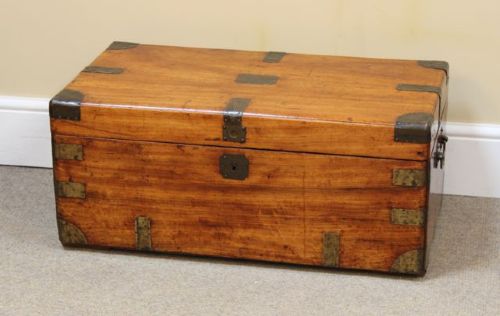


Chinese Export Campaign Chest
When you want a Chinese export campaign chest, you are looking for durable travel furniture built overseas for military officers and merchants.

Chinese Export Campaign Chest
These pieces are functional storage items designed for travel, most commonly taking the form of 19th-century chests of drawers, secretaire chests, and trunks. You are most likely to encounter camphor-wood trunks and two-section military campaign chest-of-drawers on this page.
Originating from the China Trade and Chinese Export markets, the examples span the 18th century, the 19th century, and the Victorian period. They combine utilitarian strength with overseas craftsmanship tailored for British and European buyers on the move.
How they were made
Makers utilised fragrant camphor wood and burl wood to construct the primary bodies, chosen for insect-repellent properties and resilience during transit. Structural joints and drawer divisions required sturdy timber to withstand repeated dismantling and long sea voyages.
Metal reinforcement defines the technique, incorporating heavy brass bound edges, corners, and copper elements to protect vulnerable points. Selected pieces feature leather coverings, polychrome painted pigment, and lacquered surfaces to finish the exterior.
Chinese Export Campaign Chest Retail Price Guide 2026
Typical asking prices for chinese export campaign chest among the pieces listed under this phrase on Sellingantiques today, from the lower quarter to the upper quarter. They describe what is for sale here now, not the wider market.
Listings on this site span the 18th century, 19th century, and Victorian period, utilising camphor wood, brass, leather, and burl wood.
What varies in quality
The sophistication of the internal configuration sets superior examples apart, particularly where fitted secretaire drawers and dressing compartments transform a simple trunk into a writing desk. The integration of complex sliding trays and hidden compartments demonstrates higher workshop skill.
The density and selection of the timber grain, alongside the weight and neatness of the brass binding and hardware, dictate the overall standard. Pieces retaining original leatherwork, pigment, and lacquered finishes show greater integrity than those stripped or altered over time.
The Chinese Export Campaign Chest Glossary
- Camphor wood
- A strongly aromatic timber native to Asia, utilised for its pest-resistant qualities and stability in humid climates. It forms the primary material for the majority of these trunks and chests.
- Secretaire chest
- A chest of drawers featuring a pull-out writing drawer with a hinged front and internal small drawers and pigeonholes. This hybrid form allowed officers to carry a desk within their luggage.
- Campaign chest
- Modular furniture designed to separate into stacked sections with recessed brass carrying handles for military transport. The corners and edges are protected with brass plates to endure rough handling.
- China Trade
- Goods manufactured in China during the 18th and 19th centuries specifically for export to Western markets. These objects often blend traditional Chinese woodworking with European furniture forms.
Chinese Export Campaign Chest: Frequently Asked Questions
What is a campaign chest?
A campaign chest is a piece of modular furniture built in sections with recessed handles, designed to be packed up and transported easily during military or merchant travels.
The style prioritises durability and practicality, often featuring reinforced brass corners to protect the wood from heavy knocks on long journeys.
Why use camphor wood?
Camphor wood was chosen because its strong natural aroma repels moths and insects, protecting uniforms and textiles stored inside during humid voyages.
It is also a stable and resilient timber that responds well to being carved and handled in overseas workshops.
How do secretaire chests work?
A secretaire chest includes a specialised middle drawer that drops down on hinges to reveal a writing surface and small internal compartments.
This allowed travellers to combine wardrobe storage with a functional desk without taking up extra space in cramped quarters.
How do I date these chests?
Dating relies on combining the wood type, brass hardware style, construction methods, and any historical labels or inscriptions found on the piece.
Most surviving examples on this page originate from the 19th century and the Victorian era, reflecting the peak of trade and military movement.