


Chinese Bamboo Carved Table
A chinese bamboo carved table brings the quiet discipline of scholars and export workshops straight into a room.
Chinese Bamboo Carved Table
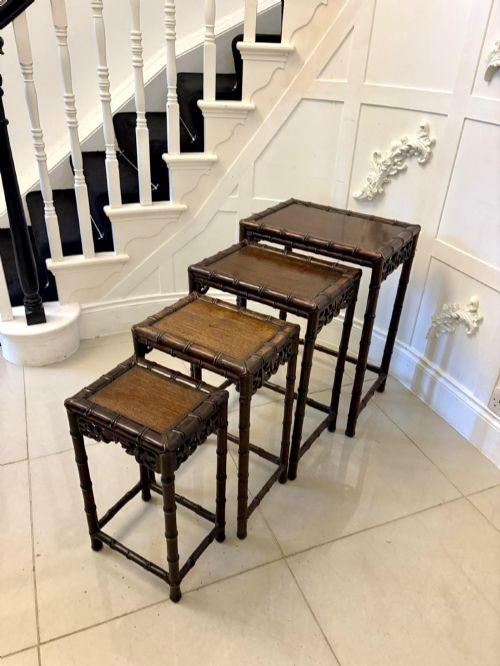
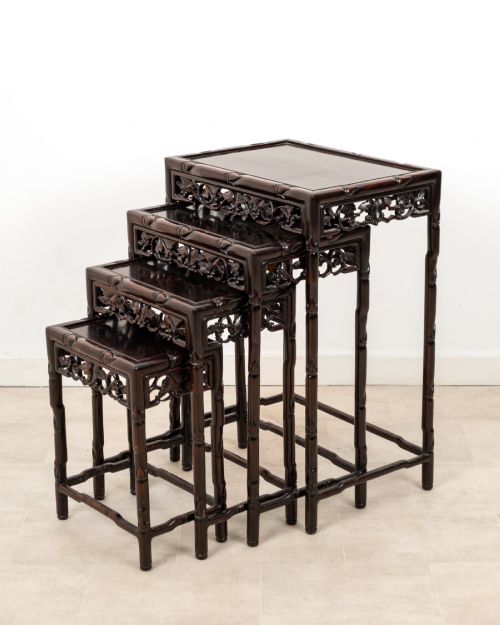
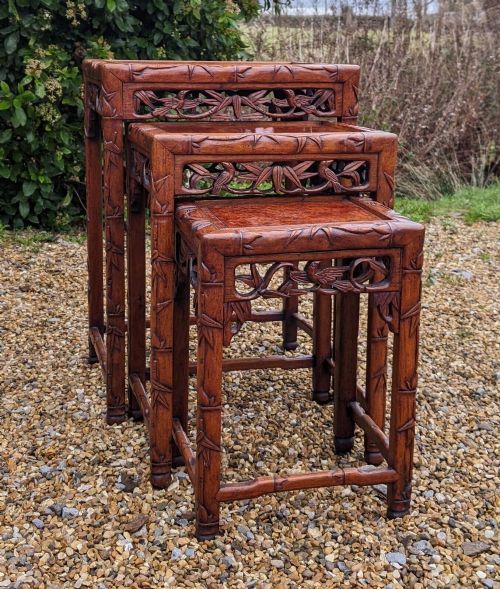
A chinese bamboo carved table usually takes the form of a nest of four tables, a coffee table, a plant stand, or an occasional table designed for flexibility in the home. These pieces emerge primarily from the nineteenth century, the Victorian era, and the early twentieth century, spanning Qing Dynasty and Chinese Export traditions.
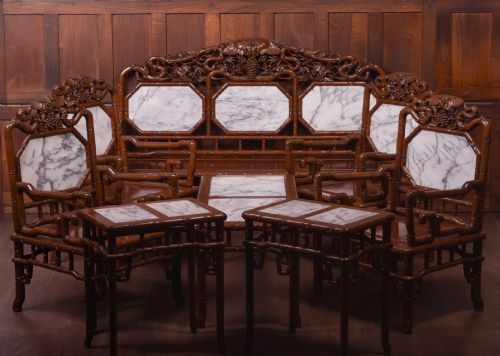
Most examples found in these listings rely on dense hardwoods like rosewood, hongmu, and huanghuali carved to imitate the segmented joints and natural grain of bamboo. True bamboo construction appears alongside faux bamboo frames and marble inserts, creating versatile surfaces for scholar's studios and traditional parlours.
Materials and Construction
Craftsmen utilised heavy timbers including hongmu, rosewood, and huanghuali wood, often combining structural hardwood frames with marble inset tops or carved panels. The illusion of bamboo requires meticulous carving of timber to replicate natural nodes and hollow stems.
Joinery methods allowed nesting sets to slide smoothly together in graduated sizes, whilst occasional tables utilised folding bases or rigid four-legged frames. Surface finishing highlighted the natural grain and deep colour of the timber without obscuring the intricate hand-carved details.
The listings feature pieces spanning the nineteenth century, the Victorian era, and nineteen-ten, utilising bamboo, hardwood, rosewood, and marble.
Distinctions in Quality
Quality rests upon the selection of timber, where exceptional colour, striking grain patterns, and heavy dense hardwoods like huanghuali elevate a piece far above standard variants. The crispness of the carving defines the artisan's hand, particularly where hardwood successfully mimics the organic irregularities of bamboo.
Structural integrity across nesting sets and folding bases dictates everyday utility, with superior examples maintaining tight joints and smooth sliding action across all four graduated tables. The integration of inset marble tops and balanced proportions further separates accomplished export workshop pieces from simpler utilitarian stands.
The Chinese Bamboo Carved Table Glossary
- Hongmu
- A dense, dark tropical hardwood favoured in traditional Chinese furniture making for its strength and rich natural colour.
- Nest of tables
- A set of graduated tables designed to fit neatly beneath one another to save space when not in use.
- Chinoiserie
- European artistic style reflecting Chinese motifs and techniques, frequently intersecting with actual Chinese export pieces.
- Brush pot
- A cylindrical scholar's desk accessory carved from bamboo or hardwood to hold writing implements.
Chinese Bamboo Carved Table: Frequently Asked Questions
How do I use a nest of tables?
These graduated sets sit compactly together as a single side table until entertaining requires separate surfaces for drinks or books.
Pull out the individual tables as needed around a room, then slide them back into the main frame when floor space is required.
What is the difference between hongmu and rosewood?
Hongmu translates as red wood and encompasses several dense tropical hardwoods used in traditional Chinese furniture construction.
Rosewood shares similar heavy properties and dark reddish-brown tones, though specific grain patterns vary according to the exact botanical species.
Are these tables strictly for traditional interiors?
The clean lines and organic bamboo motifs integrate easily into contemporary rooms alongside minimalist or mid-century furnishings.
Their compact scale makes them useful as plant stands, bedside surfaces, or occasional coffee tables in smaller spaces.
How can I tell a nineteenth-century piece from a later one?
Nineteenth-century examples often display deep hand-carving in dense timbers like huanghuali or rosewood with traditional joinery.
Later Victorian and early twentieth-century pieces frequently show different manufacturing tolerances or softer timber selections adapted for export markets.