
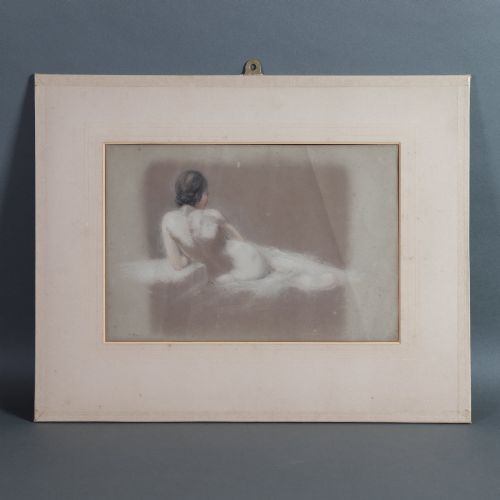
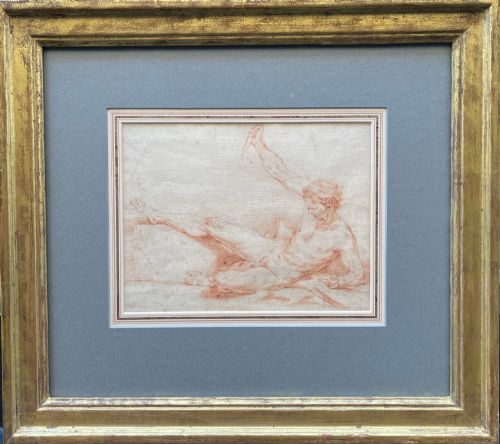

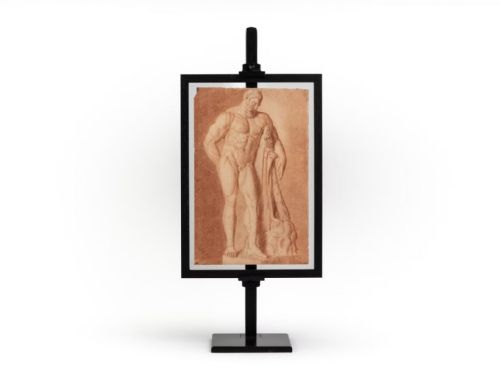


Chalk Nude Study
A chalk nude study captures the human form with linear immediacy, offering collectors direct access to an artist's hand.
Chalk Nude Study
A chalk nude study represents the human body rendered primarily in dry media on paper, ranging from rapid academic exercises to finished exhibition pieces. When you search for this phrase, you encounter original works that span several centuries, from eighteenth-century Italian sheets to mid-century modernist compositions.
The format typically appears as a framed drawing on paper, toned paper, or card, preserving the delicate dust of the pigment. Works on this page bridge multiple movements, including French Neoclassical, Art Deco, and Cubism, reflecting shifting ideals of the figure over time.
Subjects vary from classical mythological figures and reclining postures to robust life drawings executed in charcoal, pastel, and red chalk. Collectors acquire these pieces to observe the intimate process of anatomical rendering unencumbered by layers of oil paint.
Materials and technique
Artists create these works using dry mediums such as chalk, charcoal, and pastel applied directly to paper or toned supports. Red chalk, historically known as sanguine, allows for warm tonal modeling and precise contour lines when sharpened.
Draftsmen frequently utilise toned paper to build highlights with white chalk while leaving the mid-tone of the sheet to serve as shadow. Charcoal provides deep, matte blacks that contrast against softer chalk strokes, creating depth within monochrome or two-crayon compositions.
Object types span original fine art works on paper, framed drawings, and wall art from British and continental European schools.
What varies in quality
Quality rests upon the sureness of the line and the artist's command of anatomical proportion and volume. A superior study demonstrates confident economy of stroke, where every mark describes muscle tension or bone structure without redundant correction.
The preservation of the fragile medium also dictates standing, as unsealed chalk and pastel are vulnerable to smudging and light degradation over centuries. Stronger examples retain the crisp texture of the pigment against the paper without excessive loss or heavy restoration.
William Etty·Hyacinthe Colin de Vermont·Lucien Gibert·Pierre-Paul Prud'hon·Demetrios Galanis·Frank Dobson·Henry Bird·Harry Epworth Allen
The Chalk Nude Study Glossary
- Recto and verso
- Recto. The front side of a sheet of paper or drawing. In older works, drawings sometimes appear on both sides of the support.
- Deux crayon
- A drawing technique using two distinct colours of chalk or crayon, typically black and red on tinted paper, to achieve highlight and shadow. This method was favoured by classical draftsmen.
- Life study
- An artwork produced by observing a live human model directly in the studio. These pieces capture immediate physical presence.
- Sanguine
- A type of red chalk made from iron-rich haematite, popular for portraiture and figure drawing since the Renaissance. It produces a warm, earthy reddish-brown line.
- Toned paper
- Paper manufactured or stained with a neutral mid-tone colour, such as grey, tan, or blue, rather than stark white. This allows artists to work upwards with white highlights and downwards with dark shadows.
Chalk Nude Study: Frequently Asked Questions
How do I care for a chalk drawing?
Keep drawings out of direct sunlight to prevent fading of sensitive pigments like red chalk and pastel. Ensure the frame has a spacer so the glass does not touch the surface of the paper.
Avoid hanging these works in areas with high humidity, which can cause paper to warp and encourage mould growth. Professional framing with acid-free materials protects the integrity of antique paper.
Are these works original or prints?
Every piece on this page is an original, unique work drawn by hand directly onto the paper. You are viewing the exact strokes made by the artist.
Unlike printed reproductions, genuine drawings show physical buildup of chalk dust and impression marks in the paper fibres.
How do I distinguish between an 18th-century and 20th-century study?
Eighteenth-century sheets often display laid paper with visible watermark lines and water-based chalks applied for academic or mythological practice. The paper texture and framing conventions usually reveal the period.
Twentieth-century examples tend to utilise machine-made wove paper and embrace modernist distortions of the human form, as seen in Cubist or Art Deco compositions.
Why do some drawings feature sketches on the back?
Artists historically reused expensive paper, sketching a preliminary composition or unrelated study on the reverse side before completing the main work. This practice gives insight into the working habits of the studio.
Both sides of the sheet hold artistic value and are often documented as recto and verso when catalogued.