

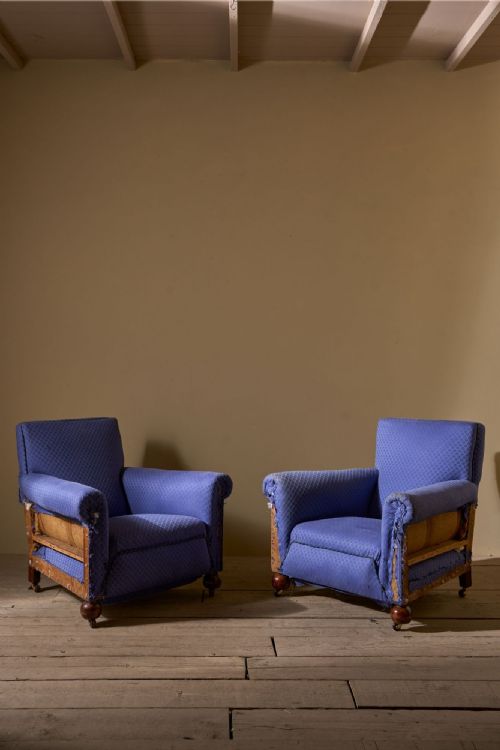


Chair for Reupholstery Project
A chair for reupholstery project offers the raw skeleton of a Victorian or Edwardian armchair, waiting for new calico and fabric.
Chair for Reupholstery Project
A chair for reupholstery project provides an uncovered structural frame ready for a complete rebuild. Buyers encounter Victorian armchairs, French salon chairs, and Art Deco club chairs stripped back to their bare springs and webbing.
The selection ranges from heavy mahogany and walnut frames to hardwood daybeds and chaise longues. Many pieces arrive wrapped in hessian and calico, awaiting a fresh textile finish.
Origin and period vary widely, spanning Regency, William IV, and early twentieth century English and French workshops. Each piece requires a dedicated hand to restore its upholstery and webbing.
Materials and construction
Frames are built from sturdy hardwoods such as mahogany and walnut, joined to bear the weight of heavy springing. Metal components like brass castors often support the feet.
Internal support relies on traditional webbing and hessian stitched directly to the wooden frame. Calico forms the foundational layer over which final decorative fabrics are tacked.
Chair for Reupholstery Project Retail Price Guide 2026
Typical asking prices for chair for reupholstery project among the pieces listed under this phrase on Sellingantiques today, from the lower quarter to the upper quarter. They describe what is for sale here now, not the wider market.
Beneath the torn calico, old horsehair stuffing occasionally yields long-forgotten buttons and stray pins left behind by Victorian tradesmen.
What separates the finest examples
The integrity of the underlying timber frame dictates the worth of the piece. Deeply carved mahogany or well-turned bobbin woodwork shows superior joinery and cabinet-making skill.
Proportion and scale distinguish grander country house armchairs from smaller salon chairs. Original brass hardware and intact internal webbing preserve the authentic character of the manufacture.
SF Cullen·Morison and Co·Holland and Sons
The Chair for Reupholstery Project Glossary
- Calico
- A plain-woven cotton fabric used as the tight inner lining over stuffing before the final decorative textile is applied. It holds the padding firmly in place.
- Hessian
- A coarse woven fabric made from jute fibres used as the base foundation for webbing and springs. It provides the tensile strength beneath the padding.
- Webbing
- Strong woven strips stretched tightly across the wooden seat frame to support the coil springs. Good webbing prevents the seat from sagging under weight.
- Slipper chair
- A low-seated bedroom chair traditionally designed without arms to allow women to sit while putting on shoes. They usually feature compact upholstered frames.
- Napoleon III
- A nineteenth century French style characterised by eclectic revivalism and ornate carving. These chairs often feature exposed wooden frames ready for fresh covering.
Chair for Reupholstery Project: Frequently Asked Questions
What is included with these chairs?
These frames are sold bare, stripped down to their wooden skeletons, metal springs, and original hessian or webbing. You receive the foundational structure without the final decorative top fabric.
Buyers must source their own upholstery materials, including padding, calico, and top fabric, to complete the restoration work.
How do I choose the right frame?
Look closely at the exposed wood, whether mahogany, walnut, or another hardwood, to ensure the structural joinery remains solid. Consider the scale of the armchair or chaise longue to match your interior space.
Check whether brass castors or carved details are intact, as replacing missing wooden or metal elements requires specialist cabinet-making skill.
Are these pieces structurally sound?
Most frames date from the nineteenth and early twentieth centuries and generally require tightening of the joints. The underlying hardwood is durable, but past use may have loosened the dowels and glue.
A professional upholsterer or restorer should check the frame stability and secure the joints before any new webbing or padding is applied.
Can I use modern fabrics on them?
Modern textiles work exceptionally well on these historic frames, bridging traditional forms with contemporary interior design. Ensure your chosen fabric meets current fire safety regulations for domestic upholstery.
Heavier weaves suit large country house armchairs, while lighter printed cottons complement smaller Victorian salon or slipper chairs.