
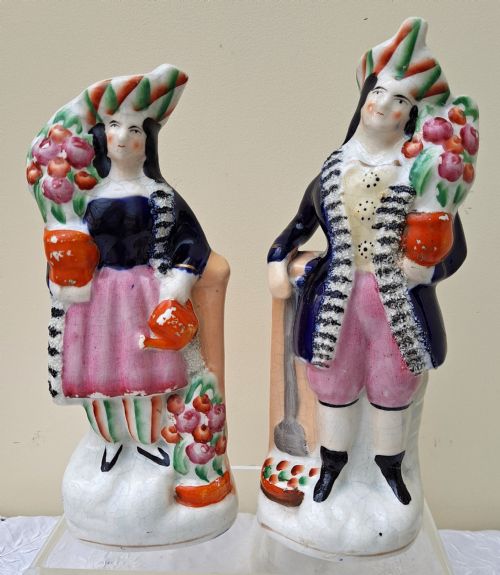


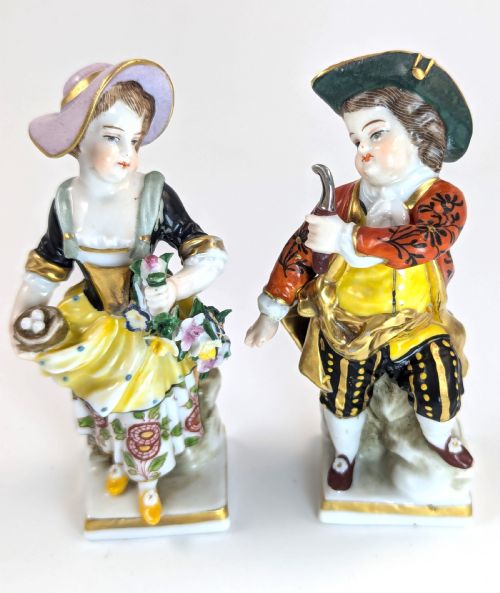


Ceramic Gardener Figurines
Ceramic gardener figurines bring figures of rural workers to interior display, capturing botanical pursuits in porcelain and earthenware.
Ceramic Gardener Figurines
When you search for ceramic gardener figurines, you encounter sculptural representations of horticulturalists produced across several centuries. These items take the form of paired figures, candlesticks, and decorative statuettes holding flowers or baskets.
The selections on this page span the eighteenth century, the nineteenth century, and the Victorian era. English Staffordshire pottery and continental porcelain factories account for the primary origins of these works.
How they were made
Potters utilised hard-paste porcelain, parian biscuit porcelain, and earthenware as the foundational bodies for these figures. Moulding and casting techniques shaped the clay before detailed modelling rendered the clothing and botanical accessories.
Finishes applied to the surfaces include colourful glaze, enamel, and gold leaf highlights. Biscuit porcelain pieces relied on unglazed firing to achieve a matte, marble-like texture reminiscent of carved stone.
What varies in quality
The complexity of the base decoration and the fidelity of the factory modelling significantly impact the sophistication of the piece. Well-preserved surfaces retain their original glaze lustre and colour saturation without excessive rubbing.
Meissen Porcelain Figurine·Minton·Sitzendorf·Limbach Thuringia·Derby
The Ceramic Gardener Figurines Glossary
- Biscuit porcelain
- Unfired or unglazed porcelain that has been fired once, resulting in a matte, porous finish resembling marble. This material gained popularity during the nineteenth century for classical and figurative subjects.
- Hard-paste porcelain
- A true porcelain composed of kaolin and petuntse, fired at very high temperatures. It produces a durable, translucent body resistant to scratching.
- Enamel
- Opaque vitreous colours applied over the glaze and fixed by a low-temperature firing. Enamels provide the bright palette seen on historical figures.
- Parian porcelain
- A fine-grained, unglazed porcelain developed in the nineteenth century to imitate carved marble. It is named after the white marble of Paros.
- Staffordshire pottery
- Earthenware produced in the English region of Staffordshire, known for popular figures and utilitarian wares. These pieces often feature hand-painted or transfer-printed details.
Ceramic Gardener Figurines: Frequently Asked Questions
How were these figures displayed historically?
Historically, ceramic gardeners stood in pairs on domestic mantelpieces, sideboards, or dining tables as decorative accents. Some variations incorporated candle sockets, serving a functional role alongside their sculptural display.
Their cheerful rural themes suited the interior decoration tastes of both eighteenth-century European courts and Victorian homes.
How do I identify eighteenth-century pieces?
Eighteenth-century examples often exhibit characteristic paste compositions and hand-painted enamel palettes specific to early European factories. Makers such as Meissen, Limbach, and Derby utilised distinct potting techniques and sculptural styles during this era.
Examining the underside of the base can reveal factory marks or distinctive potting traits associated with these historical periods.
What is the difference between porcelain and earthenware?
Porcelain is a vitrified, ceramic material fired at high temperatures, resulting in a dense and sometimes translucent body. Earthenware is a porous, lower-fired ceramic that requires a glaze to become impermeable to liquids.
Staffordshire pieces on this page are typically earthenware, whilst continental works like Sitzendorf and Meissen are porcelain.