
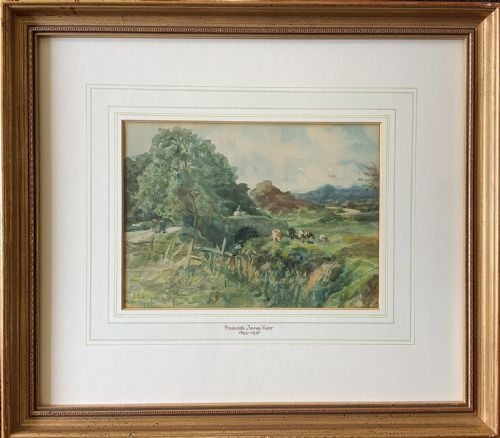
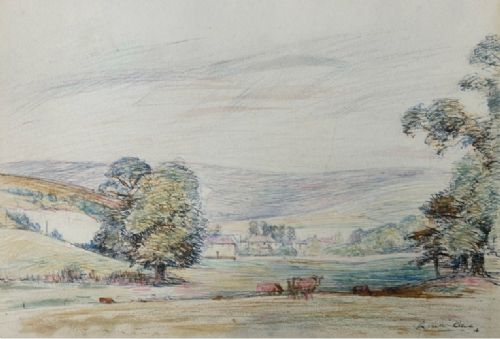


Cattle Watercolour Painting
A cattle watercolour painting captures the quiet rhythm of rural life through delicate washes and precise line work.
Cattle Watercolour Painting
A cattle watercolour painting presents pastoral scenes, riverbanks, and highland pastures inhabited by herds of cattle, bulls, and calves. These original artworks span the Victorian era, the Edwardian period, and the early twentieth century, reflecting a deep fascination with British and Irish rural landscapes.
Buyers encounter framed paintings and works on paper showing animals grazing by pools, watering in rivers, or driven by herdsmen through valleys. The compositions range from detailed realism to looser impressionistic interpretations created by notable artists of the nineteenth and twentieth centuries.
Most examples originate from British and Irish artistic traditions, capturing everything from Cumbrian mountains and Welsh rivers to Scottish highlands. The focus remains consistently upon livestock integrated harmoniously into expansive rural scenery.
Materials and Techniques
Artists executed these works using watercolour pigment applied to paper, sometimes incorporating gouache or pastel to build opacity and texture in highlights and cattle hides. Washes created atmospheric skies and misty distance, whilst finer brushwork defined the anatomy of the beasts and the surrounding foliage.
Framing typically involved wood, gilt wood, or burr frames, often protected behind glass to shield the delicate pigments from moisture and light. Original period framing frequently complements the artwork, preserving the piece as a unified historical object.
Even the most placid painted cow spent hours posing in damp Cumbrian fields while artists wrestled with fickle British weather.
Assessing Quality
Quality rests upon the artist's command of anatomy, light, and atmospheric depth, distinguishing masterly observations from formulaic studio output. Skilled hands capture the weight and posture of cattle alongside the transient effects of weather on open moorland.
The preservation of the paper and the vibrancy of the pigment determine the visual strength of the piece. Strong works retain their tonal contrast and delicate washes without excessive fading or discoloration from acidic mounts.
Thomas Sidney Cooper·Henry John Kinnaird·Lennard Lewis·John Macpherson·James Walsham Baldock
The Cattle Watercolour Painting Glossary
- Watercolour
- A painting method where fine pigment is suspended in a water-based solution and applied to paper. This medium allows for luminous washes and subtle blending.
- Gouache
- An opaque water-based paint that includes white pigment to create solid areas of colour. Artists used it alongside transparent watercolours to add highlights.
- Pastel
- A dry drawing medium composed of powdered pigment and a binder, used on paper to create textured landscape effects. It appears in several mixed-media rural scenes.
- Burr frame
- A wooden picture frame constructed from burr wood veneers, notable for its swirling, knotted grain patterns. These frames often encase early twentieth-century pastoral works.
- Pastoral realism
- An artistic style focused on depicting rural subjects and agricultural life with close attention to natural detail. It defines much of nineteenth-century British landscape art.
Cattle Watercolour Painting: Frequently Asked Questions
What periods do these paintings date from?
The available works span from the mid-nineteenth century through the Victorian and Edwardian eras into the early twentieth century. Many pieces carry specific dates or stylistic markers from the 1850s to the 1940s.
Artists of these periods worked within distinct regional traditions across Britain, Ireland, and continental European influences.
How should I display a watercolour painting at home?
Watercolours require careful placement away from direct sunlight to prevent the pigments from fading over time. UV-protective glass and acid-free mounting help preserve the paper and colours.
Keep them in rooms with stable humidity levels to protect both the paper support and the original wooden or gilt frames.
How do I identify different regional landscapes?
Artists inscribed titles or left distinct geographical clues such as Welsh valleys, Cumbrian mountains, Scottish highlands, or English river meadows. The vegetation, topography, and architecture depicted often point directly to specific locales.
Inscriptions on the reverse or original mounts frequently record the exact river, county, or landmark shown.
What is the difference between a watercolour and gouache?
Watercolour relies on transparent washes where the white of the paper illuminates the pigment from beneath. Gouache incorporates chalk or white pigment to create an opaque finish that conceals the paper.
Artists often combined both mediums in a single painting to render both glowing skies and solid highlights on cattle.