


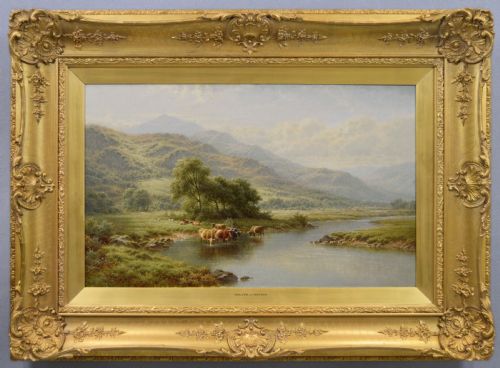


Cattle by River Painting
A cattle by river painting captures rural tranquility through pastoral scenes of livestock drinking and grazing beside waterways.
Cattle by River Painting
A cattle by river painting depicts rural British landscapes featuring cows, calves, and watering scenes beside rivers, streams, and valleys. These works typically date from the nineteenth century into the early twentieth century, spanning Victorian and Edwardian periods.
The most common formats on this page are oil on canvas and watercolour paintings, often housed within ornate giltwood frames incorporating gesso and gold leaf. Subjects range from Welsh mountain rivers and Scottish landscapes to pastoral scenes in English counties.
Makers and artists working in the British School tradition produced these pastoral scenes, utilising detailed brushwork to capture livestock and water. Buyers encounter both signed works by listed artists and traditional British School watercolours or oils.
Materials and technique
Artists painted primarily with oil on canvas or applied watercolour on paper, capturing light on water and the texture of cattle hides. Canvas supports provided durability for larger oil paintings, while watercolours offered fluid transparency for river and atmospheric effects.
Frames utilised wood bases shaped with plaster and gesso, finished with surface gilding using gold leaf to create ornate giltwood surrounds. These frames protect the edges of the canvas and complement the pastoral subject matter.
Calves and ducks frequently share the riverbanks with grazing cattle, adding charming rural details to pastoral paintings.
Quality and execution
Quality rests in the anatomical accuracy of the cattle, the handling of water reflections, and the depth of the landscape perspective. Superior works display confident brushwork in the rendering of animal forms and atmospheric light.
The craftsmanship of the original giltwood and gesso frame contributes significantly to the overall integrity of the piece. Intricate moulding and well-preserved gilding elevate the presentation of nineteenth-century canvases.
George Vicat Cole·Sidney Richard Percy·Robert Thorne Waite·Harold Lawes·Thomas Baker of Leamington·Claude Cardon·Henry Cheadle·William Sidney Cooper·Walter J Watson·Alfred de Breanski·Thomas Pyne·Thomas Thomas·Thomas E Francis·Thomas Sidney Cooper·Etty Horton·Owen Bowen·John Pedder·J Scott·Thomas Danby·John Nicholas Rhodes·Georgio Aicardi·William Langley·Arthur Herbert Buckland·Albert Dunington·Robert Mann
The Cattle by River Painting Glossary
- Giltwood
- Wood carved and covered with gold leaf. This material forms the ornate frames frequently found surrounding nineteenth-century oil paintings.
- Gesso
- A plaster mixture applied to wooden frames as a smooth base before gilding. It allows artisans to mould intricate decorative patterns.
- Pastoral Realism
- An artistic style focusing on authentic depictions of rural life and farm animals in natural settings. Painters of this genre observed cattle and riverbanks directly from nature.
- Watercolour
- A paint consisting of pigment suspended in a water-based solution, typically applied to paper. This medium was widely utilised for British landscape paintings.
Cattle by River Painting: Frequently Asked Questions
What periods do these paintings date from?
The selections span the nineteenth century and the early twentieth century, encompassing Victorian and Edwardian artistic movements.
Most items date between the eighteen-fifties and the nineteen-twenties, reflecting established British landscape traditions.
How were these paintings originally framed?
Artists and contemporary framers utilised wood structures coated in gesso and finished with gold leaf. These ornate giltwood frames were designed to complement the pastoral subject matter.
Many surviving works retain their original frames, which show period decorative techniques.
What mediums are used in these artworks?
Works utilise oil paint on canvas or watercolour applied to paper supports. Canvas pieces provide robust surfaces for layered oil pigments.
Watercolours capture lighter atmospheric effects in river valleys and rural landscapes.
Where do the landscape settings originate?
Scenes frequently depict specific British locations, including Welsh rivers, Scottish mountains, and English counties such as Warwickshire and Kent.
Artists recorded actual rural waterways where cattle gathered to water and graze.