
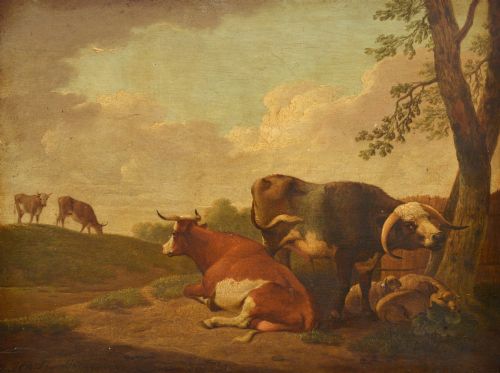


Cattle and Sheep Painting
A cattle and sheep painting brings the quiet pastoral world of the farmyard and Highlands straight into a room.
Cattle and Sheep Painting
A cattle and sheep painting depicts rural livestock settled within expansive British, Scottish, and continental landscapes. These works primarily take the form of framed oil paintings on canvas and panel, alongside delicate watercolours on paper.
The pieces on this page span the eighteenth and nineteenth centuries, taking in Georgian works, Victorian realism, and pastoral Dutch romanticism. Buyers most frequently encounter nineteenth-century canvases showing herds resting by rivers or sheltering in barns.
What varies in quality
The skill of the brushwork in rendering animal anatomy and expression defines the upper tier of these works. Master painters capture the heavy coat of a Highland beast and the soft fleece of sheep with convincing weight and natural light.
Compositional depth and the rendering of atmospheric weather, such as winter snow or evening mist, elevate certain landscapes above standard studio output. The preservation of the original canvas and the crispness of the giltwood framing also influence the standing of a piece.
Listings feature works rendered in oil on canvas, copper panel, and watercolour on paper, housed in original giltwood and plaster frames.
Hendrik Willem Schweickhardt·Thomas Sidney Cooper·James de Rijk·Bernard Walter Evans·Basil Bradley·Charles Jones·Robert Watson·William Frederick Hulk·Aster R C Corbould·William Bielby·William Shayer Snr·Herbert St John-Jones
The Cattle and Sheep Painting Glossary
- Oil on Canvas
- A painting technique using pigments bound in a drying oil, applied to a stretched woven fabric support. This combination allows for rich blending and deep colour tones.
- Giltwood
- Timber carved and coated with a thin layer of gold leaf or metallic powder. It provides a bright, decorative border for nineteenth-century paintings.
- Watercolour
- A painting method where fine pigment is suspended in a water-soluble vehicle on paper. It creates transparent washes of light and colour.
- Pastoral
- A style of art concerning itself with rural life, shepherds, and domesticated animals in a peaceful countryside setting. These scenes evoke a calm, romantic view of agriculture.
- Victorian Realism
- An artistic approach focusing on the accurate, unidealized depiction of everyday subjects and nature. In animal painting, this translates to precise observation of livestock and weather.
Cattle and Sheep Painting: Frequently Asked Questions
How do I date a cattle and sheep painting?
Examination of the canvas support, the stretcher frames, and the style of the giltwood surround provides initial clues to the age of a work. Pigment analysis and artist signatures, where present, help narrow down the period.
The clothing of figures and the specific artistic conventions of Victorian realism or eighteenth-century Dutch romanticism further point towards a particular decade.
Where were these paintings hung originally?
These rural scenes typically hung in the reception rooms and parlours of country houses and town residences. They served to bring the perceived tranquillity of the countryside into domestic urban interiors.
Larger canvases commanded central positions above fireplaces, while smaller watercolours were grouped in private sitting rooms.
What is the difference between oil and watercolour versions?
Oil paintings on canvas or copper panels offer rich textures and deep colour saturation that endure strongly over centuries. They represent the more substantial works produced by artists for formal exhibition.
Watercolours on paper are lighter in tone and require glass protection, often capturing swift observational studies of livestock in the field.