
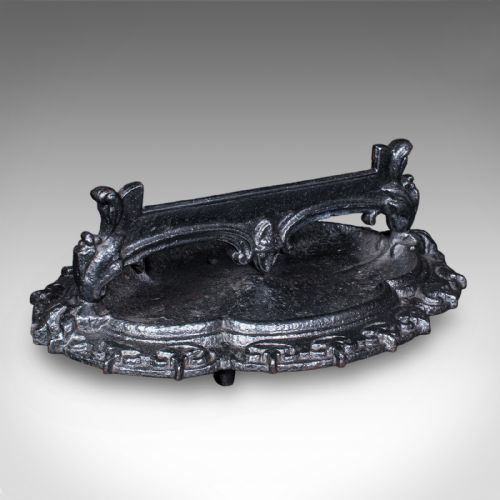


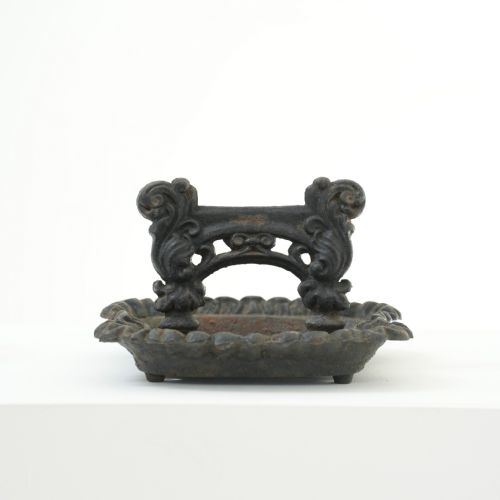


Cast Iron Scraper Tray
A cast iron scraper tray clears heavy mud from boots before visitors step inside.
Cast Iron Scraper Tray
A cast iron scraper tray combines a sturdy metal blade for clearing mud with a shallow base designed to catch dirt. When you search for a cast iron scraper tray, you encounter practical entrance accessories from the Georgian, Regency, and Victorian periods.
Most examples found here date from the nineteenth century, including pieces featuring Gothic Revival ornamentation and designs attributed to Coalbrookdale. They range from small oval footscrapers to large country house and townhouse models equipped with integrated shoe pulls.
Materials and construction
These items are produced entirely from durable cast iron, poured into moulds to create both the upright scraping blades and the surrounding trays. The manufacturing process allows for crisp decorative details, from simple geometric borders to elaborate Gothic Revival tracery.
Foundries utilised this robust metal to withstand heavy outdoor use and the weight of boots. Many pieces incorporate separate or integral shoe pulls designed to help remove footwear.
Country house models are sometimes found in matched pairs, suggesting that Victorian guests arrived with twice as much mud to tackle.
Judging quality and design
Quality in these pieces rests upon the crispness of the casting and the thickness of the iron. Finer examples display sharp definition in their decorative motifs and retain clean lines along the scraper blade without excessive wear from decades of use.
Proportion and scale also separate standard domestic models from large country house or London townhouse editions. Weight and stability indicate superior manufacture, as heavier castings remained firmly in place beside a doorway.
Coalbrookdale
The Cast Iron Scraper Tray Glossary
- Boot scraper
- A metal blade mounted near a doorway for removing mud from the soles of shoes. It is often combined with a tray to catch the falling debris.
- Shoe pull
- A handle or loop attached to the scraper assembly that helps steady the foot while removing muddy boots. This feature appears frequently on townhouse and country house models.
- Coalbrookdale
- A famous Shropshire ironworks known for producing high-quality decorative and functional cast ironware during the nineteenth century. Their castings often display superior artistic detail.
- Gothic Revival
- An architectural and decorative style popular during the nineteenth century, characterised by pointed arches and medieval motifs. Scrapers in this style often feature tracery patterns.
Cast Iron Scraper Tray: Frequently Asked Questions
Where were these placed?
These scrapers stood immediately outside front doorways, porches, and entrance halls of houses. Their position allowed visitors to clean heavy mud from their footwear before entering the main rooms.
Property owners anchored them firmly near the threshold to endure daily use by household members and guests alike.
How do I date a scraper?
Dating relies on stylistic clues such as Regency curves, Victorian proportions, and Gothic Revival ornamentation. Nineteenth-century examples often exhibit distinct casting techniques and heavier iron weights.
Comparing the decorative motifs with documented periods helps narrow down the approximate decade of manufacture.
What is the shoe pull for?
The integrated loop or handle assists users in leveraging their foot while pulling off mud-caked boots. It provides balance and makes footwear removal much easier after walking through wet terrain.
This practical addition is most commonly found on larger townhouse and country house models.
How do I maintain cast iron?
Keep the metal clean of accumulated dirt and moisture to prevent surface oxidation. Applying a protective wax or specialised metal treatment helps preserve the original dark finish.
Displaying the piece in a covered entranceway also shields it from prolonged exposure to heavy rain.