
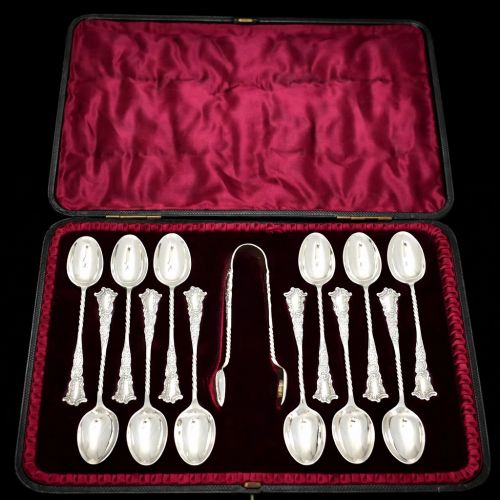


Cased Silver Coffee Set
A cased silver coffee set brings together fine spoons and a protective fitted box, offering a glimpse into early twentieth-century dining habits.
Cased Silver Coffee Set
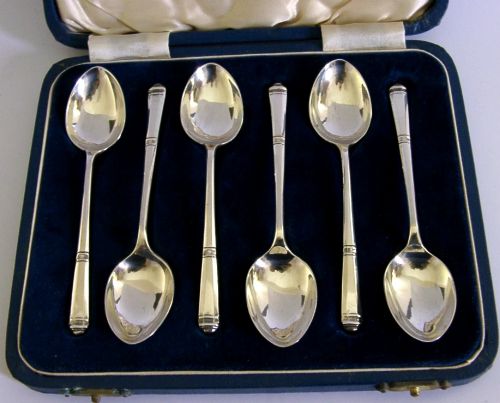
A cased silver coffee set typically comprises a matching group of small spoons alongside tongs or a matching service, housed in a fitted box. These assemblies date predominantly from the late Victorian period through the mid-twentieth century.
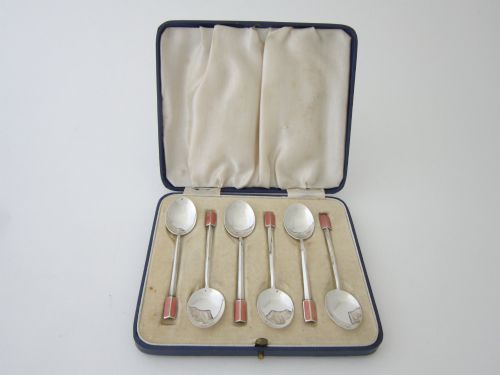
Buyers encounter various forms ranging from plain sterling silver teaspoons to decorative demitasse sets accented with enamel or silver gilt. The most frequently seen examples date from the Art Deco period, often featuring geometric handles or coloured enamel work.
Originating largely from British assay offices in cities such as Sheffield, Birmingham, and London, these sets also occasionally hail from continental makers in Norway and Germany.
Materials and Techniques
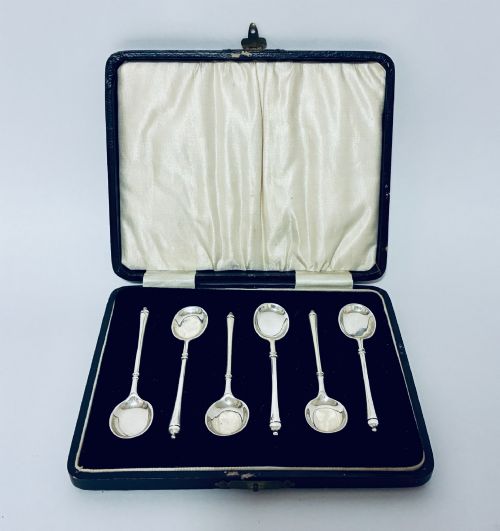
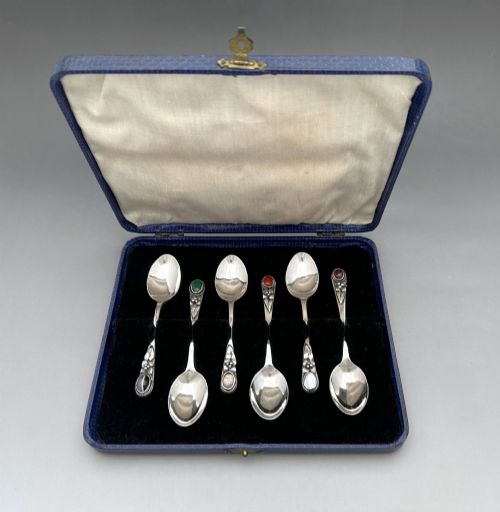
Silversmiths utilised sterling silver and silver gilt for the spoons, frequently applying guilloché or cloisonné enamel to the terminals for added colour. Handles incorporate specialist elements like semi-precious stones, Bakelite, or distinct finial shapes such as bean knops and seal tops.
The protective cases use a wooden or card base lined internally with velvet, satin, or silk, and covered externally with durable leatherette to safeguard the contents during storage and transport.
Some sets feature unusual golf themes and reindeer motifs on the spoons, proving that morning caffeine has long inspired playful design.
Distinctions in Quality
Quality rests on the crispness of the hallmarks, the weight of the silver, and the preservation of the interior lining. Sets featuring undamaged enamel work and original fitted boxes command higher regard among collectors.
Maker reputation heavily influences the standard, with output from renowned silversmiths demonstrating superior finishing and more intricate handle detailing compared to standard commercial productions.
David Andersen·Walker and Hall·Cooper Brothers and Sons·Harry Atkin·Henry Clifford Davis·Turner and Simpson·Arthur Price and Co·Barker Ellis Silver Co·James Dixon and Sons·Bruchmann and Sohne·William Suckling Ltd·Charles Horner·West and Sons
The Cased Silver Coffee Set Glossary
- Demitasse
- A small cup used for serving Turkish coffee or espresso, which dictates the shorter length of the accompanying spoons. These spoons measure roughly half the size of a standard teaspoon.
- Guilloché
- A decorative technique where a precise, intricate pattern is mechanically engraved into the underlying silver before translucent enamel is applied. This creates a shimmering, wavy visual depth beneath the coloured surface.
- Hallmark
- An official stamp applied by an assay office indicating the purity of the metal, the maker, and the year of manufacture. These small stamped symbols provide the primary method for dating British silver.
- Silver Gilt
- Sterling silver that has been coated with a thin layer of gold through an electrolytic or fire-gilding process. This treatment adds a warm golden tone to the bowls or stems of the spoons.
- Bean Knop
- A spoon terminal shaped to resemble a coffee bean, commonly found on twentieth-century demitasse sets. It serves as an ergonomic grip and a decorative motif.
Cased Silver Coffee Set: Frequently Asked Questions
What is a demitasse spoon?
A demitasse spoon is a miniature spoon designed specifically for small coffee cups, measuring significantly shorter than a standard teaspoon.
These pieces form the core of most cased coffee sets from the Edwardian and Art Deco eras.
How should I store a silver set?
Keep the pieces inside their original fitted case in a dry environment away from direct sunlight to protect the velvet or satin lining.
Minimising exposure to air helps prevent rapid tarnish accumulation on the silver surfaces.
Are enamel spoons fragile?
Enamel consists of fused glass powder and can chip or crack if the spoons are dropped or knock firmly against one another.
Gentle handling during use and cleaning preserves the coloured decoration over time.
How do I identify the maker?
Inspect the reverse of the spoon stems for stamped maker's marks alongside the assay office symbol and date letter.
These tiny struck initials correspond to registered silversmiths and manufacturing companies.