
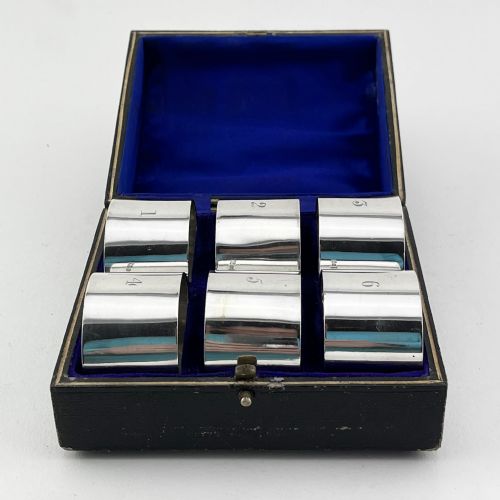


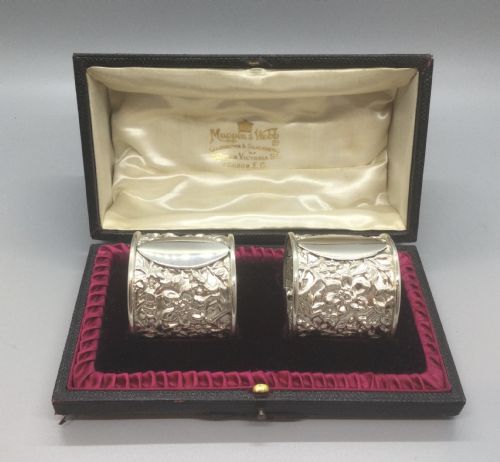
Cased Napkin Ring Set
A cased napkin ring set brings matched silver service to the dining table within a fitted presentation box.
Cased Napkin Ring Set
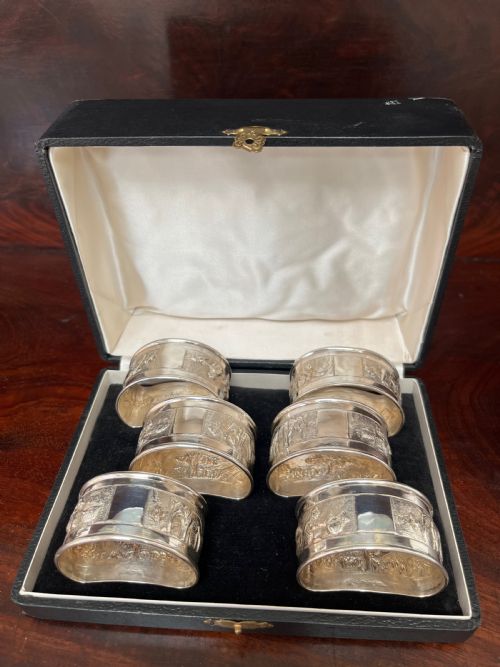
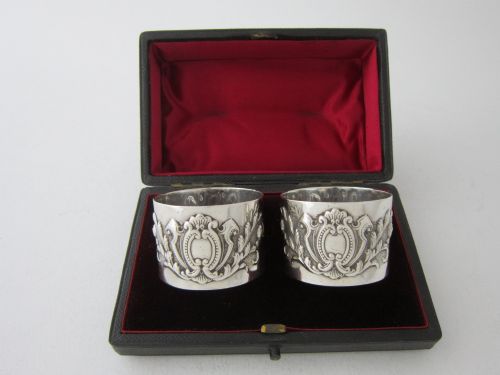
A cased napkin ring set consists of matching silver or silver plated rings housed in a dedicated box designed for safe storage and presentation. Buyers searching for a cased napkin ring set most commonly encounter Victorian, Edwardian, and Art Deco groupings, often containing sets of four, six, or eight matching pieces alongside occasional christening combinations.
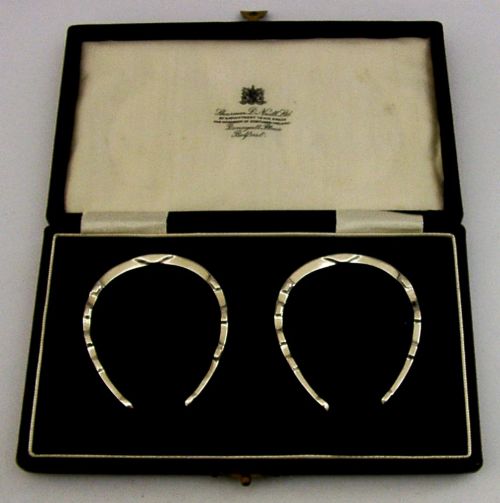
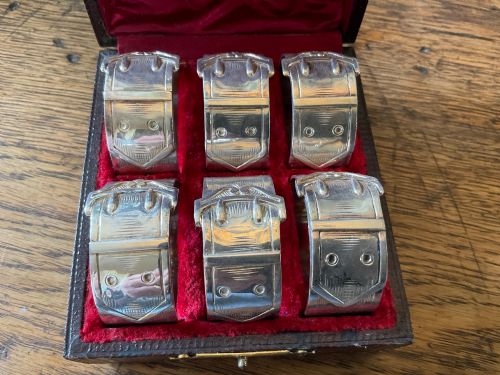
The objects span the nineteenth and twentieth centuries, originating primarily from English silver workshops in cities such as Birmingham, Sheffield, and London. Beyond standard circular bands, forms include engraved ferns, lucky horse shoes, belt buckles, and nautical themes that reflect the stylistic preferences of their period.
Sets frequently include supplementary dining items such as egg cups and spoons within the same fitted enclosure. The survival of the original case remains a primary draw for collectors who value complete domestic sets preserved in their original presentation containers.
How They Were Made
Silver rings were shaped from solid sterling or formed through silver plating onto a base metal, then decorated with hand engraving, applied motifs, or structural modelling such as belt buckles and horse shoes. Maker marks, assay office stamps, and date letters were punched directly into the metal to record the standard of purity and the place of manufacture.
The protective cases were constructed from wood covered in durable leatherette or textured paper, then lined with delicate fabrics like silk, satin, or velvet to cushion the silver rings securely in individual fitted slots.
Some Victorian rings are ingeniously modelled as tiny belt buckles, ready to cinch your napkins tightly.
What Varies In Quality
Quality rests upon the uniformity of the matched set and the integrity of the silver work, distinguishing heavy cast or substantial gauge sterling pieces from thinner plated alternatives. Crispness in hand engraved motifs and deeply struck hallmarks indicate superior craftsmanship.
The condition and completeness of the original fitted presentation box heavily influence desirability, particularly when the interior silk and velvet linings remain intact and undamaged alongside working hinges and clasps.
C.T. Burrows & Sons·Cooper Brothers·Robert Chandler·F.H.Adam & Co·Walker & Hall·Broadway & Co
The Cased Napkin Ring Set Glossary
- Sterling Silver
- A silver alloy containing 92.5 percent pure silver by mass, widely utilised for quality tableware throughout the Victorian and twentieth-century periods.
- Silver Plate
- A base metal coated with a thin layer of silver, commonly found in nineteenth-century matched sets produced for domestic dining.
- Hallmark
- A series of official marks stamped on precious metals by an assay office to indicate purity, maker, and year of manufacture.
- Christening Set
- A specialised presentation grouping combining a napkin ring with matching items like an egg cup and spoon, often given as a traditional gift.
- Leatherette
- A simulated leather material made from a fabric base coated with plastic, frequently used to cover the exterior of twentieth-century presentation boxes.
Cased Napkin Ring Set: Frequently Asked Questions
What periods do these sets come from?
The available pieces span from the nineteenth century through the Victorian, Edwardian, and Art Deco eras up to the mid-twentieth century.
Most surviving examples date from the height of domestic silver production between eighteen-eighty and nineteen-thirty.
How many rings come in a standard set?
Sets commonly contain four, six, or eight matching napkin rings, though pairs and larger groupings of twelve also appear.
Specialised christening sets typically include a single napkin ring alongside an egg cup and spoon.
Why are original cases important?
The original velvet or silk lined boxes provide secure storage and display that preserved the matching rings together over generations.
A surviving fitted case adds historical context and completes the presentation intended by the original retailer.