


Cased Demitasse Spoons
These cased demitasse spoons are small silver sets made for after-dinner coffee, offering fine metalwork preserved in fitted presentation boxes.
Cased Demitasse Spoons
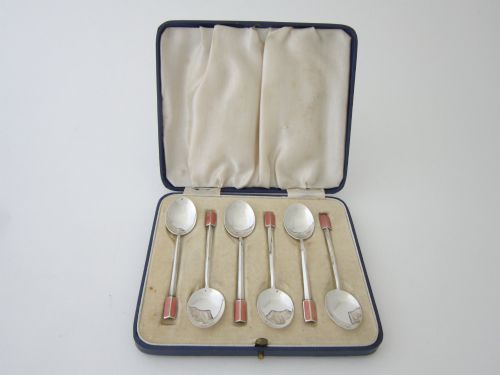
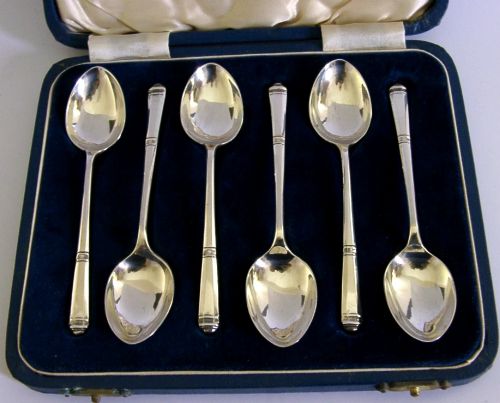
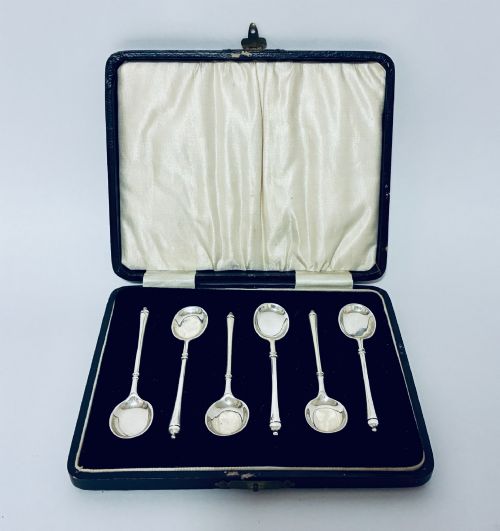
When you search for cased demitasse spoons, you find small sets of flatware designed specifically for after-dinner coffee rather than standard tea use. The pieces on this page appear in matched groups, usually containing six or twelve items housed in their original presentation boxes.
The forms span several decades, ranging from late Victorian and Edwardian examples to bolder Art Deco and mid-century designs. Most sets function as coffee spoons, teaspoons, or specialised silver-gilt pieces accompanied occasionally by matching sugar tongs.
Originating largely from British workshops alongside Scandinavian makers, these sets reflect the formal dining habits of the late nineteenth and early twentieth centuries. The surviving boxes keep the individual spoons protected and complete as a set.
How they were made
The construction relies heavily on sterling silver and silver gilt, shaped into miniature proportions suited for demitasse cups. Many examples incorporate colourful enamel work applied to the bowls or handles, adding visual depth to the metal substrate.
Presentation cases utilise sturdy wooden frames lined internally with materials such as velvet, satin, silk, or leatherette. These fitted interiors secure each spoon in an individual recess, protecting the delicate metal surfaces from wear over generations.
Some sets hide tiny sugar tongs in the box, proving that even the smallest spoons demand a companion for the cubes.
What varies in quality
The standard of a set depends on the crispness of the hallmarking, the weight of the solid sterling silver, and the preservation of any applied enamel. Superior examples maintain intact enamel without chips and retain their original gilding across the spoon bowls.
The fitted case also dictates overall desirability, with original lined boxes featuring intact hinges and undamaged velvet or satin interiors commanding greater interest. Sets that remain entirely complete with their matching components demonstrate higher preservation quality.
David Andersen·Walker and Hall·Cooper Brothers and Sons
The Cased Demitasse Spoons Glossary
- Demitasse
- A small cup used for serving after-dinner espresso or strong coffee. The spoons made for these cups feature miniature bowls and shortened handles.
- Silver Gilt
- Sterling silver that has been coated with a thin layer of gold. This technique provides a warm, rich tone to the interior of the spoon bowls.
- Enamel
- A glassy substance fused to the surface of metal through firing for decoration. It introduces vibrant colour panels to the handles of twentieth-century sets.
- Sterling Silver
- An alloy of silver containing 92.5 percent pure silver and 7.5 percent other metals, usually copper. This standard composition provides the necessary durability for functional cutlery.
- Leatherette
- A simulated leather material used to cover the exterior of presentation cases. It offers a protective and uniform finish for storage boxes.
Cased Demitasse Spoons: Frequently Asked Questions
What are cased demitasse spoons used for?
These small spoons are designed specifically for stirring after-dinner espresso or strong coffee served in diminutive cups. Their reduced scale allows them to fit comfortably into smaller vessels without cluttering the saucer.
Because they were principally produced for formal dining, they spent most of their existence tucked inside protective presentation boxes rather than enduring daily kitchen use.
How do I date a set of spoons?
Dating relies heavily upon the metal hallmarks stamped into the silver, which record the assay office, the specific year of testing, and the maker's mark. Stylistic indicators also help, such as the geometric lines of Art Deco pieces or the flowing motifs of the earlier periods.
The style of the fitted case and the typography used on the interior silk lining provide additional clues to the manufacturing decade.
Are the presentation cases original?
Many sets survive with their fitted boxes, which were custom-made to hold the exact number of spoons included in the original purchase. The interior contours match the profile of the flatware precisely to prevent movement during storage.
Makers often stamped their retail names or crests onto the inside lid satin, confirming the association between the case and the cutlery.
How should I care for silver and enamel?
Silver components require occasional gentle cleaning with a suitable polish to remove tarnishing while preserving the underlying hallmarks. Enamelled surfaces need extra caution, avoiding abrasive cleaners that might scratch the vitreous glass layer.
Storing the pieces within their original lined boxes keeps them protected from dust and airborne pollutants when not on display.