


Cased Coffee Spoon Set
A cased coffee spoon set offers matched flatware nestled within a fitted protective box, combining domestic utility with compact presentation.
Cased Coffee Spoon Set
A cased coffee spoon set consists of smaller-scale spoons, often designed for demi-tasse cups, housed in purpose-built boxes lined with protective textiles. These objects date across the Victorian, Edwardian, Art Nouveau and Art Deco periods, extending into the mid-century era.
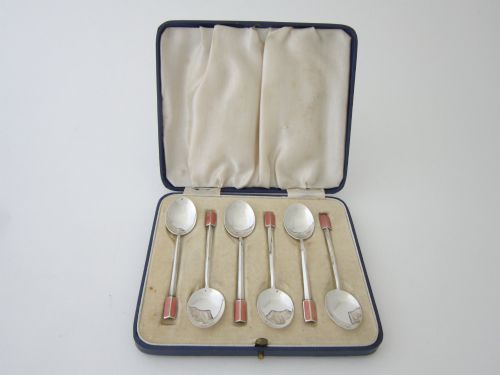
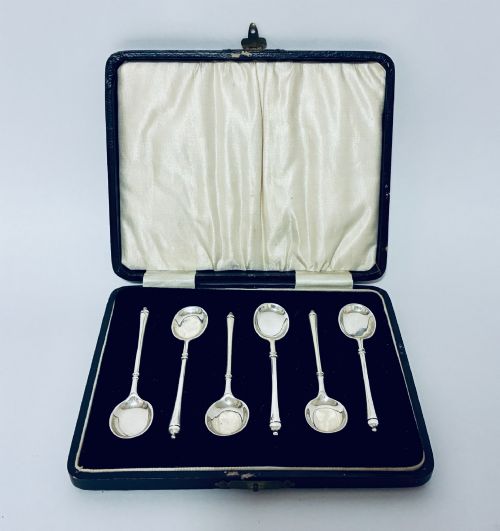
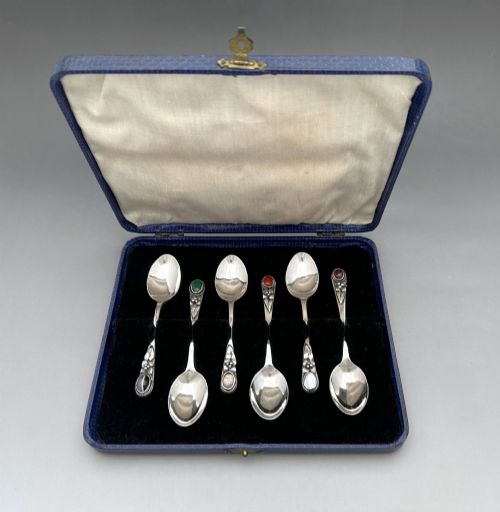
The most common formats found here include sets of six or twelve solid sterling silver spoons, frequently displaying coloured enamel work or parcel-gilt finishes. Form variations encompass bean knops, seal tops, and botanical or geometric motifs.
Originating largely from British silversmithing hubs such as Birmingham, Sheffield, London and Chester, these groupings also incorporate continental European makers. They survive with their original fitted cases intact, preserving both the cutlery and its enclosure.
Materials and construction
The spoons are manufactured primarily from solid sterling silver or silver-gilt, utilising techniques such as casting, pressing, and hand-finishing. Many examples incorporate vitreous enamel, including guilloché and cloisonné variants, applied to the metal surfaces.
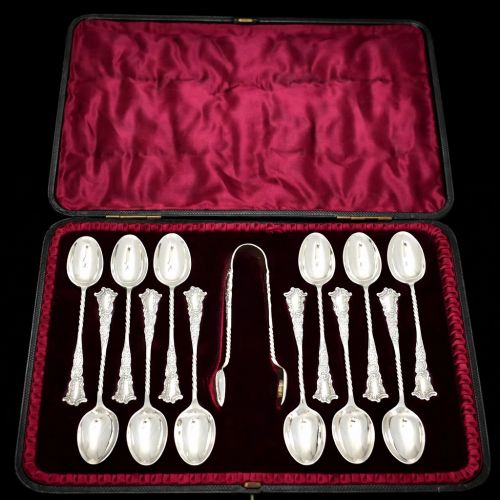
Cases are constructed from sturdy outer frames covered in materials like leatherette, finished internally with fitted linings of silk, satin, or velvet to cradle each individual piece securely.
Distinctions in quality
Quality varies through the execution of the decorative elements, particularly the precision of the enamel work and the crispness of the hallmarking stamps. Hand-painted or multi-layered guilloché designs demonstrate greater artisanal skill than plain silver forms.
The integrity and original condition of the fitted case also influence overall merit, noting whether the internal silk and velvet linings remain clean and the exterior closures function correctly alongside the metalware.
David Andersen·Walker and Hall·Robert Stebbings·Cooper Brothers and Sons·Henry Clifford Davis·Turner and Simpson·Arthur Price and Co·Barker Ellis Silver Co·James Dixon and Sons·Bruchmann and Sohne·Tiffany and Co·William Suckling Ltd·Charles Horner·West and Sons
The Cased Coffee Spoon Set Glossary
- Demi-tasse
- A small coffee cup requiring appropriately scaled spoons. These miniature vessels dictate the reduced proportions of the accompanying cutlery.
- Silver-gilt
- Sterling silver that has been coated with a thin layer of gold. This technique provides a rich, dual-tone appearance across the bowl and stem.
- Guilloché
- A decorative engine-turned technique engraved into metal beneath translucent enamel. It produces repeating geometric patterns that catch the light.
- Bean knop
- A spoon terminal shaped like a coffee bean. This specific terminal design is frequently encountered on twentieth-century examples.
- Leatherette
- A synthetic imitation of leather used to cover exterior case shells. It offers durable protection while mimicking traditional bookbinding finishes.
Cased Coffee Spoon Set: Frequently Asked Questions
What is a cased coffee spoon set used for?
These sets are designed for stirring after-dinner coffee served in small cups, where standard teaspoons prove too large. The compact size of the spoons suits restricted cup dimensions.
Beyond functional dining use, the inclusion of a fitted presentation box indicates they were frequently purchased as presentation gifts for weddings, anniversaries, or domestic milestones.
How do I date a set?
Dating relies heavily upon the hallmarks stamped into the silver, which record the assay office, date letter, and maker's mark. Stylistic indicators like Art Deco geometry or Art Nouveau organic lines provide additional chronological context.
The materials used for the internal box linings and the overall typographic style of the maker's stamp inside the lid also assist in establishing the decade of manufacture.
Are all the spoons solid silver?
Most pieces recorded here are fashioned from solid sterling silver, often indicated by specific standard marks such as the lion passant. Some variations feature silver-gilt surfaces or German silver compositions.
Enamelled sections use silver as a base substrate for the vitreous glass coatings, while the structural boxes utilise wood or card covered in leatherette and lined with silk or velvet.
How should I store and display my set?
Keeping the spoons inside their original fitted case protects the metal from excessive tarnishing and prevents the pieces from scratching against one another. Store the box in a stable environment away from direct sunlight and damp conditions.
Displaying the set involves keeping the case closed when not admired, as prolonged exposure to ambient air accelerates the oxidation of silver surfaces.