

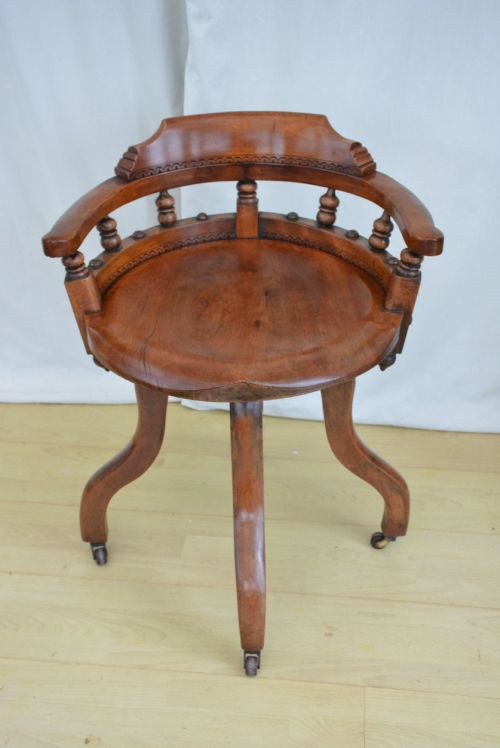
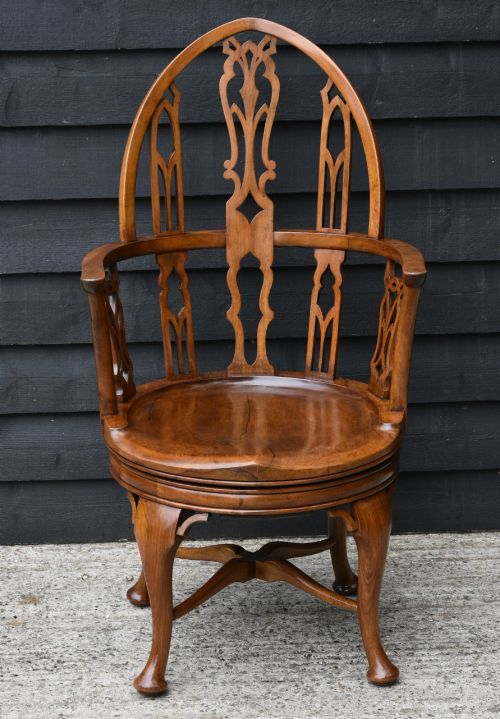
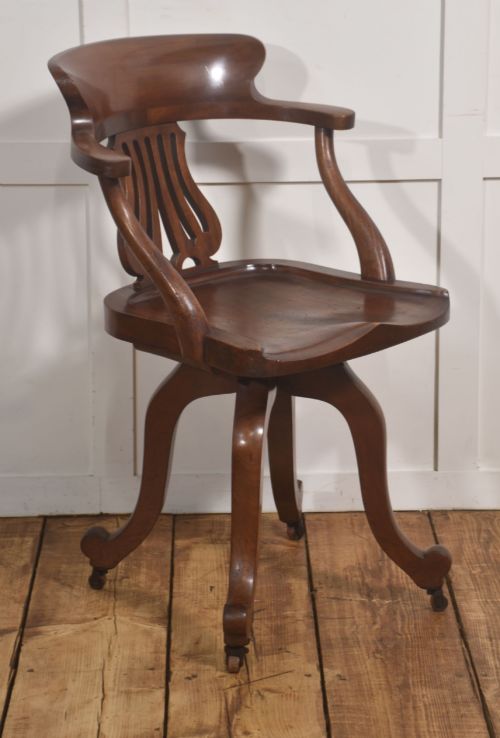
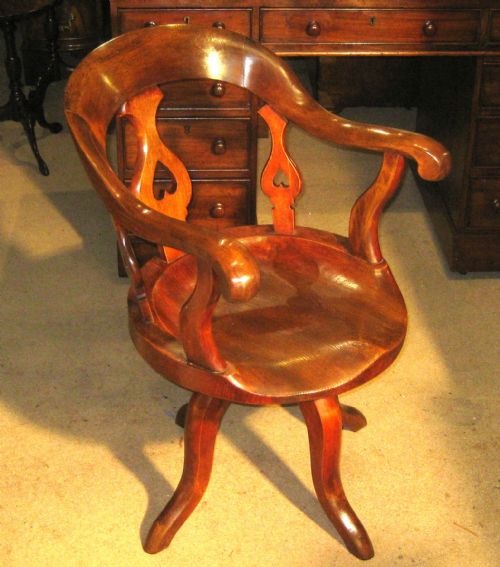
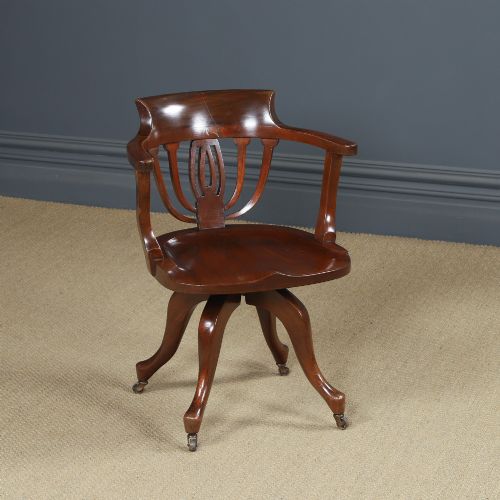
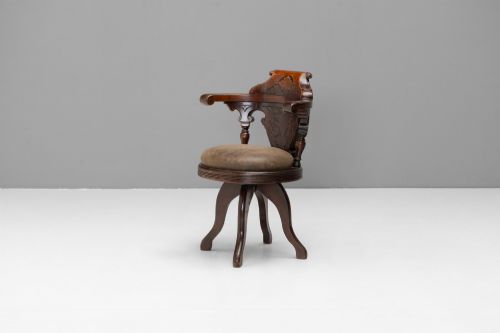


Carved Wood Swivel Chair
A carved wood swivel chair brings movement and solid craft to a desk or music room, joining utility with rotation.

Carved Wood Swivel Chair
A carved wood swivel chair sits on a revolving mechanism, merging the function of a desk chair or piano stool with mobility. The examples on this page span the Victorian, Edwardian, and Georgian periods, alongside William IV and Arts and Crafts pieces.
Most items appearing under this search are revolving desk chairs, music stools, or piano stools constructed in mahogany, walnut, rosewood, and oak. Forms range from simple revolving seats to heavily carved ships chairs and grotto stools.
Origins stretch from English workshops to Anglo-Burmese colonial production, showing varied levels of carving from plain turned pillars to elaborate floral and structural decoration.
Materials and construction
Makers utilised dense timbers such as mahogany, rosewood, walnut, and oak to withstand the rotational stress placed on a swivel base. These hardwoods were turned, joined, and intricately carved by hand, often incorporating brass and iron mechanisms to enable smooth 360-degree rotation.
Upholstery materials like leather, velvet, and various fabrics were integrated into seats, sometimes paired with adjustable height screws and iron column supports. The combination of heavy timber frames with metal screw threads allowed the upper portion to rise and fall while remaining anchored.
Carved Wood Swivel Chair Retail Price Guide 2026
Typical asking prices for carved wood swivel chair among the pieces listed under this phrase on Sellingantiques today, from the lower quarter to the upper quarter. They describe what is for sale here now, not the wider market.
Listings span from the Georgian era through Victorian and Edwardian periods, utilising mahogany, rosewood, walnut, oak, brass, and iron.
Assessing quality and build
The distinction between standard utility seating and exceptional pieces lies in the crispness of the timber carving and the robustness of the revolving mechanism. Superior pieces exhibit deeply moulded wood, robust joinery, and smooth mechanical action that maintains stability at any height.
Finer examples integrate quality secondary materials like heavy brass fittings, robust iron screws, and well-preserved original leather or velvet upholstery. Lesser pieces may show wear in the central screw thread or simpler, flatter turnings on the legs and column.
Jennens & Bettridge·SHOOLBRED·George Bartholomew & Co.
The Carved Wood Swivel Chair Glossary
- Revolving
- Turning around an axis or centre point. This mechanism allows the user to rotate fully without moving the base of the chair.
- Piano Stool
- A seat designed specifically for keyboard players, often featuring an adjustable height screw. Many examples in this category share the swivel function.
- Padouk
- A durable tropical hardwood with a reddish hue. It appears in colonial pieces such as harpist chairs.
- Grotto Stool
- A heavily carved seat style taking inspiration from natural shell and rock motifs. These ornate pieces often feature intricate woodwork.
- Adjustable Height
- A seat mechanism operated by a central screw thread that raises or lowers the user. This feature is common in music and desk seating from the nineteenth century.
Carved Wood Swivel Chair: Frequently Asked Questions
How do I adjust the height on these chairs?
Most antique swivel chairs use a central wooden or iron screw thread concealed beneath the seat. Turning the upper portion clockwise or anticlockwise raises or lowers the seating platform.
Ensure the mechanism is clean and free of debris to allow the screw to move smoothly without straining the surrounding timber joints.
Were these designed for desks or pianos?
The listings include both forms, serving distinct domestic and professional rooms. Desk chairs usually feature backrests and arm support for sustained writing, while piano and music stools are typically backless to allow freedom of arm movement.
Both types utilise the same core revolving mechanism, though music stools frequently incorporate height-adjustment screws for player comfort.
How do I care for the swivel mechanism?
Keep the central screw and pivot points clean, applying a small amount of appropriate lubricant to metal threads if movement becomes stiff. Avoid forcing the rotation if the mechanism binds.
Regular dusting and occasional treatment of the surrounding wood with suitable wax will preserve both the movement and the timber finish.