


Carved Walnut Salon Suite
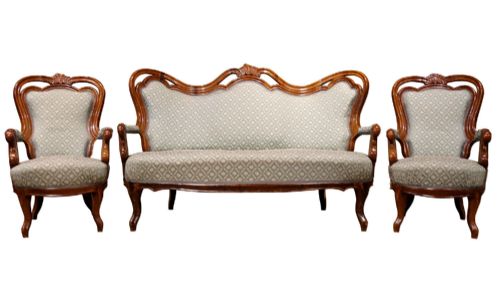
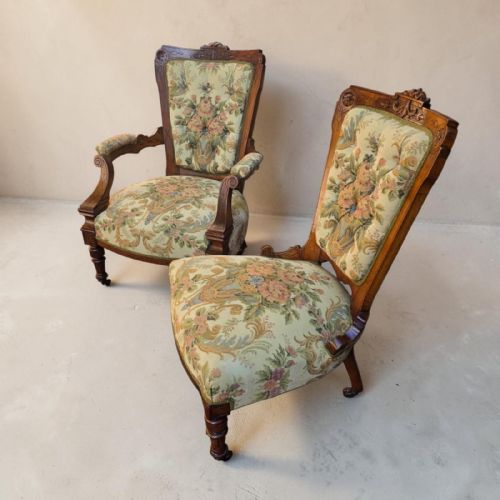
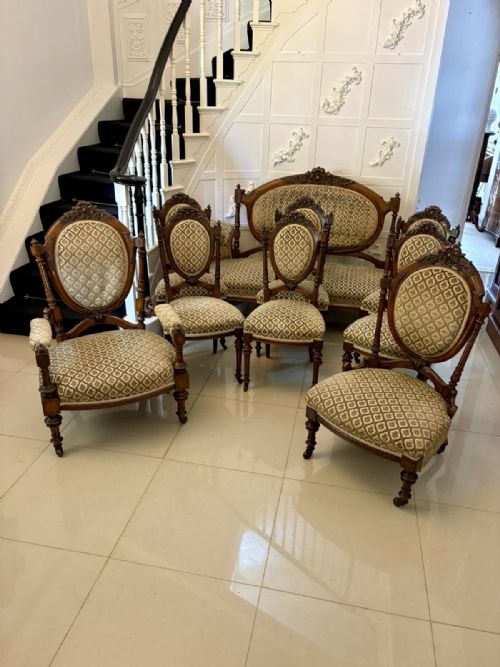
A carved walnut salon suite brings formal Victorian and continental reception rooms to life with matching timber seating.
Carved Walnut Salon Suite
A carved walnut salon suite comprises matching groups of drawing room and parlour seating designed for formal entertaining. You will encounter configurations ranging from pairs of his and hers armchairs up to extensive multi-piece sets containing sofas and numerous side chairs.
The prevailing styles on this page span Victorian and continental revivals including Rococo, Louis XV, Louis XVI, Empire, and Egyptian Revival. These suites date primarily from the nineteenth century through to the early twentieth century.
Forms include settees, small sofas, cameo back chairs, and lounge suites tailored for drawing rooms. Some selections arrive complete with footstools or require re-upholstery to restore their original grandeur.
How they were made
Cabinet makers utilised solid walnut timber to form the structural frames, allowing for deep and intricate relief carving along the crest rails and cabriole legs. Metal components and brass hardware occasionally provide structural support or decorative accents within the joinery.
Upholstery forms a vital component of the construction, employing traditional textiles such as velvet, damask fabric, and cane panelling. Button back detailing and parcel-gilt highlights frequently finish the surface work on finer continental and French examples.
Listings feature walnut timber, textiles, brass, velvet, cane, and damask fabric across Victorian, Rococo Revival, and Empire Revival styles.
What varies in quality
The depth and crispness of the timber carving separate standard parlour sets from exhibition quality suites. Sculpted details such as lion paw feet or elaborate crests demonstrate superior craftsmanship by the cabinet maker.
The scale and completeness of the suite dictate its architectural presence within a room. Larger groupings comprising sofas alongside matched sets of armchairs and side chairs represent more substantial commissions than isolated pairs of chairs.
The Carved Walnut Salon Suite Glossary
- Salon suite
- A matching collection of seating furniture intended for formal reception rooms. These suites typically include a settee or sofa accompanied by several armchairs and side chairs.
- Cameo back
- An upholstered chair back shaped to resemble a carved stone cameo, often oval or cartouche-form. This profile is frequently bordered by carved walnut timber work.
- Rococo Revival
- A nineteenth-century design movement drawing on eighteenth-century French motifs. It is characterised by asymmetrical curves, naturalistic scrollwork, and floral carved walnut.
- Damask
- A reversible figured fabric traditionally utilised for heavy upholstery. It provides the decorative textile finish seen on many period drawing room suites.
- Parcel-gilt
- Partially gilded woodwork where gold leaf is applied selectively to highlight specific carved details. This technique enhances the decorative contrast against the dark walnut grain.
Carved Walnut Salon Suite: Frequently Asked Questions
What is a salon suite?
A salon suite is a matched group of drawing room or parlour seating designed for formal entertaining. These groupings typically comprise a settee or small sofa paired with armchairs and side chairs.
Such suites allowed nineteenth-century households to furnish a reception room in a unified aesthetic. They range from modest two-piece pairings up to extensive multi-piece collections.
How do I date a walnut suite?
Dating relies on stylistic revival cues, construction techniques, and documented periods such as Victorian or early twentieth century. Rococo and Egyptian Revival influences point to specific design decades within the Victorian era.
Examining the timber frame construction and upholstery style helps establish the manufacturing period. Walnut was utilised extensively across the nineteenth and early twentieth centuries for these formal seating groups.
Where were these suites placed?
These seating groups were positioned in formal drawing rooms, parlours, and salons for receiving guests. The arrangement of sofas and matching chairs facilitated polite conversation.
Larger nine or eleven-piece suites suited expansive Victorian drawing rooms. Smaller three-piece suites accommodated more intimate parlour settings.
What styles are common?
Victorian, Rococo Revival, Louis XV, Louis XVI Revival, Empire Revival, and Egyptian Revival dominate the available styles. These designs reflect historical European revivals adapted by nineteenth-century makers.
Carved walnut frames paired with velvet, damask, or cane define the aesthetic across these diverse revivals. French influences appear frequently in the lighter parcel-gilt and pale walnut configurations.
Can I reupholster these chairs?
Many suites require re-upholstery to refresh worn textiles or to match specific interior schemes. Certain listings specifically offer chairs intended for re-upholstery.
Preserving the original frame and traditional padding methods ensures the structural integrity remains intact. New damask or velvet upholstery can restore the seating to its original formal appearance.