
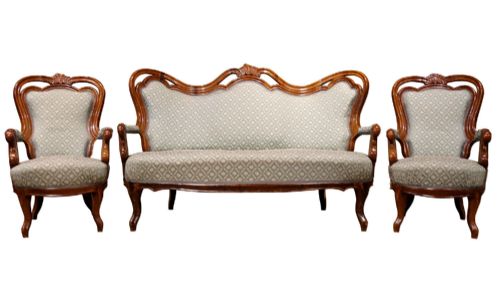
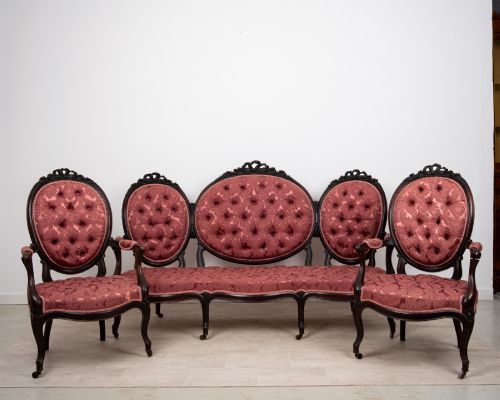
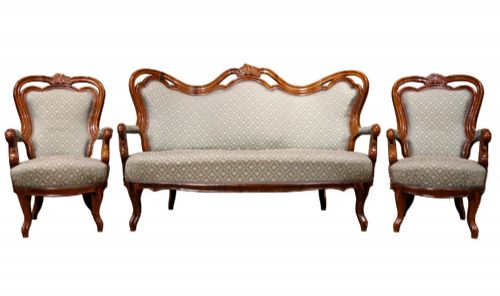


French Salon Sofa Set
A french salon sofa set brings unmatched elegance to a room, offering matched seating with period charm.
French Salon Sofa Set
A french salon sofa set comprises a matching arrangement of seating, typically pairing a small sofa or settee with matching armchairs designed for formal reception rooms. These suites range from three-piece configurations to larger seven-piece collections originating across the nineteenth and early twentieth centuries.
The aesthetic draws heavily on historical revivals, with pieces adhering to Rococo, Louis XV, Louis XVI, and Empire styles. Walnut, mahogany, and giltwood form the structural foundation of these matching groups.
Buyers frequently encounter three-piece walnut configurations featuring carved frames and upholstered seating. Larger five-piece and seven-piece suites appear less often but offer complete period arrangements.
How they were made
Cabinetmakers shaped solid timber frames from walnut, mahogany, beech, and giltwood using traditional joinery methods. Artisans carved intricate details into the wooden structures, reflecting revival aesthetics from the nineteenth century.
Upholstery techniques involved traditional stuffing and springs covered in textiles such as silk damask, tapestry, and deep-buttoned fabrics. These materials were secured directly to the frames to create formal seating.
Listings feature pieces spanning the nineteenth and early twentieth centuries, constructed from walnut, mahogany, beech, and giltwood.
What varies in quality
The refinement of the carved woodwork dictates the overall grade of a suite, with crisper hand-carved details and superior timber selection elevating the piece. Heavier giltwood applications and intricate frames denote higher workshop standards.
The integrity of the matching upholstery and the cohesion of the suite components determine its standing. Complete sets showing uniform wear and original textile types retain greater stylistic harmony.
The French Salon Sofa Set Glossary
- Giltwood
- Timber treated with a thin layer of gold leaf or gilt finish. This technique highlights carved details on formal nineteenth-century frames.
- Damask
- A reversible figured fabric traditionally woven from silk or wool. It frequently appears as the primary upholstery material on revival salon seating.
- Salon Suite
- A matched collection of furniture designed for a formal reception room. It typically includes a settee paired with several armchairs.
- Rococo Revival
- A nineteenth-century design movement mimicking eighteenth-century French styles. It is characterised by asymmetrical curves and naturalistic floral carvings.
French Salon Sofa Set: Frequently Asked Questions
What is included in a salon suite?
A salon suite typically consists of a matching settee or small sofa accompanied by matching armchairs. The number of pieces varies from three-piece configurations up to larger five-piece and seven-piece arrangements.
These collections were designed to provide uniform seating for formal entertaining in nineteenth-century reception rooms.
How do I identify the revival style?
Revival styles reflect specific historical periods through distinct decorative motifs carved into the wood. Rococo and Louis XV styles feature flowing curves, while Louis XVI pieces display straighter, neoclassical lines.
Empire revival furniture incorporates heavier proportions and classical ornamentation derived from nineteenth-century interpretations.
Where were these suites used?
These seating groups were traditionally placed in formal reception rooms, parlours, and drawing rooms of grand houses. They served as primary seating for receiving guests and social gatherings.
Today, buyers frequently utilise them in modern living rooms and conservatories to add historical character.
What woods are commonly used?
Walnut and mahogany form the primary structural timbers found in nineteenth-century salon furniture. Pale walnut and beech also appear frequently across French revival pieces.
Giltwood frames provide an alternative finish where the timber surface is gilded for a decorative appearance.