
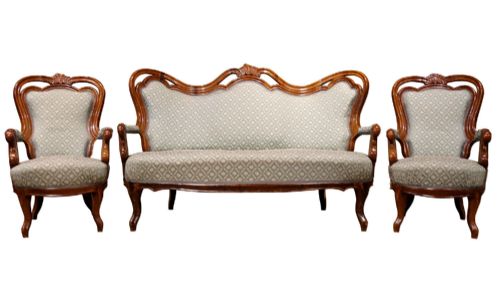
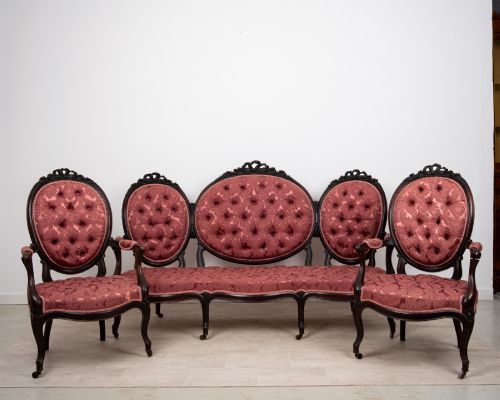
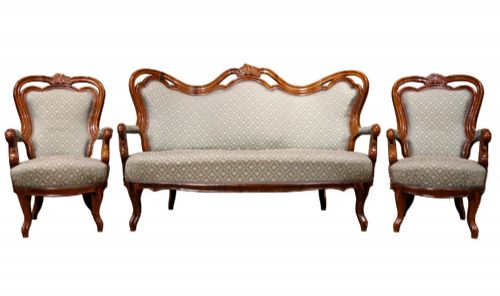


French Settee and Armchairs
These French settee and armchairs groupings bring coordinated seating to a room, offering matched woodwork and upholstery designed for formal or everyday reception spaces.
French Settee and Armchairs
A french settee and armchairs grouping combines matching seats into a unified salon suite, typically comprising a small sofa alongside two or more matching chairs. These seating arrangements appear in various historical iterations, ranging from ornate nineteenth-century revival designs to geometric twentieth-century interpretations.
Buyers frequently encounter three-piece configurations featuring a settee paired with a pair of armchairs, constructed from woods like walnut, mahogany, and beech. Styles span from Rococo Revival and Louis XVI to Art Deco and French Empire, reflecting the aesthetic preferences of their respective periods.
What Varies in Quality
The precision of the wood carving and the choice of primary timber establish the baseline of a suite's refinement. Finer sets display crisp detailing in gilt-wood or figured walnut, whereas simpler iterations rely on plain painted finishes or standard mahogany.
Cohesion across the suite determines its overall success, as matched grain patterns and uniform upholstery details unite the settee and its companion armchairs into a singular composition.
Even chairs need company, which explains why centuries of makers insisted on introducing sofas to their lonely armchairs.
Baumann
The French Settee and Armchairs Glossary
- Salon suite
- A coordinated set of seating furniture designed for a reception room, usually containing a settee and multiple matching armchairs. These suites ensure visual harmony within formal domestic interiors.
- Canapé
- A traditional French term for a small sofa or settee, often sharing design motifs with accompanying armchairs. They frequently feature exposed wooden frames and upholstered backs.
- Gilt-wood
- Timber coated with a thin layer of gold leaf or gilt paint for decorative emphasis. This finish appears commonly on formal revival seating from the nineteenth century.
- Marquetry
- Decorative woodwork where small pieces of veneer form patterned designs on the surface. This technique adds pictorial interest to the structural frames of select suites.
- Bentwood
- Wood softened through steaming and then bent into curved structural forms. This method defines specific twentieth-century seating designs.
French Settee and Armchairs: Frequently Asked Questions
What pieces are included in a salon suite?
A salon suite typically includes a central settee or small sofa paired with matching armchairs. The exact count varies, ranging from three-piece arrangements up to larger sets with five or seven pieces.
These coordinated groupings were built to furnish reception rooms with matching woodwork and upholstery. Each component shares stylistic traits like carved frames or specific wood types.
How do I identify a Louis XVI style suite?
Louis XVI style seating is distinguished by straight, fluted legs and symmetrical geometric framing. The silhouettes often incorporate neoclassical ornamentation rather than the curved lines of earlier rococo designs.
Craftsmen working in this tradition utilised polished hardwoods or gilt surfaces. The resulting forms feel restrained and architectural compared to elaborate nineteenth-century revivals.
Where were these seating suites used historically?
These seating groups were placed in formal reception rooms, drawing rooms, and parlours for entertaining guests. They provided unified seating arrangements designed to impress visitors.
Today, they serve similar decorative and functional roles in large living spaces. Their coordinated nature helps anchor the design scheme of a room.
What is the difference between walnut and beech frames?
Walnut offers a rich, figured grain that is often left polished or waxed to highlight its natural pattern. It appears frequently in fine nineteenth-century salon suites.
Beech is a dense hardwood that provides strong structural support while remaining receptive to painted finishes or gilding. It was commonly selected when the final surface was intended to be opaque rather than showing bare wood.