

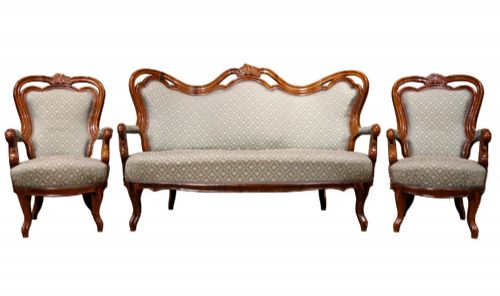


French Upholstered Suite
A french upholstered suite brings unmistakable continental formality to a principal reception room through matched seating.
French Upholstered Suite
A french upholstered suite comprises matched groups of seating, typically uniting a settee or small sofa with armchairs, designed for formal reception rooms.
Buyers seeking this phrase encounter multi-piece salon sets spanning the nineteenth century into the early twentieth century, incorporating walnut, giltwood and mahogany frames.
The configurations range from intimate three-piece groupings of a small sofa and two armchairs to extensive dining sets and seven-piece parlour arrangements in revival styles.
Materials and construction
Frames are constructed from sturdy timbers including walnut, mahogany and giltwood, often shaped with hand-carved ornamentation reflecting Louis XVI, Empire or Rococo aesthetics.
Upholstery relies on traditional textiles such as silk damask, patterned fabric and standard damask, secured with brass detailing where appropriate to the period.
Some nineteenth-century suites include ribbon decoration carved directly into the wooden crest rails to charm visitors.
Determining quality
Quality rests in the crispness of the frame carving, the structural integrity of the walnut or giltwood, and the harmony between the woodwork and the textile choice.
Comprehensive suites displaying matching upholstery across numerous chairs command attention over assembled groupings, particularly when retaining original silk damask or precise marquetry inlay.
Baumann
The French Upholstered Suite Glossary
- Bergère
- An enclosed upholstered armchair with wooden framing, frequently seen in pairs within nineteenth-century salon groupings. It offers deep, comfortable seating compared to upright parlour chairs.
- Giltwood
- Timber treated with gold leaf or gilt preparation to create a brilliant decorative surface. This finish defines many formal salon suites from the nineteenth century.
- Louis XVI Style
- A neoclassical design aesthetic characterised by straight tapered legs, geometric symmetry and restrained classical carving. It appears frequently across nineteenth-century seating suites.
- Duchesse Brisée
- A multi-part daybed or chaise longue arrangement, sometimes split into components forming a three-piece set. It allows for reclining within a formal reception room setting.
- Damask
- A reversible figured fabric traditionally woven in silk or wool, commonly utilised for upholstering grand salon furniture. Its patterned surface catches the light in formal interiors.
French Upholstered Suite: Frequently Asked Questions
How do I clean the fabric?
Maintenance depends entirely on the textile used, with silk damask requiring specialist care rather than standard domestic cleaning methods.
Regular gentle brushing prevents dust accumulation in the carved wooden recesses and textured fabric weaves.
Where were these suites placed?
These seating groups traditionally furnished principal drawing rooms, salons and formal parlours where guests were received.
They provided cohesive arrangements of settees and armchairs designed for conversation and social display.
Can I mix these with modern furniture?
Placing a historic salon suite within a contemporary interior creates a striking contrast between ornate woodwork and minimal surroundings.
The neutral tones of walnut and giltwood frames allow them to anchor modern living spaces effectively.
What defines Louis XVI style?
This style shifts away from curved rococo excesses towards straight lines, fluted columns and neoclassical symmetry.
Seating frames from this aesthetic feature disciplined proportions and architectural carving details.
How many pieces make a suite?
A standard grouping often consists of three pieces, combining a settee with two matching armchairs.
Larger configurations extend to five or seven pieces, and occasional dining sets comprise dozens of matching chairs.