

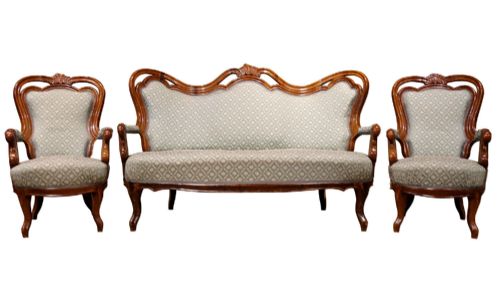
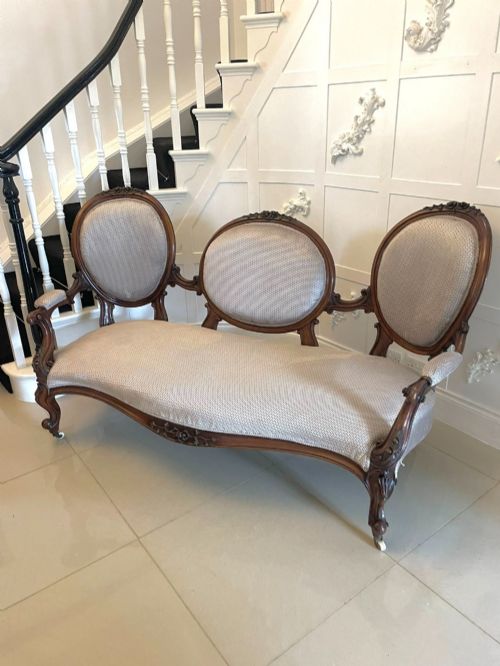
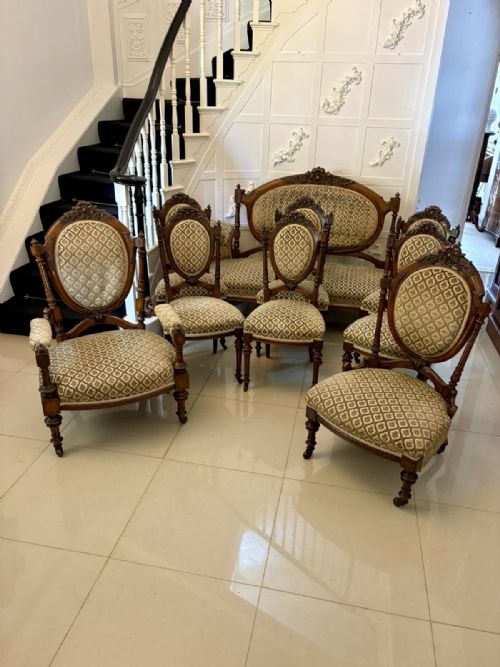



Carved Walnut Salon Sofa
A carved walnut salon sofa brings together rich timber and elaborate upholstery, offering a grand seat for a formal parlour.
Carved Walnut Salon Sofa
Most examples hail from the Victorian era and the late nineteenth century, spanning decades from eighteen-forty through to the early nineteen-twenties. Continental and French influences shape many of these items, displaying Rococo Revival and Louis XV design vocabularies. Buyers frequently encounter pieces upholstered in damask, velvet, or contemporary textile fabrics that complement the carved wooden frames.
Materials and construction
The primary structural timber is walnut, selected for its strength and suitability for intricate hand carving along the crest rails, frames, and cabriole legs. Artisans shaped this wood to form curvaceous frames, sometimes incorporating details such as lion paw feet or cameo backs. Metal elements like brass occasionally appear within the hardware or structural reinforcement of the suites.
Upholstery forms a vital component of the construction, utilising materials such as velvet, damask fabric, and standard textile upholstery. These soft coverings are secured over padded foundations within the walnut framework, transforming a wooden bench into a comfortable salon seat.
The inventory encompasses single settees as well as expansive multi-piece drawing room suites including footstools and side chairs.
Distinguishing quality in walnut seating
Quality rests significantly upon the depth, crispness, and ambition of the timber carving across the frame. Pieces featuring elaborate flourishes, well-defined motifs, and balanced proportions on the arms and legs stand apart from simpler iterations.
The integrity of the walnut timber and the quality of the chosen upholstery fabric dictate the overall standing of a piece. Suites that retain matching fabric or high-grade damask alongside sound wooden frames represent the upper tier of surviving examples.
The Carved Walnut Salon Sofa Glossary
- Canapé
- An upholstered French sofa or settee featuring an exposed wooden frame. This form typically displays curved lines and decorative carving common in period salon furniture.
- Cameo back
- A chair or sofa back shaped like a medallion or cameo, bordered by carved wooden framing. It is a frequent feature on mid-nineteenth-century Victorian seating.
- Rococo Revival
- A nineteenth-century design movement inspired by the French Rococo style of the eighteenth century. It utilises asymmetrical scrolls, naturalistic plant motifs, and C-scrolls in the walnut carving.
- Double end settee
- A sofa style with scrolled or raised ends at both sides rather than a traditional back and single arm arrangement. These pieces allow a sitter to recline from either direction.
- Salon suite
- A matching set of drawing room or parlour furniture comprising a sofa or settee alongside a number of armchairs and side chairs. They were created en suite to furnish formal reception rooms uniformly.
Carved Walnut Salon Sofa: Frequently Asked Questions
Where were these sofas placed originally?
These pieces sat in formal drawing rooms, parlours, and reception spaces where hosts entertained guests. They served as the central seating option during social calls.
Over time, owners moved them into private sitting rooms or bedrooms as domestic fashions shifted towards comfort over strict formality.
How do I identify a French influence?
French influence appears through characteristic stylistic revivals such as Louis XV and Rococo Revival forms. Look for sweeping cabriole legs and flowing scrollwork.
These designs emphasise lightness and curving asymmetry compared to heavier, rigid structural traditions.
Can I use these sofas daily?
These items were built for formal entertaining rather than heavy lounging, requiring a considerate approach to daily use. The antique frames and historic upholstery demand gentle treatment.
Placing them out of direct sunlight helps protect both the walnut timber and the delicate textile coverings.
What is a salon suite?
A salon suite is a matched group of seating furniture designed to create a cohesive interior scheme. A typical grouping includes a settee accompanied by matching armchairs and side chairs.
These suites ensure uniform style and wood finish across all the main seats in a reception room.