
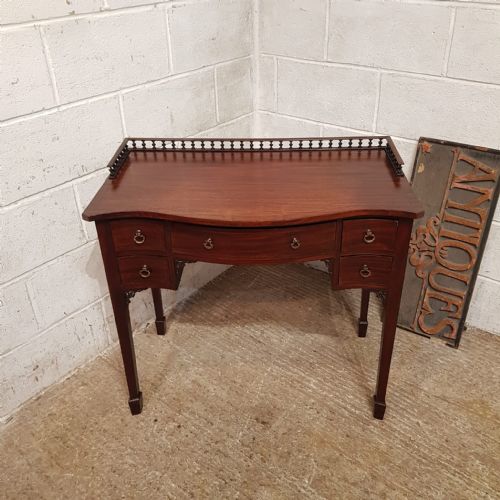
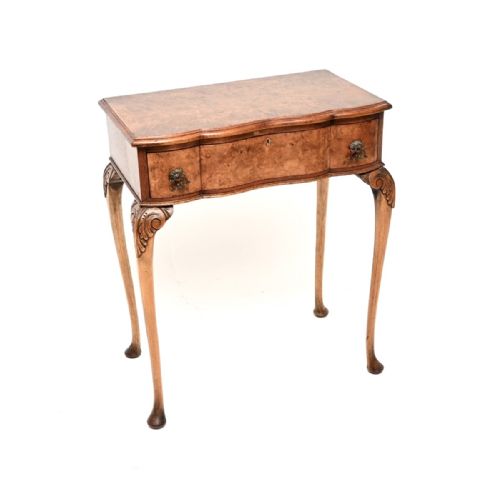


Carved Serpentine Desk
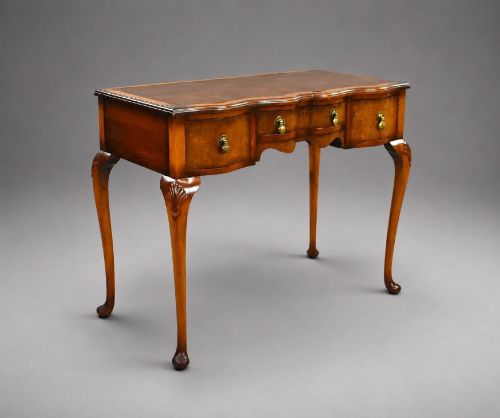
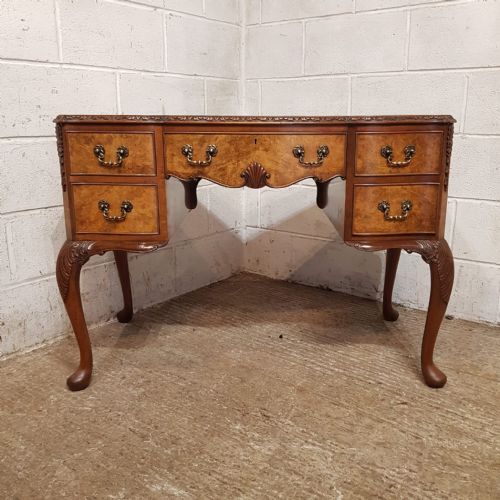
A carved serpentine desk brings an undulating, sculptural outline to a room, offering both practical workspace and striking period character.
Carved Serpentine Desk
The versions most commonly met on this page date from the Victorian, Edwardian, and early twentieth-century periods, alongside revivals spanning Georgian and Chippendale styles. These pieces range from twin-pedestal workspaces to compact writing tables, frequently paired with carved details and leather writing surfaces.
How they were made
Cabinet makers constructed these desks using dense hardwoods like mahogany, walnut, and burr walnut, often selecting figured veneers to accentuate the sweeping curves of the serpentine front. Solid timbers were carefully shaped and joined to support the undulating profile without warping.
Secondary materials such as brass for hardware and leather for inset writing surfaces were integrated into the construction. Carving was applied by hand to mouldings, drawer edges, and pedestals, aligning with the prevailing Victorian Rococo revival or Chippendale styles.
Listings feature periods from the Georgian era through to the 1930s, constructed in mahogany, walnut, burr walnut, and rosewood.
What varies in quality
Execution of the curves is vital, as achieving a clean, symmetrical serpentine sweep requires supreme carpentry skill. Finer examples maintain structural integrity and harmonious proportions across large partners formats, whereas simpler iterations show plainer secondary woods and minimal ornamentation.
The Carved Serpentine Desk Glossary
- Serpentine
- A furniture front characterised by three curves, a convex centre flanked by two concave ends, creating a wave-like profile. This outline requires precise woodworking to shape timber smoothly.
- Partners desk
- A large freestanding desk designed with drawers and cupboards on both sides, allowing two people to work opposite one another. These often feature substantial carved mahogany or burr walnut construction.
- Kneehole desk
- A compact writing desk featuring a central recessed space for the legs, flanked by pedestals of small drawers. They frequently incorporate serpentine fronts and leather-lined tops.
- Burr walnut
- A highly prized timber veneer showing swirling, knotty grain patterns harvested from the growth excrescences of walnut trees. It is frequently utilised on tabletops and drawer fronts for decorative impact.
- Chippendale revival
- A late nineteenth and early twentieth-century design movement replicating or reinterpreting the mid-eighteenth-century furniture styles of Thomas Chippendale. Pieces in this style often display elaborate carved mahogany details.
Carved Serpentine Desk: Frequently Asked Questions
What is a serpentine front?
A serpentine front is an undulating furniture edge defined by a convex centre section curving outward, flanked by two concave sections curving inward. This distinct shape creates a dynamic, flowing visual rhythm across the face of a desk or table.
Cabinet makers used this design to soften rigid rectangular silhouettes, though cutting and fitting timber to these curves required advanced woodworking skill.
How do I identify a partners desk?
A partners desk is built to be accessed from both sides, featuring matching sets of drawers, cupboards, or kneeholes facing opposite directions. They are typically larger than standard single-sided writing desks and were originally designed for business colleagues or banking partners.
Look for finished panelling or duplicate drawer configurations on the reverse side to confirm this dual-working format.
Where should I place a freestanding desk?
A freestanding desk is designed to sit away from walls, allowing all four sides to be visible in the middle of a study or library. Because the back and sides are finished with the same attention to detail as the front, it functions well as a central room anchor.
Ensure there is sufficient clearance around the desk for chairs and movement, particularly with larger pedestal models.
What woods were used for these desks?
Cabinet makers predominantly utilised mahogany and walnut, frequently selecting figured varieties or burr walnut veneers for enhanced visual texture. Secondary woods like oak or pine were sometimes used for internal drawer construction.
Leather was also commonly inlaid into the top surface to provide a smooth writing plane.
How do I care for leather desk inserts?
Leather desk inserts require gentle dusting and occasional conditioning with appropriate leather balms to prevent drying and cracking. Avoid using harsh chemical cleaners or excess moisture, which can stain the hide and damage the surrounding wood.
Keeping the surface protected from direct sunlight helps preserve the colour and supple texture of the leather.