

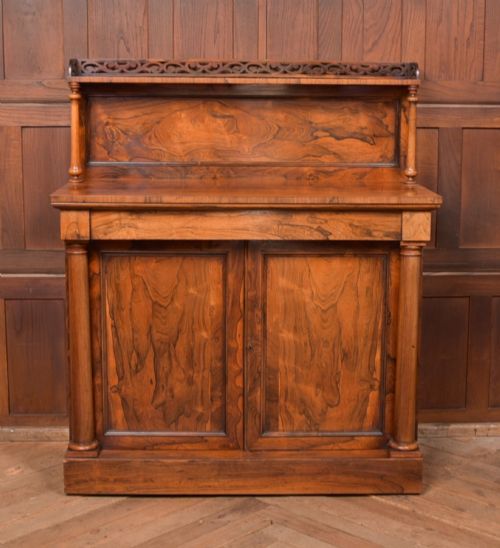


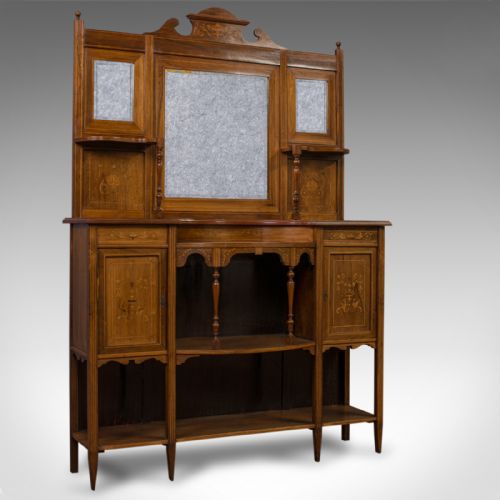


Carved Rosewood Server
A carved rosewood server brings dense tropical timber and deep relief work into a dining room or hall, offering substantial storage and a commanding visual anchor.
Carved Rosewood Server
When you search for a carved rosewood server, you encounter forms that overlap with chiffoniers, sideboards, and console tables from the nineteenth century. These pieces serve as functional furniture for dining rooms and libraries, providing surface display and enclosed storage.
The versions most likely to appear on this page span the Regency, William IV, and Victorian eras, along with Anglo-Indian interpretations. They combine heavy timber construction with elaborate carving, sometimes featuring marble tops or mirrored backs.
Makers across nineteenth-century Britain and colonial workshops produced these items to suit formal interiors. They range from compact chiffoniers to broad sideboards and library tables.
How they were made
Carpenters utilised dense tropical hardwoods, specifically rosewood and palisander, often complemented by secondary timbers like boxwood for inlay. These heavy woods required precise joinery to support marble tops and mirrored components without warping.
Carvers applied deep relief work directly to the solid timber, executing floral and geometric motifs by hand. Brass fittings and glass elements were integrated into doors and backsplashes to complete the construction.
Makers occasionally hid compartments behind carved rosewood panels, giving nineteenth-century diners a secret spot to misplace the port decanter.
What varies in quality
The depth and crispness of the hand carving separate standard production from superior examples. Sharp undercutting in the foliage and figures indicates a skilled hand rather than mechanical shaping.
The Carved Rosewood Server Glossary
- Chiffonier
- A low sideboard or cabinet, typically featuring enclosed shelving below and sometimes a raised tier or mirror above. These pieces gained popularity during the Regency and Victorian periods for dining room storage.
- Palisander
- A dense, dark timber belonging to the rosewood family, prized for its rich grain and heavy weight. Cabinetmakers utilised it for high-status nineteenth-century furniture.
- Anglo-Indian
- A style of furniture produced in India during the British colonial period, combining European forms with intricate local carving traditions. These items frequently employ dense tropical hardwoods.
- Boxwood inlay
- The technique of inserting contrasting pale boxwood strips into dark timber surfaces to create geometric or botanical patterns. It requires precise cutting and fitting by the cabinetmaker.
- Marble top
- A slab of polished stone fitted to the upper surface of a console table or cabinet. This addition provided a durable, heat-resistant surface for serving food and displaying objects.
Carved Rosewood Server: Frequently Asked Questions
What is a carved rosewood server used for?
These pieces functioned historically as dining room sideboards or serving tables for food and silverware. They provided enclosed storage in cupboards alongside surface space for display.
Today, buyers utilise them in hallways, living rooms, and dining spaces for contemporary storage needs while retaining period character.
How do I date a rosewood server?
Dating relies on examining the overall style, construction methods, and hardware. Regency and William IV pieces often display classical proportions and bold scrollwork, while Victorian examples introduce heavier ornamentation.
Reference to specific periods like 1860 or 1900 in the design details helps narrow the decade of manufacture.
What is the difference between rosewood and palisander?
Palisander is a specific classification within the broader rosewood family, known for its distinct dark coloration and prominent figuring. Both terms describe dense, durable tropical hardwoods favoured in nineteenth-century cabinetmaking.
Craftsmen used these interchangeable descriptions based on regional sourcing and timber trade terminology.
How do I care for a rosewood surface?
Rosewood requires stable indoor humidity levels to prevent timber movement and cracking in the dense grain. Regular dusting with a soft, dry cloth preserves the polished finish.
Avoid placing these items in direct sunlight or near heat sources, which can dry out the historic wood and fade the rich colour.