


Carved Rosewood Music Stand
These carved rosewood music stand examples and closely related canterburys bring rich cabinet timber and functional nineteenth-century design to domestic interiors.
Carved Rosewood Music Stand
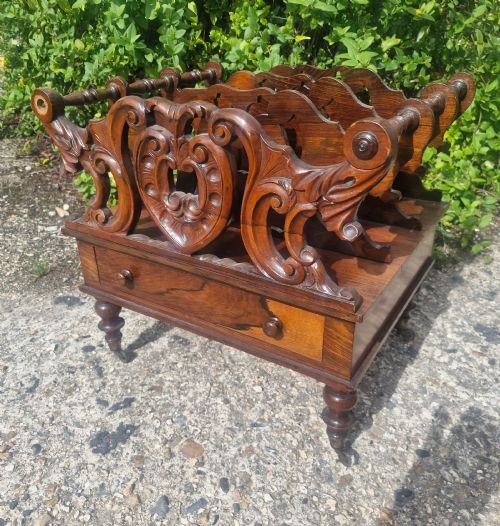
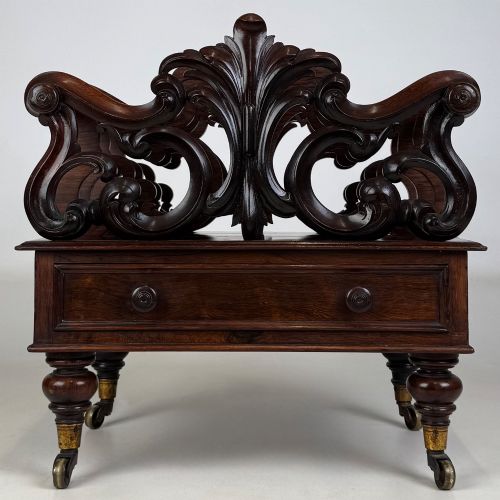
A carved rosewood music stand search uncovers nineteenth-century pieces designed for holding scores, newspapers, and sheets, alongside closely related canterburys and whatnots. The selection spans Regency, William IV, and Victorian periods, reflecting the domestic musical pursuits of country houses and urban drawing rooms alike.
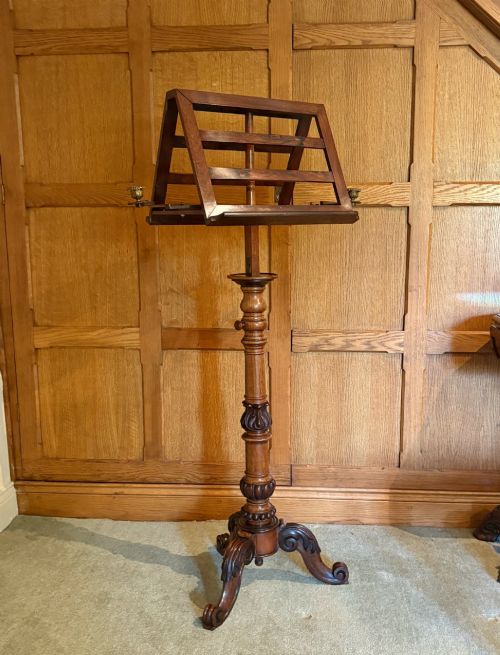
Canterburys dominate the offerings, appearing as partitioned racks on castors intended for sheet music or periodicals. Duet music stands and tripod stands emerge less frequently, offering adjustable book rests for performers.
The materials and styles cross English, French, and American workshops, with rosewood forming the primary timber alongside occasional goncalo alves and mahogany.
How they were made
Cabinet makers utilised dense rosewood for its dark grain and polished finish, often pairing it with secondary woods and brass fittings for castors and hinges. Carved details such as foliate designs and Prince of Wales feathers show hand-chizzled execution on uprights and rails.
Tripod music stands and canterburys rely on joined uprights, turned pillars, and slatted dividers constructed to bear the weight of heavy bound music volumes. Metal components like steel or brass fixings allow for adjustable stands and mobile frames.
Listings feature nineteenth-century pieces predominantly in rosewood, complemented by brass hardware, ceramic elements, and occasional goncalo alves.
What varies in quality
Quality rests upon the crispness of the timber carving and the architectural proportion of the frame, distinguishing standard production items from workshop pieces attributed to makers like Gillows. Finely turned pillars, well-figured rosewood grain, and intact original brass castors elevate the standing of a piece.
The integrity of the partitioned dividers and the smoothness of any adjustable mechanisms dictate the success of the construction, separating utilitarian items from refined drawing room furnishings.
Gillows·J C Loudon
The Carved Rosewood Music Stand Glossary
- Canterbury
- A low stand with partitioned sections for holding sheet music, newspapers, or magazines, typically fitted with castors. This form developed in the late eighteenth century and remained popular through the Victorian era.
- Goncalo alves
- A dense exotic hardwood with striking contrasting figuring, sometimes utilised as an alternative to rosewood in nineteenth-century cabinet work. It appears in tripod stands and occasional tables from the period.
- Whatnot
- A piece of open shelving supported by slender uprights, used for displaying ornaments or holding books and papers. Examples in the evidence are fashioned from rosewood.
- Duet music stand
- A stand designed to hold scores for two performers simultaneously, often featuring an adjustable reading desk. These pieces can be mounted on tripod bases or cabinet supports.
Carved Rosewood Music Stand: Frequently Asked Questions
What is a canterbury used for?
A canterbury serves as a partitioned stand for holding sheet music, folios, and periodicals near a piano or seating area. The slatted vertical sections keep unbound papers upright and organised.
Cabinet makers designed these pieces with low profiles and castors so they could move easily across carpets during cleaning or musical evenings.
How do I date a rosewood stand?
Dating relies on stylistic markers such as Regency curves, William IV bold turning, or Victorian foliate carving. Cabinet construction details and leg forms provide further clues.
Earlier pieces from around 1820 often display restrained Regency lines, while mid-nineteenth-century examples incorporate heavier carved ornament and varied timber selections.
Are music stands adjustable?
Duet music stands and tripod variants often feature mechanical adjustments for altering the height and angle of the book rest. These mechanisms use screw keys or sliding brass stems.
Fixed canterburys and magazine racks remain static, focusing on storage compartments rather than performance support.
Can these stands hold modern magazines?
Most nineteenth-century canterbury partitions accommodate standard modern periodicals, newspapers, and sheet music volumes without difficulty. The vertical slots suit soft-cover publications well.
Oversized art folios may exceed the depth of traditional partitions, so measuring compartment widths helps determine suitability for specific collections.