

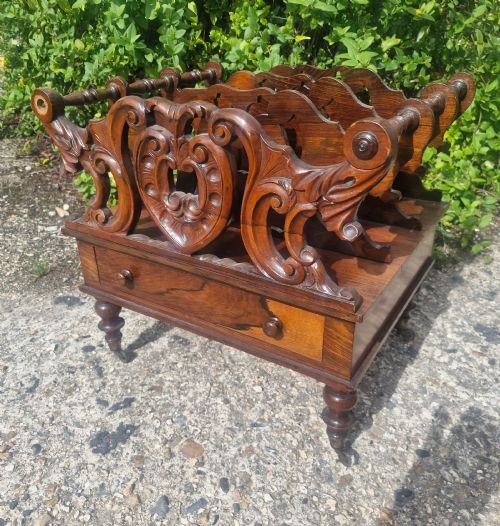
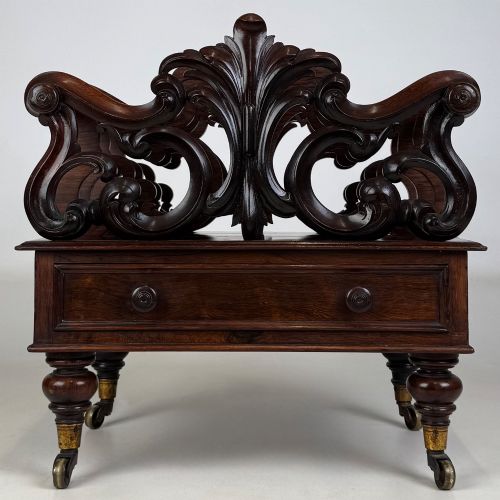


Carved Rosewood Music Rack
A carved rosewood music rack is a sturdy piece for holding folios and papers, combining timber work with practical shelving.
Carved Rosewood Music Rack
When buyers search for a carved rosewood music rack, they encounter items predominantly catalogued as canterburys, alongside designated music stands, magazine racks, and newspaper tidies. These items span the Regency, William IV, and Victorian periods, with origins recorded in England, France, and America.
The dominant form on this page is the canterbury, a low standing rack designed with vertical divisions to organise sheet music, periodicals, and folios. Pieces take various regional interpretations, from English country house examples to French and American creations.
Makers and designers of the period, such as J C Loudon, influenced the structural layout and decorative vocabulary seen across these items. Detail work incorporates motifs like foliate designs and the Prince of Wales feathers.
Materials and construction methods
Construction relies primarily upon dense, figured rosewood timbers, frequently augmented with secondary components in mahogany, brass fittings, ceramic elements, and metal.
Carpenters shaped these woods using traditional joinery techniques, applying hand-carving to uprights, slats, and stretcher rails to achieve the Gothic Revival, Regency, and Victorian styles recorded in the evidence.
Carved Rosewood Music Rack Retail Price Guide 2026
Typical asking prices for carved rosewood music rack among the pieces listed under this phrase on Sellingantiques today, from the lower quarter to the upper quarter. They describe what is for sale here now, not the wider market.
Assessing quality in rosewood pieces
Quality reveals itself through the crispness of the hand-carving upon the rosewood frames and the structural integrity of the vertical partitions that hold the music sheets.
Finely made examples display balanced proportions, coherent styling within periods such as the Regency or William IV eras, and harmonious integration of brass or ceramic details.
The Carved Rosewood Music Rack Glossary
- Regency
- A style period dating from the early 19th century, known for classical restraint and elegant lines. Pieces from this era often incorporate rosewood with brass inlay or mounts.
- William IV
- A transitional style bridging the Regency and early Victorian periods, characterised by robust proportions and substantial carved detail. Furniture from this era often utilises dense tropical hardwoods.
- Gothic Revival
- An architectural and decorative style drawing inspiration from medieval forms, featuring pointed arches and reticulated tracery. In these listings, it appears on mid-century American and English pieces.
- Foliate design
- Ornamentation based on leaf motifs, carved into the wooden framework of the piece. This style of carving adds texture to the upright supports and rails.
Carved Rosewood Music Rack: Frequently Asked Questions
What is a canterbury?
A canterbury is a low compartmentalised stand designed specifically for storing sheet music, folios, and periodicals within a domestic interior. The open vertical slats keep items upright and sorted for easy access.
Historically placed beside a piano or seating area, these stands functioned as practical furniture for musicians and readers alike. Today they serve a similar organising purpose in living spaces.
How do I date a rosewood music rack?
Dating relies on observing stylistic markers, construction methods, and the specific period characteristics recorded across the pieces. Regency items typically show cleaner classical lines, while Victorian examples often incorporate heavier carved foliate motifs.
Comparing the turning on the legs and the joinery style helps narrow down the decade of manufacture. Consulting the listed periods provides a reliable benchmark for these attributes.
Where were these racks used?
These pieces originated primarily for use in the principal rooms of country houses and town residences. They sat in music rooms, drawing rooms, and libraries where sheet music and newspapers accumulated.
Their portable nature allowed them to be shifted near a fireside or instrument stand as required. They accommodated the daily reading matter of 19th-century households.
How do I care for antique rosewood?
Rosewood requires stable environmental conditions away from direct heat sources and strong sunlight to prevent the timber from drying out. Gentle dusting with a dry cloth maintains the surface finish.
Occasional application of appropriate wax polish helps nourish the grain without building up a heavy residue. Keeping humidity levels steady protects both the wood and any integrated brass or ceramic fittings.