
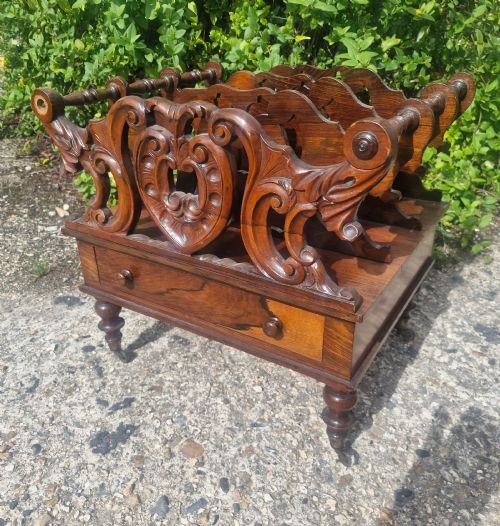
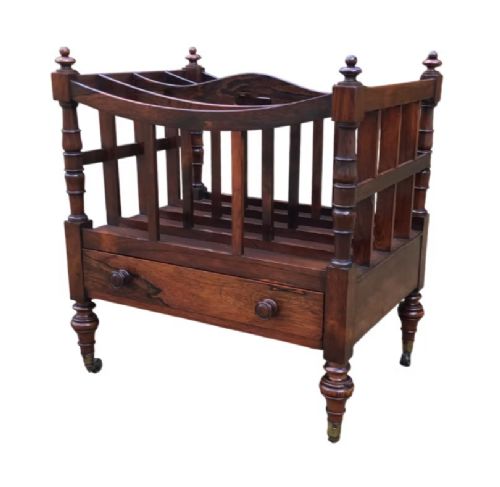
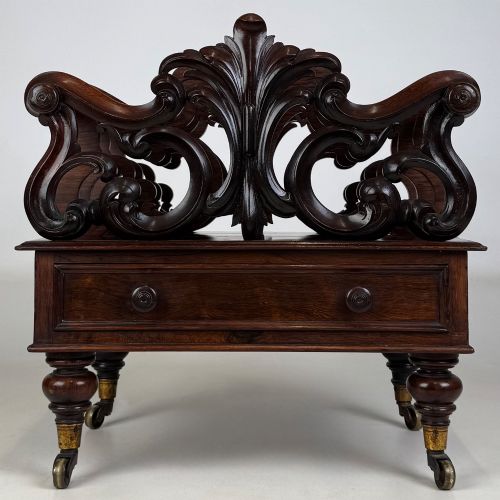


Dark Rosewood Canterbury
A dark rosewood canterbury organises sheet music, newspapers and folios with upright slatted divisions above a shallow drawer, combining refined timber with practical daily utility.
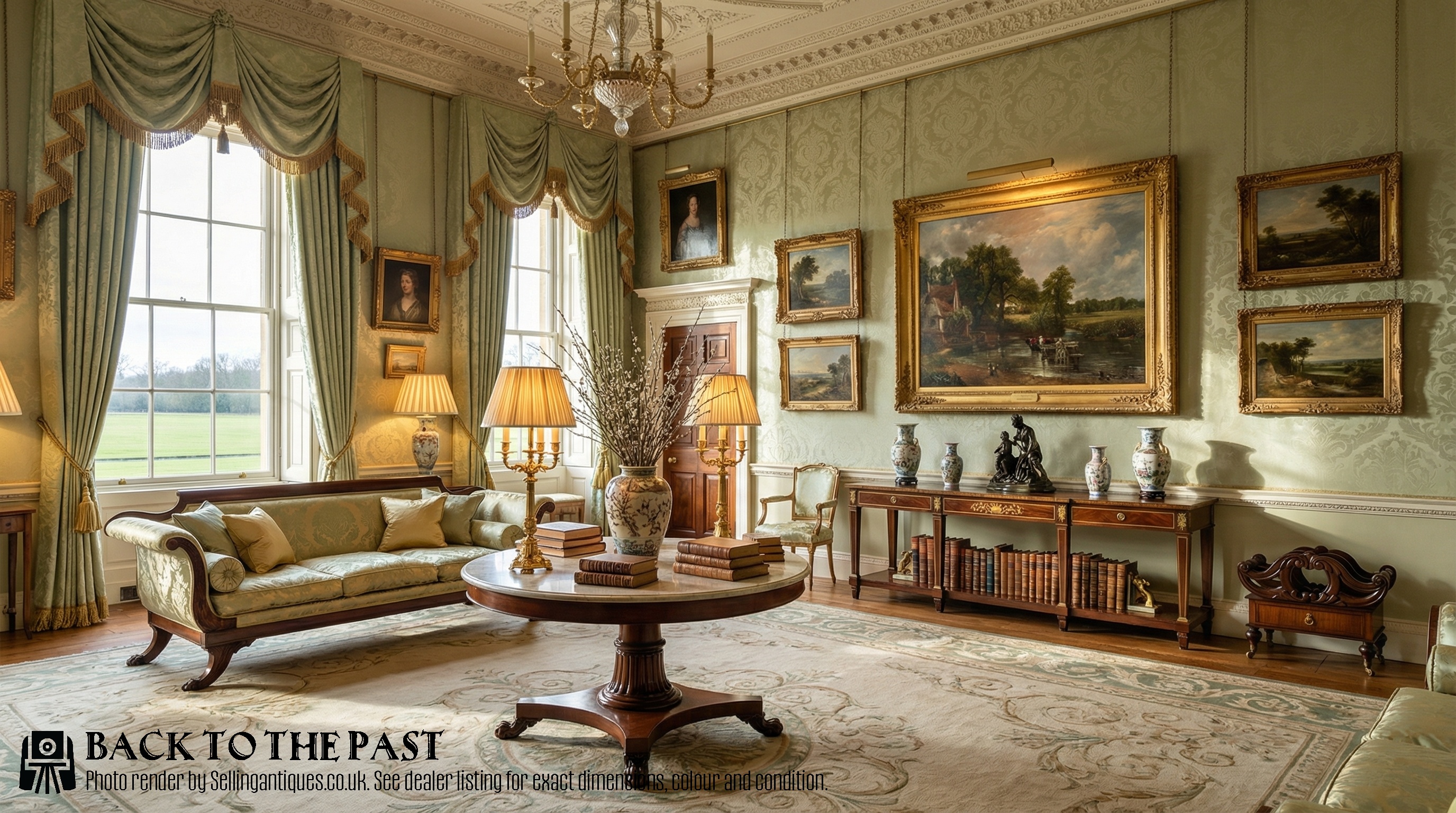
Dark Rosewood Canterbury
A dark rosewood canterbury is a dedicated storage stand designed for sheet music, periodicals and books, usually set on castors for easy movement across a room. The form typically comprises several upright slatted partitions, occasionally combined with a low drawer beneath or adapted into a multi-functional whatnot or music cabinet.
Buyers seeking a dark rosewood canterbury encounter examples predominantly from the nineteenth century, spanning Regency, William IV, George IV and Victorian periods. The selection includes standard newspaper and magazine racks alongside broader folio stands and music cabinets referencing specific period designs.
How they were made
Cabinet makers utilised dense rosewood timber, often selecting dark grain patterns for the main framework and partitions, and occasionally incorporating contrasting satinwood inlay, marquetry, or brass mounts. Individual sections were shaped with turned supports, carved foliate details, or open slatted dividers joined securely to a low platform base.
Structural elements commonly include small turned wooden knobs, dovetailed drawer construction beneath the main rack, and brass castors affixed to low feet. Certain variants integrate glass panels or mirror backs within broader side cabinets and music furniture.
Several pieces include concealed compartments or miniature drawers tucked beneath the musical racks for storing stray tuning keys and spare guitar strings.
What varies in quality
The degree of refinement in a dark rosewood canterbury depends on the crispness of carved details, such as Prince of Wales feathers or foliate motifs, and the depth of the timber's grain. Superior pieces display deliberate proportion, balanced divisions, and integrated secondary timbers within drawer construction.
Execution of secondary decorative techniques, including precise inlay work or the quality of cast brass fittings and castors, separates standard utility stands from finer examples associated with known cabinet-making traditions.
Gillows
The Dark Rosewood Canterbury Glossary
- Canterbury
- A low stand with upright slatted divisions used originally for holding sheet music and folios. The name derives from an Archbishop of Canterbury who reportedly commissioned the first such piece.
- Whatnot
- A multi-shelved open cabinet used for displaying ornaments and books. These often incorporate canterbury sections or drawer units at the base.
- Folio stand
- A large rack designed to hold oversized prints, drawings, and newspapers. They share functional similarities with standard canterburys but on grander proportions.
- Marquetry inlay
- Decorative patterns formed by fitting contrasting veneers into timber surfaces. This technique adds geometric or floral ornamentation to the panels and tabletops.
- Castor
- A small wheel attached to the legs of furniture to permit smooth rolling across floors. Most period pieces use brass fittings to hold these wheels.
Dark Rosewood Canterbury: Frequently Asked Questions
What is a dark rosewood canterbury?
A dark rosewood canterbury is a nineteenth-century furniture piece created to hold sheet music, newspapers, and periodicals within vertical wooden partitions.
Most examples feature a low rectangular base, often incorporating a small drawer and small castors for mobility around a drawing room or parlour.
How were canterburys originally used?
These stands kept loose sheets of music close to pianos and gathered daily newspapers or magazines in sitting rooms. The slatted divisions kept papers upright and sorted for easy access.
Later Victorian variants expanded this function by combining music racks with small cabinets, shelves, and folio holders.
How do I identify a Regency canterbury?
Regency pieces often display classical proportions, boat-shaped frames, finely turned supports, and occasionally carved details like Prince of Wales feathers. The timber selection emphasises dark, richly figured rosewood.
Maker influences from this era, such as designs associated with J. C. Loudon, point towards architectural clarity and balanced arrangement of the slatted divisions.
Where does a canterbury fit in a modern room?
A canterbury serves well beside a sofa or armchair as a practical rack for magazines, books, and current reading materials. Its compact footprint allows it to sit neatly against walls or beside occasional tables.
The rich dark rosewood grain and traditional brass castors also make it a strong decorative accent piece in a study or living space.