
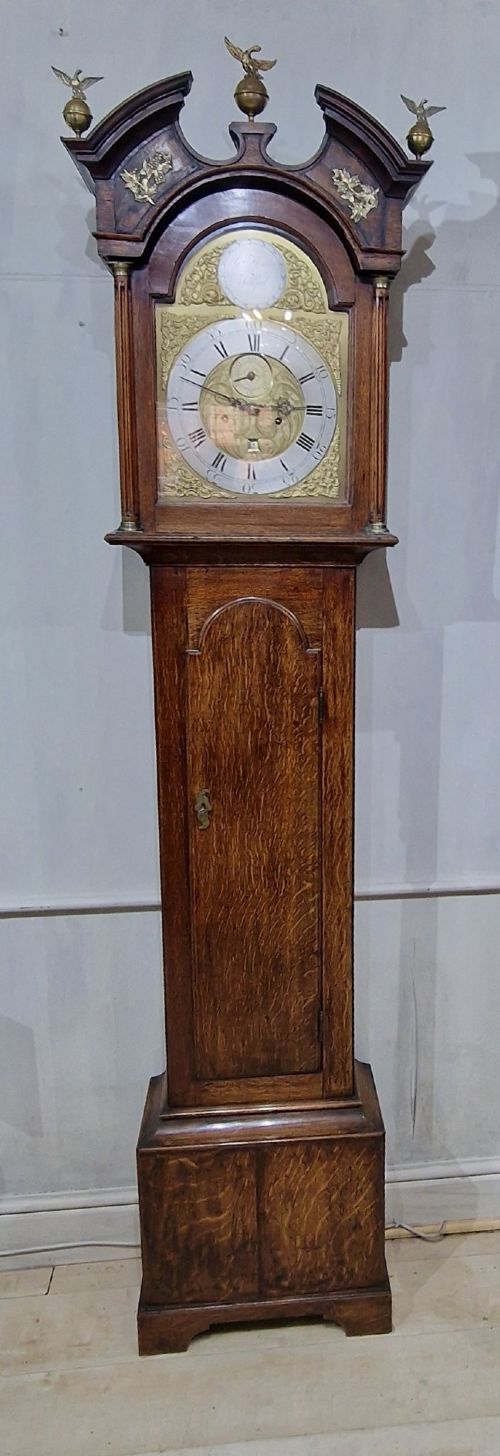
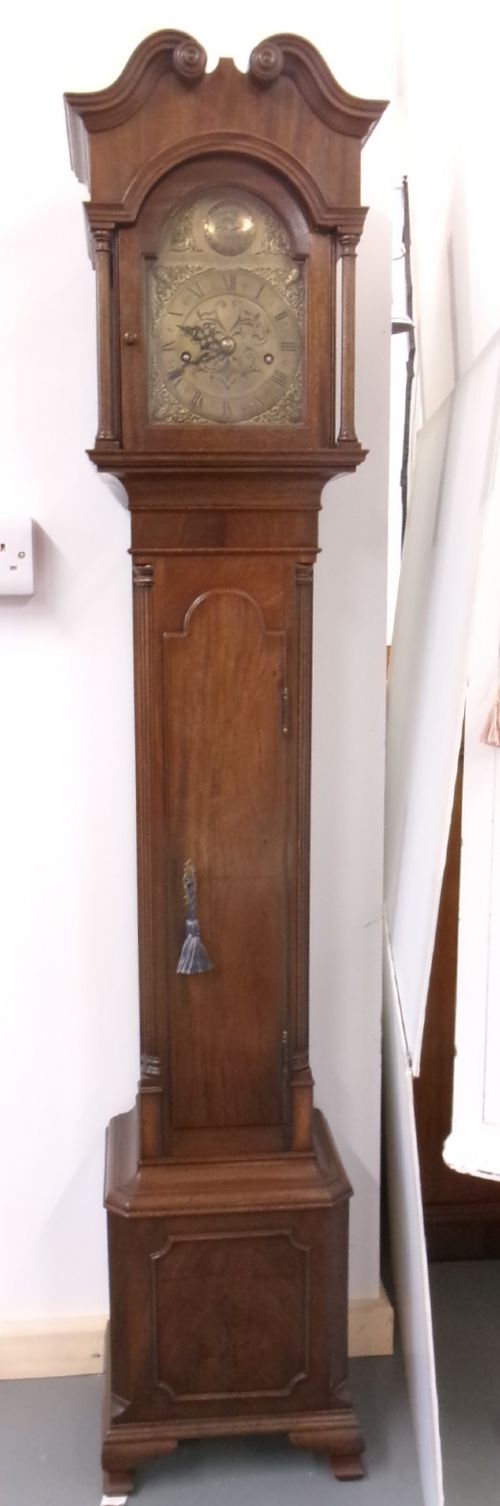


Carved Pediment Grandfather Clock
A carved pediment grandfather clock brings monumental presence to a room, housing intricate timekeeping beneath architectural timber hoods.

Carved Pediment Grandfather Clock
A carved pediment grandfather clock is a tall floor-standing timepiece defined by an architectural hood decorated with carved woodwork above the dial. These pieces appear across multiple historical eras, spanning the eighteenth and nineteenth centuries into the early twentieth century.
The selection on this page includes standard longcase clocks alongside smaller grandmother clocks and miniature longcase variations. Timbers vary between rich mahogany, figured walnut, and sturdy oak.
Regional variations emerge from Scottish centres such as Falkirk, Edinburgh, and Melrose, showcasing local cabinet-making traditions. Makers constructed these floor clocks with brass dials, painted faces, and single-train or multi-train movements.
Materials and construction
Cabinet makers constructed these tall cases using solid timbers like mahogany, oak, and walnut, often applying veneers and intricate inlay work to the trunk and base. Iron and brass components formed the mechanical movements inside.
Glazed doors protected the circular or arched dials, which featured either engraved brass chapter rings or hand-painted face details. Carved pediments at the summit required skilled joinery and hand-chisel work to shape the timber crests.
Some clocks required two weights just to keep time, while others added a third to chime tunes that echoed through the hallway.
Assessing quality and craftsmanship
Quality separates simple utility cabinets from masterworks through the depth of the timber carving and the sophistication of the movement. Superior examples display crisp hand-carved pediments, well-figured mahogany or walnut grain, and signed brass dials.
The integrity of the timber case and the precision of the mechanical movement dictate the standard of the piece. Regional clocks signed by documented makers command attention through refined proportions and advanced musical or moonphase complications.
James Hendrie·David Craig·Edward Stanton·Robert Darling·G Brown
The Carved Pediment Grandfather Clock Glossary
- Pediment
- The architectural crown above the clock dial, often carved with scrolls, swan necks, or architectural mouldings. This decorative wooden summit defines the silhouette of the hood.
- Grandmother clock
- A smaller version of the traditional longcase clock, typically produced during the Victorian and Edwardian periods. These compact floor clocks suit rooms with lower ceilings.
- Longcase clock
- The formal term for a tall pendulum clock housed in a wooden floor-standing case. Collectors often use this interchangeably with grandfather clock.
- Moonphase
- A dial mechanism displaying the lunar cycle through a rotating painted disc behind the clock face. This complication adds visual movement and technical intricacy.
- Chapter ring
- The outer ring on a clock face bearing the numerals for hours and minutes. These are frequently engraved on brass or painted directly onto white metal.
Carved Pediment Grandfather Clock: Frequently Asked Questions
What is a grandmother clock?
A grandmother clock is a scaled-down version of the traditional longcase, built with a shorter and narrower proportion. These smaller floor clocks emerged primarily during the Victorian and Edwardian eras.
Cabinet makers designed them to fit modern domestic spaces where a standard grandfather clock would overwhelm the room height. Despite their reduced scale, they retained mechanical movements and timber cases.
How do I date an oak longcase clock?
Dating an oak longcase involves examining the construction methods of the timber case and the style of the dial. Eighteenth-century examples often feature simpler oak boards and single-handed brass movements.
Later Victorian and Edwardian revivals incorporate machine-sawn timber and different hinge styles. Maker signatures and painted face details also provide clues to the exact decade of manufacture.
What does a moonphase dial do?
A moonphase dial tracks the phases of the moon through a rotating painted disc visible through an aperture on the clock face. This mechanical display completes a full rotation every lunar month.
Clockmakers added this feature to high-grade movements for practical maritime and agricultural tracking, as well as aesthetic display. It adds considerable visual interest to the upper arch of the dial.
Where were Scottish longcase clocks made?
Scottish longcase clocks were produced in regional workshops across towns such as Edinburgh, Falkirk, and Melrose. Local cabinet makers and clockmakers built distinct regional casework.
These pieces often bear the maker name and town inscribed directly onto the brass or painted dial. Scottish examples frequently utilise native oak or imported mahogany.