
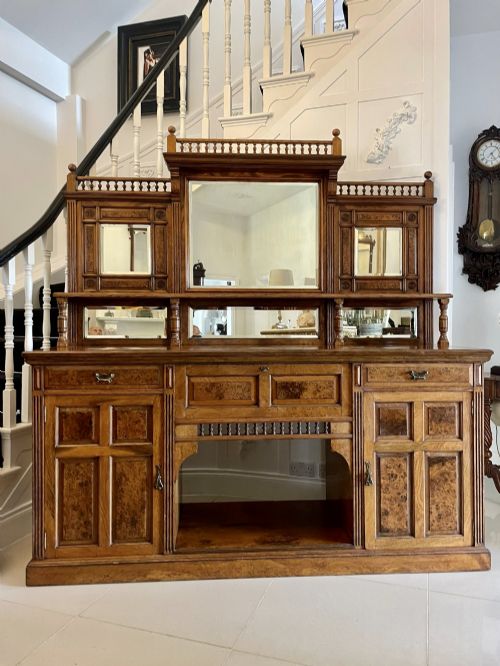
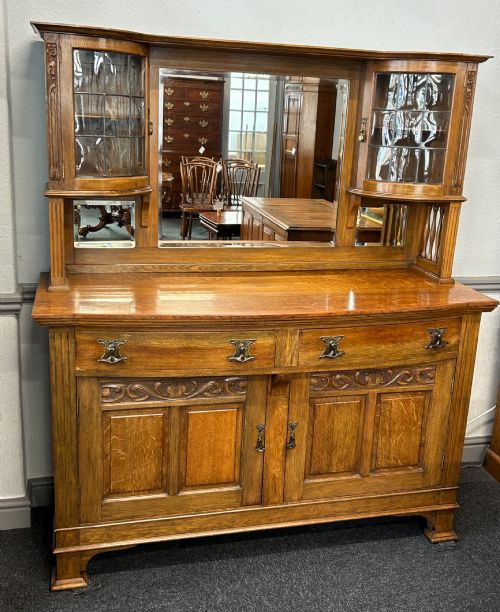
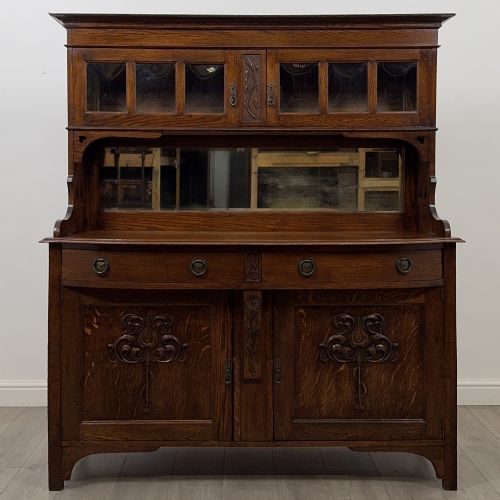


Carved Oak Sideboard Back
These carved oak sideboard back pieces bring substantial Victorian and Edwardian presence to a room, offering both display space and robust storage.
Carved Oak Sideboard Back
A carved oak sideboard back serves as the architectural superstructure rising above the main serving surface, frequently incorporating bevelled mirror glass and carved shelving. Buyers searching for a carved oak sideboard back encounter substantial Victorian and Edwardian iterations, spanning periods from the mid-nineteenth century through to the early decades of the twentieth century.
The prevalent form on this page combines a heavy timber base fitted with cupboards and drawers beneath an ornate upper section designed for display. Stylistic variations range from heavily carved Gothic Revival and Renaissance Revival expressions to linear Arts and Crafts and flowing Art Nouveau interpretations.
Distinctions in grade and execution
Quality separates along the depth and crispness of the carved ornamentation, distinguishing machine-finished repetition from hand-chiselled vitality. The integration of the superstructure to the base demonstrates the joiner's skill through secure dowelling and balanced proportions.
Selection of timber defines the upper tier of pieces, where figured pollard oak or carefully matched grain patterns elevate the visual impact. Original brass hardware, intact bevelled mirror glass, and retained maker signatures further elevate the standing of an individual example.
Several substantial pieces incorporate peering Green Man masks within their foliate carvings, keeping a watchful eye over the dining room.
T Simpson and Son·James Simpson and Sons
The Carved Oak Sideboard Back Glossary
- Pollard oak
- Timber taken from pollarded trees displaying tightly clustered, highly decorative knot formations and swirling grain patterns. It is frequently utilised for drawer fronts and feature panels.
- Green Man
- A sculptural architectural motif depicting a human face disgorging or entwined with foliage. It appears frequently in nineteenth-century revivals.
- Mirror back
- An upper superstructure inset with glass panels designed to reflect light and display ceramics or silver. These mirrors are commonly bevelled at the edges.
- Breakfront
- A cabinet facade where the central section projects forward from the flanking wings. This configuration creates visual depth and varied storage volumes.
- Gothic Revival
- An architectural and decorative style inspired by medieval forms, characterised by pointed arches, tracery, and heavy mouldings. It heavily influences Victorian case furniture.
Carved Oak Sideboard Back: Frequently Asked Questions
What is a carved oak sideboard back?
It is the decorative superstructure rising above the lower storage base of a nineteenth or early twentieth-century dining room cabinet, typically featuring carved woodwork and integrated mirrors.
These additions were designed to display decorative ceramics, glassware, and silver while visually expanding the dining space.
How do I date a carved oak sideboard back?
Dating relies upon stylistic markers, structural joints, and secondary materials visible across the framework. Victorian examples often display heavy relief carving and Gothic or Renaissance Revival motifs.
Edwardian and later pieces frequently adopt cleaner Arts and Crafts lines or lighter golden oak finishes, reflecting changing domestic tastes around the turn of the century.
Can the upper mirror section be removed?
The upper superstructure is structurally integrated into the lower cabinet carcass through heavy peg joints, screws, and vertical supports. Disconnecting the upper section requires careful dismantling of the underlying joinery.
Most pieces are designed to remain unified as a single architectural composition intended for large dining interiors.
How should I care for pollard oak surfaces?
Maintenance involves dusting with a dry lint-free cloth and applying occasional applications of traditional beeswax to nourish the timber. Avoid placing these pieces in direct sunlight or near heat sources to prevent timber shrinkage and veneer lifting.
Gentle cleaning preserves the natural patina developed over generations of domestic use.