


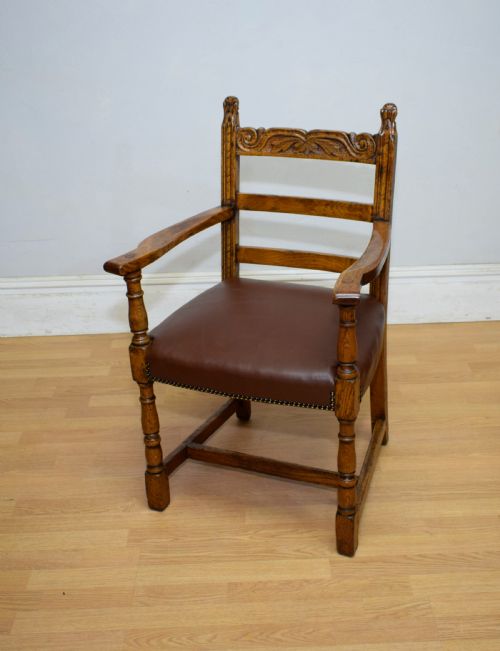


Carved Oak Ladderback Chairs
Carved oak ladderback chairs bring robust country character to a room, offering sturdy frames and tiered horizontal slats.
Carved Oak Ladderback Chairs
Carved oak ladderback chairs are traditional seating forms defined by their tiered horizontal back rails and timber frames. When you search for carved oak ladderback chairs, you encounter pieces spanning the eighteenth, nineteenth, and early twentieth centuries. These range from substantial sets intended for dining rooms to single armchairs, rocking chairs, and desk chairs.
The selections on this page draw from several distinct regional and stylistic traditions, including English country, French provincial, Arts and Crafts, and Jacobean revival designs. You will frequently meet groups of dining chairs alongside individual armchairs fitted with rush, fabric, or leather seats. Oak serves as the primary structural timber across these variations, paired occasionally with elm or mahogany.
How they were made
Maker construction relies heavily on solid oak for frames, posts, and back slats, utilising traditional joinery methods to ensure stability. Carved details are chiselled directly into the timber framework, often appearing along the crest rails or stiles in revival and regional styles.
Seats are commonly woven from natural rush or upholstered in materials such as fabric, leather, and velvet to provide practical support. Certain iterations incorporate additional functional elements like iron fittings, wheels, or rocking rails attached to the wooden base.
Listings feature oak alongside elm and mahogany, with seat surfaces formed from rush, fabric, leather, and velvet.
What varies in quality
Quality in these chairs rests upon the weight and grain of the oak timber utilised in the frame, alongside the crispness of any hand-carved ornamentation. Pieces displaying thicker stock and well-balanced proportions command greater regard among traditional seating.
The integrity of the construction and the preservation of original elements, such as rush seating or patinated wood surfaces, distinguish finer examples. Uniformity across larger sets also dictates distinction, particularly when matching multiple dining chairs from earlier centuries.
The Carved Oak Ladderback Chairs Glossary
- Ladderback
- A chair style featuring horizontal slats rising up the backrest. This design dates back centuries and remains common in vernacular furniture.
- Rush
- Woven marsh grass utilised traditionally for chair seats. It provides a flexible, textured surface across country seating.
- Stile
- The upright vertical side post of a chair back. It forms the main structural support for the horizontal slats.
- Crest rail
- The top horizontal member of a chair back. Carved ornamentation frequently appears on this specific component.
- Vernacular furniture
- Practical objects made by local tradespeople using regional materials. These pieces prioritize utility over grand stylistic movements.
Carved Oak Ladderback Chairs: Frequently Asked Questions
What periods do these chairs come from?
These chairs originate from various eras, spanning the eighteenth, nineteenth, and early twentieth centuries.
Specific periods represented include Georgian, Regency, Victorian, Edwardian, and the nineteen-twenties revival movements.
Are these chairs suitable for daily dining?
Many of these pieces function effectively as everyday dining or desk seating, provided the wooden frames and joints remain sound.
Individual armchairs, rocking chairs, and larger sets offer practical utility alongside their traditional aesthetic.
What materials make up the seats?
Seat constructions vary between traditional woven rush and upholstered pads covered in fabric, leather, or velvet.
These materials reflect both regional country traditions and later formal interior requirements.
How do regional styles differ?
Regional variations display distinct interpretations of the form, ranging from English country and rustic farmhouse to French provincial.
Arts and Crafts and Jacobean revival examples introduce specific decorative carving and structural emphases.