
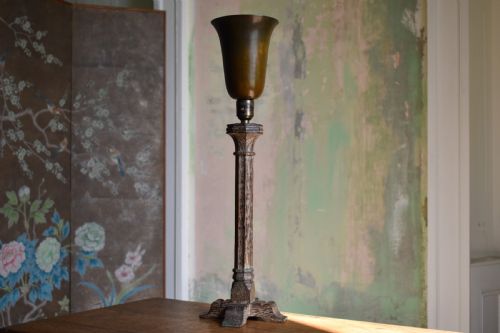
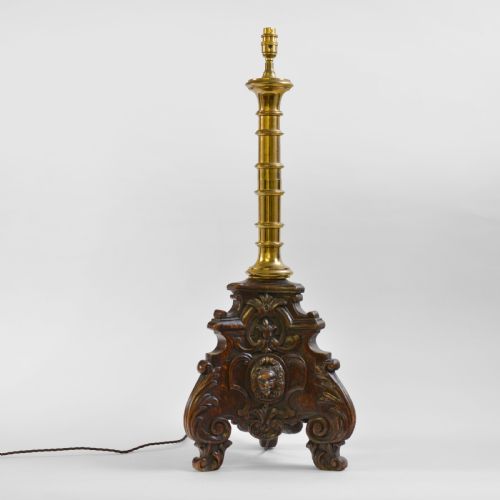


Carved Oak Candlesticks
These carved oak candlesticks bring centuries of timber-turning and hand-carving straight to a mantel or table.
Carved Oak Candlesticks
When you search for carved oak candlesticks, you find turnings and hand-carved forms originating from the seventeenth century onward. The selection spans domestic table lamps, pairs with barley twists, and figural folk art pieces.
You are most likely to meet twentieth-century interpretations, particularly from nineteen twenty, alongside nineteenth-century examples and George III style revivals. These pieces combine turned wood with brass fittings and simple timber forms.
How they were made
Maker's hands shaped these items using solid oak and hardwood, often employing a lathe to produce open barley twists. Hand-carving brought forth foliage, figures, and architectural details in Jacobean and Gothic revival styles.
Metal components such as brass tops and bobbins were integrated to hold candles or adapt the turned timber bases for illumination. Limed and dark finishes were applied to highlight the grain of the oak.
The listings feature oak, brass, and hardwood formed into candlesticks, table lamps, and candle holders across several centuries.
What varies in quality
Depth of carving and sharpness of detail separate standard turnings from exceptional sculptural pieces like folk art poachers. The proportion of the turned stem to the base dictates the visual balance of the object.
The integrity of the timber and the crispness of the twist show the maker's skill. Matching in pairs relies on uniform turning and consistent grain across both items.
The Carved Oak Candlesticks Glossary
- Barley twist
- A spiral turning resembling a twisted rope, common on the stems of these sticks. It requires precise lathe work to achieve an even rhythm.
- Limed oak
- A finish treatment that fills the open pores of the oak with a white pigment. This highlights the grain pattern against a darker background.
- Folk art
- Items made by traditional craftsmen or amateurs outside academic traditions. These pieces often feature figurative carvings like figures carrying game.
- Jacobean Revival
- A style drawing on seventeenth-century English design motifs. It favours sturdy proportions, dark wood, and geometric or floral carving.
Carved Oak Candlesticks: Frequently Asked Questions
Are these sticks suitable for everyday use?
These items function well on tables and sideboards when paired with standard taper candles. Many twentieth-century examples are adapted safely as table lamps for modern living.
Care should be taken to protect the timber and any brass components from wax drips and direct heat sources.
What is limed oak?
Limed oak displays a pale, brushed-in finish within the grain pores of the timber. This technique creates a distinct contrast against the darker oak beneath.
It appears on twentieth-century items designed to catch the light in domestic interiors.
How do I identify folk art pieces?
Folk art items show charming irregularities and hand-carved human or animal forms rather than standard classical ornament. Figures such as poachers carrying game distinguish these unique sculptures.
They reflect the individual maker's hand rather than a strict period workshop style.