



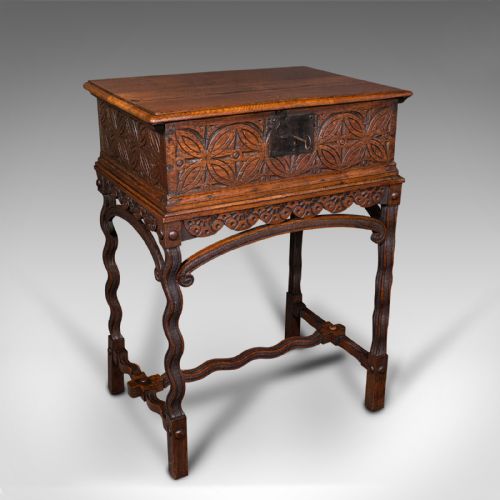


Carved Oak Box Stand
These carved oak box stands combine a secure lidded repository with a raised frame, offering sturdy timber construction suited to daily use.
Carved Oak Box Stand
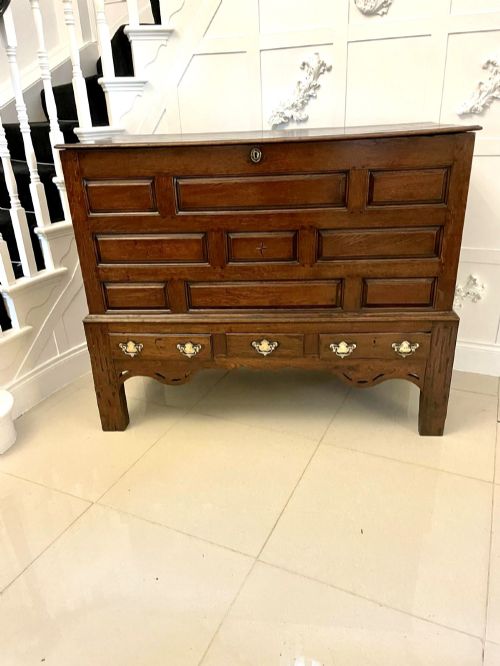
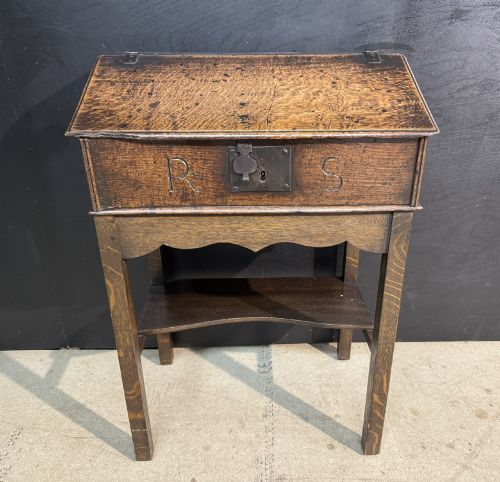
A carved oak box stand brings together a lidded container and a raised base, appearing most frequently in forms such as bible boxes, writing slopes, and chests mounted on bespoke or original frames. These pieces bridge the gap between portable storage and permanent furniture, providing a compartment for valuables or documents lifted clear of the floor.
The selection ranges from early seventeenth-century examples featuring nulled carving and geometric panels to later Victorian interpretations influenced by Jacobean revival styles. Buyers encounter both compact desk boxes raised on slender legs and larger coffer forms where the stand integrates structural stretchers and drawers.
Origins span several centuries of British cabinet making, touching the seventeenth, eighteenth, and nineteenth periods with distinct stylistic shifts. Early seventeenth-century items often display deep chip carving, whereas Victorian pieces favour elaborate foliate motifs and turned supports.
Materials and construction
Makers relied principally upon solid oak for the primary box and stand framework, selected for its density, durability, and pronounced grain pattern. This timber was frequently quarter-sawn to expose characteristic medullary rays across the panels.
Secondary elements incorporate brass for hinges, escutcheons, and carrying handles, alongside iron fixings that secure joints and lid hinges. Some later interpretations integrate glass, mirror glass, or cut glass components within compartmentalised interior layouts.
Carving techniques combine surface chip carving, relief work, and fretted detailing applied directly to the solid oak carcase. Frames are joined using traditional pegged mortise and tenon construction, ensuring the stand supports the heavy weight of the lidded box above.
Carved Oak Box Stand Retail Price Guide 2026
Typical asking prices for carved oak box stand among the pieces listed under this phrase on Sellingantiques today, from the lower quarter to the upper quarter. They describe what is for sale here now, not the wider market.
Materials across the inventory combine solid oak with brass, iron, glass, and mirror glass elements in various structural arrangements.
Assessing quality and authenticity
Quality rests upon the integrity of the timber and the harmony between the box and its supporting stand. Fine examples maintain matching oak surfaces where the box and stand share identical age, patina, and weathering.
The execution of the carved detail distinguishes superior pieces from standard workshop output. Crisp, deeply undercut relief work indicates skilled hand-tool use, whereas shallow or mechanical scoring points to later alterations or hurried production.
Originality of components heavily influences worth, particularly when considering whether a box rests on a contemporaneous stand or a later frame. Surviving original brass hardware and untouched interior fittings preserve the historical continuity of the object.
The Carved Oak Box Stand Glossary
- Bible box
- A small lidded chest designed to hold a family bible, frequently featuring a sloping lid that doubles as a reading rest. These containers represent the primary box form adapted onto stands.
- Coffer on stand
- A larger storage chest elevated on legs or a low frame, lifting textiles and household goods away from damp flagstone floors. The stand provides ergonomic height and structural elevation.
- Nulled carving
- A decorative architectural moulding consisting of a series of convex, rounded flutes carved in relief along the frieze or rail. This motif appears frequently on early seventeenth-century woodwork.
- Writing slope
- A box with an angled top designed to provide a comfortable writing surface while housing inkwells and papers inside. Examples often feature fitted interior compartments and locking mechanisms.
- Jacobean revival
- A nineteenth-century stylistic movement that emulates the heavy, dark oak furniture of the early seventeenth century. Pieces from this period often display exuberant carved strapwork and geometric panels.
Carved Oak Box Stand: Frequently Asked Questions
How were box stands used originally?
These pieces served practical storage and writing functions in domestic and institutional settings. The enclosed compartment held precious documents, books, or small valuables securely under lock and key.
The raised stand elevated the container to a convenient height for standing or sitting usage. This kept contents clear of cold, damp floors while integrating storage into the main rooms of a house.
How do I distinguish 17th-century pieces from Victorian revivals?
Seventeenth-century items display authentic tool marks, hand-split oak boards, and period construction methods such as pegged joints and wrought iron nails. The timber exhibits a deep, dry patina developed through centuries of exposure.
Victorian revival pieces often feature machine-sawn timber elements, brighter brass hardware, and softer secondary woods inside. The carving may appear more uniform and less integrated with the structural joints of the box.
Can I use a bible box stand as a desk?
Many box stands with sloping lids function effectively as compact writing desks for laptops or correspondence. The interior compartments provide convenient storage for modern stationery and small items.
Height varies depending on whether the piece was designed as a table-top box or a floor-standing unit. Buyers should check dimensions carefully to ensure comfortable use with a standard chair.