


Carved Oak Bevelled Mirror
A carved oak bevelled mirror brings rich grain and deep relief to a wall, offering both utility and strong period character.
Carved Oak Bevelled Mirror
A carved oak bevelled mirror unites substantial timber frames with angled glass plates, appearing in wall-hanging, mantel, and dressing table formats. Buyers seek these items for their robust construction and the decorative depth added by carved foliage, strapwork, or revival motifs.
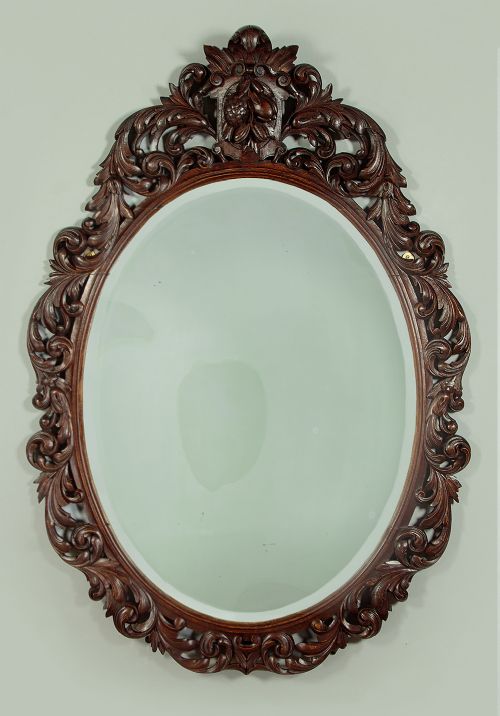
Most examples found here date from the nineteenth and early twentieth centuries, spanning Victorian, Edwardian, and Art Deco periods. Forms range from simple oval wall mirrors to large cushion frames and architectural styles influenced by Jacobean and French Renaissance revivals.
Materials and construction
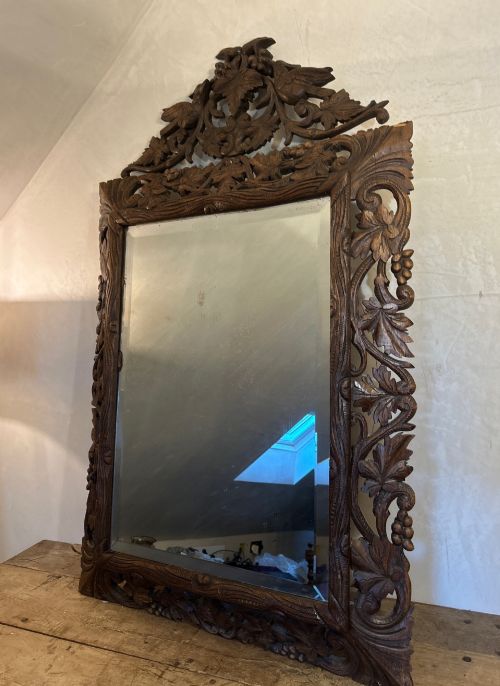
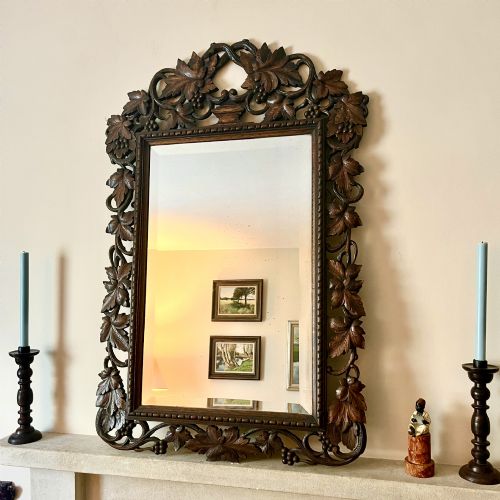
Makers utilised solid oak, often selecting quartersawn timber to highlight characteristic medullary rays across the frame. Carving was executed by hand directly into the dense wood, creating high-relief ornament such as egg and dart patterns or naturalistic foliage.
Mirror plates feature distinctive bevelled edges, ground and polished by hand to catch the light at shallow angles. Brass fittings, gesso details, and occasional gold leaf accents completed the construction of finer pieces.
Listings span periods from the eighteenth century through the Art Deco era, predominantly featuring solid oak frames fitted with bevelled mirror glass.
Assessing quality
Quality rests in the crispness and depth of the timber carving, where deeply undercut details and well-defined motifs separate superior pieces from mechanical work. The weight and stability of the solid oak frame, together with tight corner joints, indicate skilled cabinet-making.
The glass itself plays a key role, with thicker bevels and clear, distortion-free mirror plates distinguishing better examples. Secondary elements, such as original brass hangers and intact gesso enrichments, preserve the integrity of the piece.
The Carved Oak Bevelled Mirror Glossary
- Bevel
- The sloping edge ground along the perimeter of a mirror plate. This technique creates a prismatic light refraction that frames the reflection.
- Cushion frame
- A framing style with a convex, rounded profile resembling a soft cushion. It directs visual weight outward toward the carved borders.
- Gesso
- A plaster-based material applied to wood surfaces to form a smooth base for gilding. It allows for crisp ornamental moulding.
- Medullary rays
- Natural ribbon-like cellular patterns visible in quartersawn oak timber. Their presence indicates radial cutting through the log.
- Egg and dart
- A classical ornamental moulding pattern consisting of alternating egg-shaped forms and pointed arrows. It frequently appears on Victorian and revival frames.
Carved Oak Bevelled Mirror: Frequently Asked Questions
How do I hang a heavy oak mirror safely?
Heavy carved oak mirrors require robust wall fixings secured directly into masonry or timber studs. Using substantial mirror plates or heavy-duty brackets screwed to the back frame distributes the considerable weight evenly.
Avoid relying on single picture hooks or plasterboard anchors alone. Ensuring the hanging wire or integrated brackets are structurally sound protects both the wall and the heavy timber frame.
How should I clean an antique mirror frame?
Dust the carved oak frame gently with a dry, soft-bristled brush to remove accumulation from deep recesses. Period timber benefits from occasional applications of beeswax to nourish the grain without leaving sticky residue.
Keep moisture away from the carved areas and the edges of the mirror plate, where water can seep behind the silvering. Glass cleaner should be applied sparingly to a cloth rather than sprayed directly onto the glass.
What defines the Jacobean Revival style?
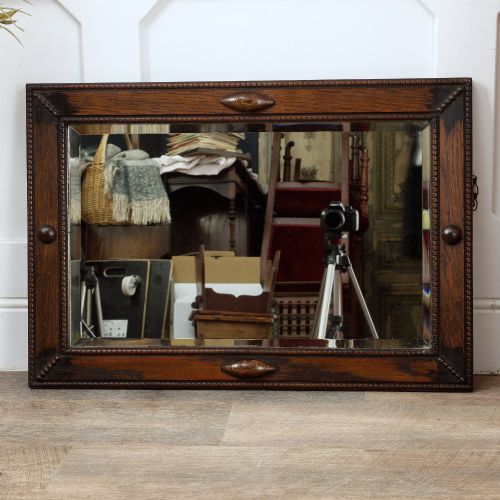
Jacobean Revival pieces borrow heavily from seventeenth-century design, featuring dark oak, geometric moulding, and heavy proportions. Carved strapwork, lozenges, and robust symmetry dominate the visual language of these frames.
This style gained immense popularity during the Victorian and Edwardian eras for domestic interiors. The dark finish and weighty construction provide a deliberate sense of historical permanence.
How do I tell an Edwardian mirror from a Victorian one?
Victorian carved oak mirrors often display heavier proportions, darker finishes, and dense ornamentation like gothic motifs or lion pediments. The carving tends to be deep and dramatic, reflecting nineteenth-century tastes for historicism.
Edwardian examples frequently show lighter oak tones and slightly more restrained, elegant carving styles influenced by arts and crafts ideals. Proportions can be taller and slimmer, suiting brighter turn-of-the-century domestic spaces.