


Carved Lion Head Armchairs
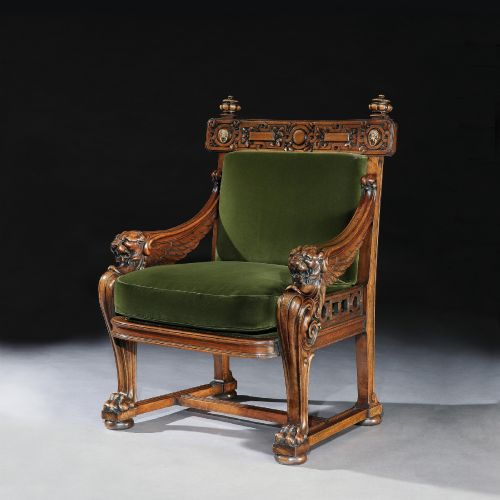
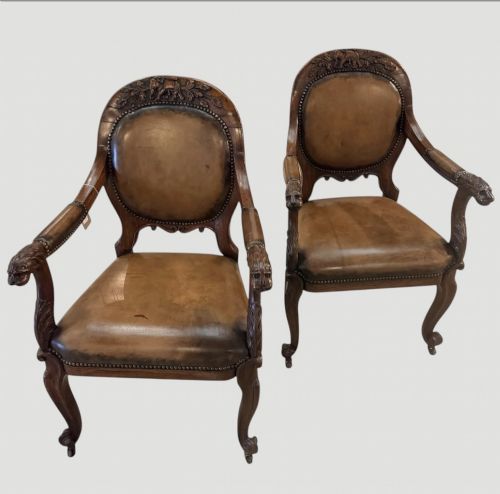
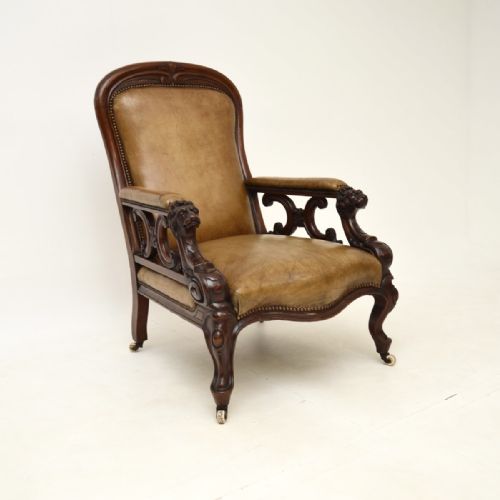
These carved lion head armchairs bring commanding presence and sculptural timberwork into a room, combining substantial seating with bold zoomorphic terminals.
Carved Lion Head Armchairs
When you search for carved lion head armchairs, you encounter robust timber seating defined by armrests terminating in carved feline terminals. The examples appearing here span the eighteenth, nineteenth, and twentieth centuries, taking forms such as library chairs, rocking chairs, throne chairs, and full armchair suites.
The aesthetic vocabulary encompasses multiple historical revivals, including Victorian, Regency, Gothic Revival, Renaissance Revival, and Arts and Crafts styles. Makers drew upon diverse regional traditions, yielding heavy oak library seating alongside mahogany library chairs and rosewood Anglo-Indian pieces.
Forms range from open-arm library designs to deep Chesterfield armchairs upholstered in leather or velvet. Oak and walnut predominate in the heavier revival pieces, whilst mahogany and rosewood underpin the library and side chair variants.
Materials and construction methods
Cabinetmakers utilised hardwoods such as oak, mahogany, walnut, and rosewood for the structural frames and intricate carving work. Timber selection dictated the depth and crispness achievable in the leonine arm terminals and decorative mouldings.
Upholstery methods varied from exposed timber frameworks with drop-in seats to deep-buttoned leather and velvet coverings secured with brass tacks. Secondary materials like brass castors and inlaid elements frequently complemented the primary wood bodies.
Listings feature woods including oak, mahogany, walnut, and rosewood across Victorian and Georgian periods.
Distinctions in craftsmanship
The distinction between standard production and superior work lies in the depth and anatomical precision of the carved lion heads. Master carvers rendered the mane, muzzle, and facial expression with individual character rather than generic repetition.
Frame integrity and timber selection further separate these seating pieces, with dense, well-figured mahogany, walnut, or quarter-sawn oak providing superior durability. The harmony between the structural joinery and the ornamental carving determines the overall visual balance.
Thomas Hope·George Smith
The Carved Lion Head Armchairs Glossary
- Monopodia
- Carved supports taking the form of a single animal leg, frequently terminating in a lion's paw. This classical motif reappears in nineteenth-century revival seating.
- Fauteuil
- An open-armed upholstered armchair with exposed wooden armrests and framework. Originating in France, the form was widely adopted across British and continental furniture design.
- Library chair
- A substantial, comfortable armchair designed for reading rooms and studies. These often feature padded armrests and durable leather upholstery.
- Gothic Revival
- A nineteenth-century design movement drawing inspiration from medieval architecture and ornamentation. Pieces in this style utilise pointed arches, tracery, and heavy carved timber.
- Chesterfield
- A heavily upholstered seating form characterised by deep buttoning and rolled arms. When combined with carved lion terminals, it yields a commanding library or lounge piece.
Carved Lion Head Armchairs: Frequently Asked Questions
What periods do these armchairs come from?
The pieces span the eighteenth to the late nineteenth centuries, capturing design movements from the Georgian era through the height of the Victorian period. Revival aesthetics heavily influence the dating.
Craftsmen drew upon Renaissance, Gothic, and Regency vocabularies during the Victorian decades to produce these distinct seating forms.
How were lion head armchairs used originally?
These chairs served as imposing library seats, morning room furniture, and principal seating within grand domestic interiors. Their robust construction suited spaces dedicated to study and entertaining.
Library chairs were built to offer comfort during extended periods of reading, combining sturdy wooden frames with upholstered backrests and seats.
Which woods are most common?
Oak and mahogany appear frequently across the surviving examples, supported by walnut and rosewood in specific regional or revival pieces. Each timber was chosen for its density and suitability for carving.
Dark hardwoods predominated, allowing workshops to achieve a formal, weighty appearance appropriate for nineteenth-century studies and libraries.
How do I identify a revival style?
Revival pieces incorporate decorative elements and proportions borrowed from earlier historical periods, such as seventeenth-century Jacobean motifs or classical Regency lines. Carving styles often give clear clues.
Examining the secondary woods, upholstery techniques, and overall form helps determine whether a piece dates to an original period or a later revival.