
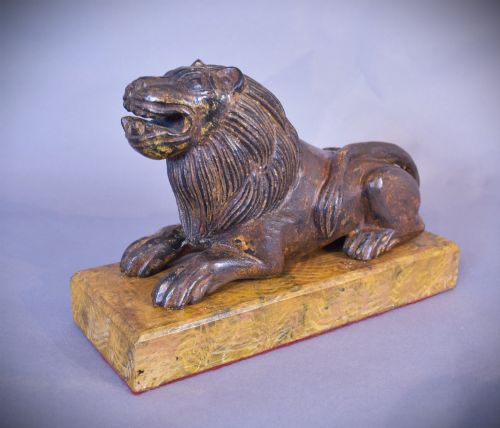
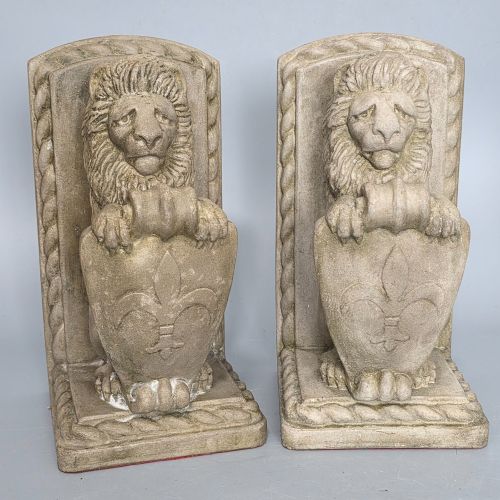


Carved Lion Bookend
A carved lion bookend holds your volumes with fierce nobility, bringing sculptural presence and weighty authority to any shelf.
Carved Lion Bookend
A carved lion bookend brings sculptural form to domestic libraries, anchoring rows of books with a commanding beast. When you search for a carved lion bookend, you encounter heavy desk accessories and shelf supports shaped as heraldic protectors, recumbent beasts, and mythical guardians.
The pieces on this page span several centuries and diverse stylistic traditions, moving from nineteenth century European revival designs to Asian stone carvings. You find nineteenth century Italian serpentine canova lions, English pine Georgian revival pairs, and soapstone Chinese temple dogs fulfilling the same supporting role on the shelf.
Many examples arrive as matched pairs designed to frame a collection, while others present single monumental beasts mounted on plinths. The makers draw upon Grand Tour, Gothic revival, Neoclassical, and Chinese export idioms to render these powerful animals in three dimensions.
Materials and construction
Carvers shape these sculptural supports from dense natural materials, working with English pine, Italian serpentine, jade marble, soapstone, and cast stone. The choice of medium dictates the weight and texture of each beast, ensuring enough mass to keep heavy volumes upright.
Periods represented across the available inventory span from the seventeenth century through the Victorian era and into the nineteen forties.
Distinctions in quality
The integrity of the material and the crispness of the original carving define the upper tier of these pieces. Fine matching between paired animals ensures balanced symmetry on the shelf, reflecting intentional workshop creation rather than an assembled pairing.
The Carved Lion Bookend Glossary
- Serpentine
- A compact, magnesium silicate rock with a mottled green appearance often polished to a smooth finish. It was popular for Grand Tour carvings originating in Italy.
- Canova Lion
- A sculptural representation modelled after the famous tomb sculptures by Antonio Canova. These recumbent beasts display classical repose and muscular dignity.
- Dog of Fo
- A traditional guardian figure resembling a stylized lion, frequently depicted protecting sacred spaces. These mythological beasts appear in pairs in Chinese export and Oriental decorative arts.
- Plinth
- A heavy rectangular block or base that supports a sculptural figure. It provides stability for bookends and elevates the carved animal above the shelf surface.
- Grand Tour
- A cultural journey undertaken by wealthy Europeans in the eighteenth and nineteenth centuries to collect art and antiquities. Souvenirs from these travels included miniature stone sculptures and architectural models.
Carved Lion Bookend: Frequently Asked Questions
What materials are used for these bookends?
The listings show items shaped from English pine, Italian serpentine, soapstone, jade marble, and cast stone. Some pieces feature additional paint, gilt, or wooden plinths.
These varied media dictate the heft and colour of each sculptural support, ranging from dark polished stone to warm timber.
Are they always sold in pairs?
Many examples appear as matched pairs designed to sit at opposite ends of a row of books. You also encounter single sculptural figures mounted on plinths.
When buying for practical shelf use, checking whether the items form a true matching pair ensures balanced display.
How do I identify the period of a piece?
Dating relies on material choice, tool marks, and stylistic revival movements such as the Georgian revival or nineteenth century Neoclassical styles. Examining the base and the wear on the stone or wood helps indicate age.
Makers referenced classical antiquity, Gothic architecture, and Chinese export traditions across the nineteenth and early twentieth centuries.
How do I use them to support books?
These dense stone and wooden sculptures possess the physical weight required to keep upright volumes stable on open shelves and desks. Their heavy plinths prevent sliding under pressure from heavy bindings.
Positioning them at the outer edges of a collection protects the texts while displaying the carved animal forms.