




Carved Gold Opal Ring
A carved gold opal ring brings together iridescent fire and precious metal in forms ranging from Victorian boat settings to mid-century cluster designs.
Carved Gold Opal Ring
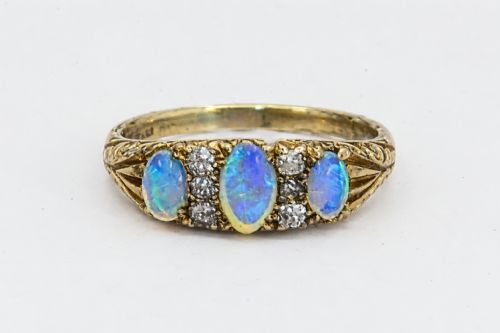
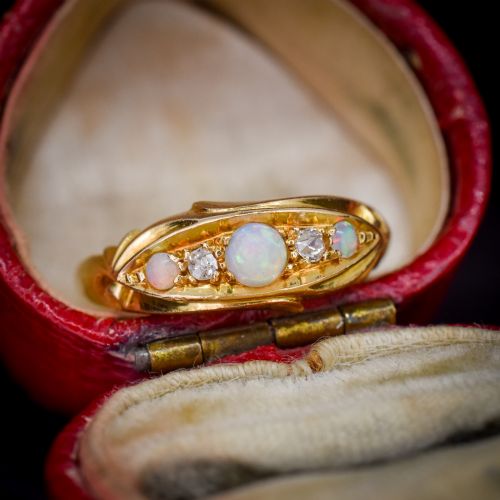
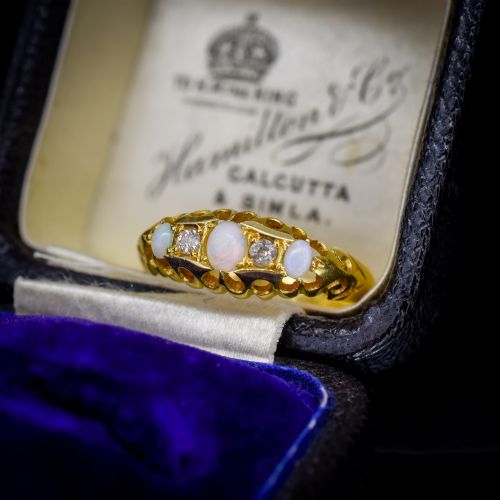
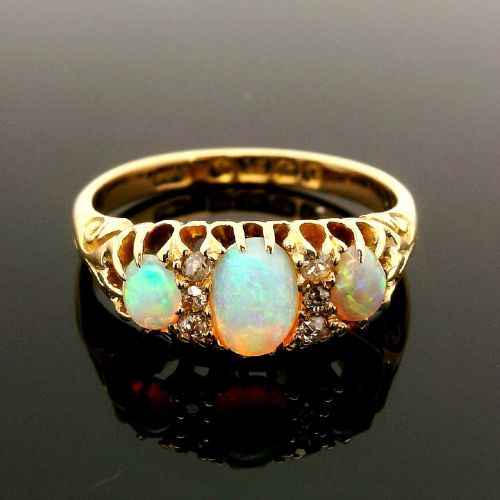
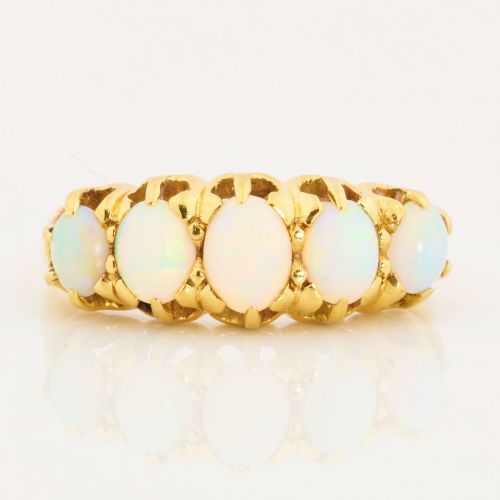
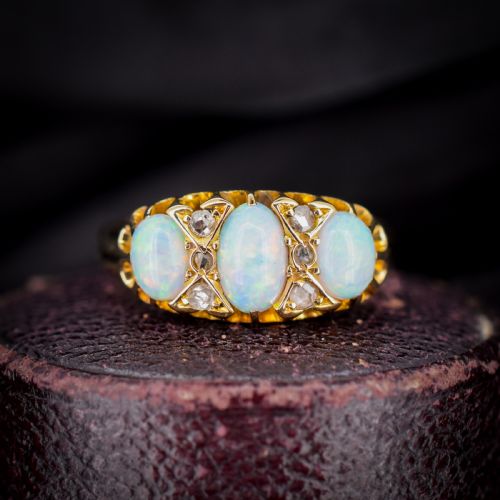
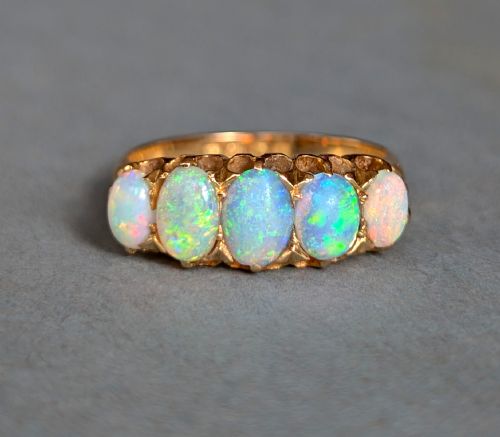
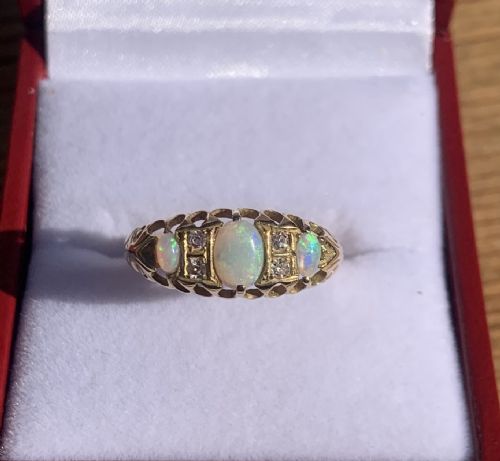
A carved gold opal ring is a piece of jewellery defined by its central gemstone and precious metal mounting, appearing frequently across the Victorian, Edwardian, and mid-century periods. These jewels take several distinct forms, most notably boat rings, trilogy arrangements, five-stone rows, and dress configurations.
The pieces on this page originate from periods spanning the late nineteenth century through to the mid-twentieth century, capturing shifts in design from ornate nineteenth-century hallmarked creations to simpler vintage milestones. Buyers encountering these rings will find that the classic boat shape, featuring alternating opals and diamonds, dominates the selection.
The combination of gold and opal forms the core identity of these rings, utilising yellow gold, white gold, and eighteen-carat compositions to frame the play-of-colour within the stones. Whether chosen for a trilogy configuration or a multi-stone stack ring, each example preserves the distinct aesthetic of its original era.
How they were made
The construction of these rings relies on the pairing of precious metals such as eighteen-carat yellow gold and white gold with natural opals and diamonds. Goldsmiths shaped the precious metal into structured mounts, including boat settings and multi-stone galleries designed to secure the softer gemstone safely.
Techniques from the Victorian and Edwardian eras involved meticulous hand-working of gold to create secure settings for both cabochons and carved stones. Hallmarks stamped into the metal by assay offices in locations like Birmingham and Chester record the purity of the gold and the year of creation.
The documented pieces span the nineteenth century, the Victorian and Edwardian eras, and mid-century vintage designs.
What varies in quality
The quality of a carved gold opal ring depends heavily on the optical performance and play-of-colour within the opal itself, alongside the clarity and brilliance of accompanying diamonds. Stones exhibiting vibrant flashes of multiple spectral colours command greater visual presence than those with muted or flat tones.
Constructional integrity and the preservation of original hallmarks also separate different examples, as crisp assay marks and robust gold settings demonstrate superior craftsmanship. The proportion and balance of the stones within boat or trilogy arrangements further distinguish finer pieces from standard production.
The Carved Gold Opal Ring Glossary
- Boat ring
- A ring setting shaped like an inverted hull, curving gently across the finger and typically housing a row of graduated gemstones. This configuration was particularly popular during the Victorian and Edwardian periods.
- Trilogy ring
- A ring featuring three principal stones, often representing a past, present, and future motif. In these listings, they frequently combine central opals flanked by diamonds in eighteen-carat gold.
- Play-of-colour
- The optical phenomenon displayed by opals where spectral colours shift and flash as the stone moves under the light. The strength and range of these flashes determine the visual impact of the gem.
- Cabochon
- A gemstone cut with a smooth, rounded, convex upper surface rather than faceted planes. This traditional shaping method highlights the internal play-of-colour within opals.
- Hallmark
- A series of official marks stamped onto precious metal items indicating the purity of the gold, the assay office, and the year of manufacture. British pieces often bear distinct town marks such as Chester or Birmingham.
Carved Gold Opal Ring: Frequently Asked Questions
How do I care for an opal ring?
Opals contain natural water content and possess a lower hardness than diamonds, requiring careful handling to avoid sharp impacts and sudden temperature changes. Store the ring away from abrasive materials and harsh chemical cleaners to protect the polish of the stone.
Clean the metal and stone gently using a soft, damp cloth rather than ultrasonic cleaners or chemical dips. Removing the ring during rigorous physical activities prevents unnecessary wear to the gold setting and the opal surface.
How can I date an antique ring?
Dating relies primarily on official hallmarks stamped into the inner shank, which indicate the specific assay office and year of manufacture. Stylistic markers, such as the boat shape typical of Edwardian pieces or the robust mounts of the Victorian era, offer additional clues.
Comparing the stone cuts and claw settings against documented periods helps narrow down the timeline further. Hallmarks remain the most reliable method for establishing an exact year of creation.
Are these opals natural stones?
The opals found in these historical rings are natural gemstones sourced from the earth, encompassing varieties such as white opal and black opal. Each stone displays a unique internal pattern and play-of-colour that cannot be replicated by synthetic alternatives.
These natural gems were selected by period jewellers for their individual character rather than uniformity. Their organic composition means no two rings share the exact same optical display.